


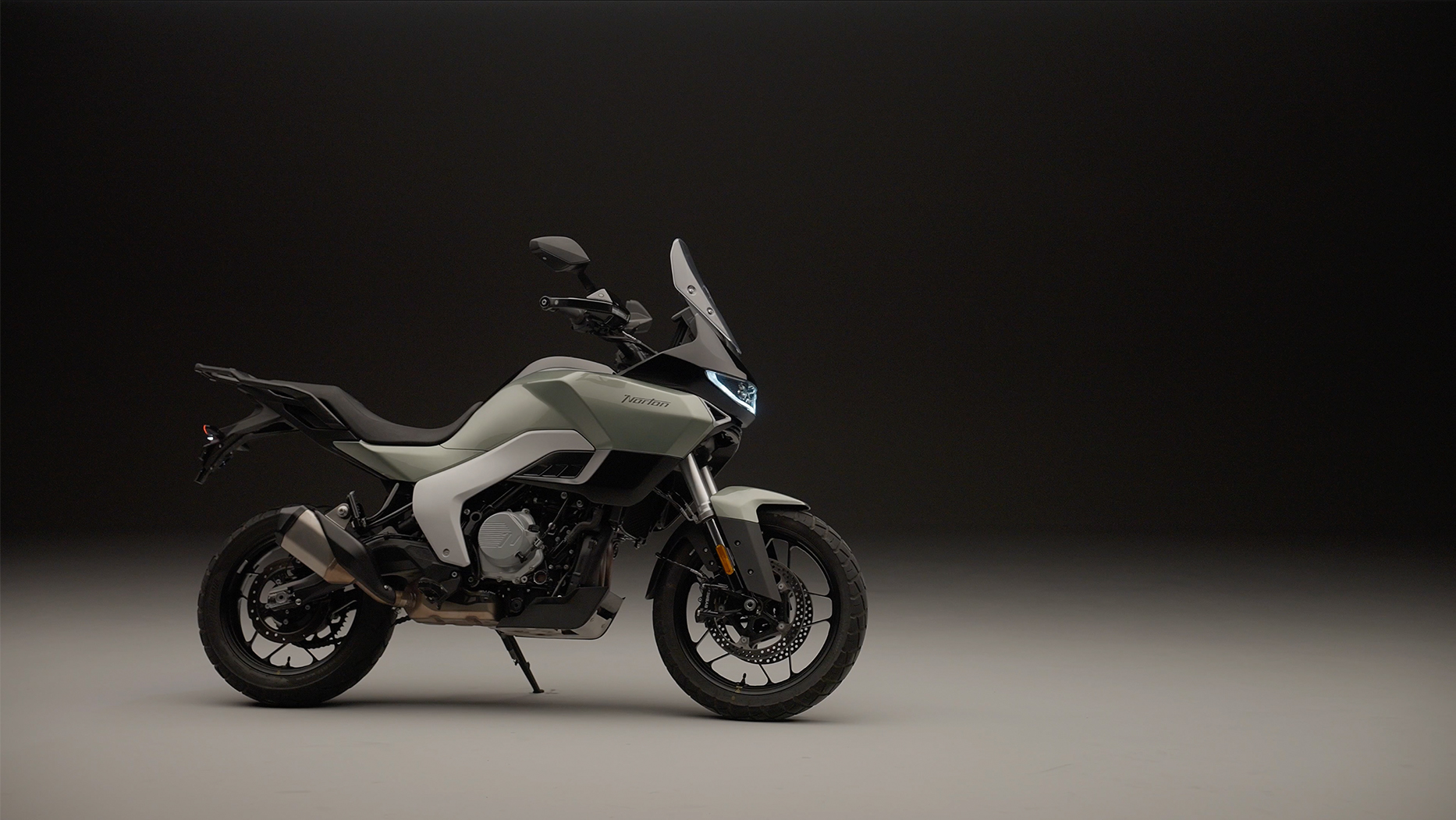
- Two distinct interpretations of the modern middleweight adventure-touring motorcycle
- Unmistakable British design
- 585cc liquid-cooled parallel twin with 270° crank, producing 69 bhp at 9,300 rpm and 57 Nm at 7,500 rpm
- High-strength steel trellis frame with engine as a stressed member
- Fully adjustable KYB suspension front and rear, with integrated hydraulic pre-load adjustment on the rear shock absorber
- Dual semi-floating 310 mm front discs with radial calipers and 270 mm rear disc
- Bosch six-axis IMU with lean-sensitive (ABS), cornering traction control and cornering cruise control as standard; Apex variant equipped with electronic combined braking and vehicle hold functionality
- Five rider modes, wheelie control and slide control
- 8-inch TFT display with integrated navigation and Norton Rider app connectivity
- 19-inch front wheel (Atlas) / 17-inch front wheel (Atlas GT) defining two distinct riding personalities
- 36-month warranty with Norton Roadside Assist
“The Atlas name is emblematic of an era when motorcycling was synonymous with adventure. We are proudly carrying forward that rich Norton legacy with our all-new line-up of modern yet quintessentially British adventure motorcycles.”
Richard Arnold, CEO Norton Motorcycles
The all-new Norton Atlas and Atlas GT spearhead the company’s entrance into the adventure and sport-touring segments, marking a defining step in Norton’s ongoing resurgence. The Atlas and Atlas GT expand the brand’s reach while remaining true to the principles that have shaped it for more than a century: purposeful engineering, confident design and machines built to be ridden.
The Atlas and Atlas GT have been developed to redefine what riders can expect from a middleweight adventure bike. They bring together a compact and characterful 585cc parallel twin engine, a lightweight steel trellis chassis and a comprehensive electronics suite led by a six-axis IMU – all delivered within a design language that is unmistakably modern Norton.
The objective is clear: to create a motorcycle that balances everyday usability with emotional appeal – equally at home navigating through weekday traffic as it is covering serious distance at the weekend. A machine that feels intuitive, mechanically honest and reassuringly capable – not overloaded with complexity but equipped with everything a modern rider needs.
At the centre of the Atlas series is Norton’s belief that passion and practicality can – and should – coexist. In a segment traditionally defined by rational decision-making, the Atlas injects design intent, tactile quality and rider engagement without sacrificing durability or real-world performance. It is engineered not merely to compete in the middleweight adventure category, but to elevate it.
Designed at Norton’s Solihull headquarters as part of the company’s wider Resurgence strategy, the Atlas and Atlas GT expand Norton’s portfolio while reinforcing its position as a premium British manufacturer with global ambition.
Design
The Atlas and Atlas GT are among the first Norton models to fully embody the brand’s modern design language developed under the company’s Resurgence strategy. The objective was not to recreate past silhouettes, but to reinterpret Norton’s visual identity through a contemporary lens that balances heritage with technical integration.
Under the direction of Head of Design Simon Skinner, the Norton design strategy provides the Atlas with visual continuity whilst retaining its own character. The Atlas reductive design with minimal visible fixings and visual clutter is unique in its category – the side panel design giving the bike drama and forward movement like no other adventure bike.
This design direction has been developed with the advisory input of Professor Gerry McGovern OBE, Chief Creative Advisor to Norton. His emphasis on modernity, integration and disciplined form has helped to shape a visual identity that is recognisably British without relying on nostalgia.
The Atlas avoids decorative excess, instead allowing structural elements to remain visually honest. Importantly, design decisions have been led by function: rider position, airflow management and component packaging ensure that visual intent does not compromise mechanical integrity.
The result is a motorcycle that stands apart through coherence, not extravagance.
Engineering
The Atlas and Atlas GT are built around a platform architecture that has been developed with a clear objective: usable performance and modern rider intelligence in a lightweight, balanced package. Within that concept, each represents a subtly distinct interpretation of the same core idea. The Atlas is configured to favour adaptability across varied terrain. It retains full electronic capability and the same powertrain specification as the GT, but its stance and suspension tuning position it closer to the traditional adventure spectrum. It is engineered for riders who may encounter changing surfaces within a single journey and require a motorcycle that remains composed off the road as well as on it.
The Atlas GT offers a more road-focused package suited to sustained touring and fast A-road riding. Its geometry and damping are tuned to prioritise road feedback and cornering composure, delivering a more direct connection to the road surface without compromising long-distance comfort.
Powertrain
At the heart of both the Atlas and Atlas GT sits a 585cc liquid-cooled parallel twin engine with segment best APS (atmospheric plasma spray) coated cylinder surface, with a 78 mm bore, a 61.2 mm stroke and a 270° crankshaft configuration. Producing 69 bhp at 9,300 rpm and peak torque of 57.5 Nm at 7,500 rpm, the engine has been developed to deliver accessible, engaging performance across real-world riding conditions. The engine’s character is defined by the breadth of its torque band and the confidence it provides across varied terrain.
The 270° crankshaft configuration provides a distinct firing character and a broad, tractable torque delivery to make the most of its inherent traction pulses, preservation of inertia and balanced secondary forces while remaining compact and efficient. The emphasis is on usable torque – clean pick-up at low revs, strong in-gear acceleration through the midrange and a willingness to rev when the road opens up.
Performance and durability are ensured thanks to twin oil pumps that reduce internal friction, maintain lubrication stability under sustained load, while a high-flow coolant system manages heat dissipation, particularly in heavy traffic or warmer climates.
A range of intelligent engineering solutions, including a knock sensor and protected air-intake system, further enhances reliability, even in demanding environments and inconsistent fuel conditions
Gearbox ratios have been selected to keep the engine within its strongest operating range across urban riding, motorway cruising and back-road exploration. A wet multi-plate slipper clutch ensures forgiving downshifts under braking, while a standard-fit bidirectional quick-shifter enables seamless clutchless gear changes, both up and down, when riding with intent.
Enhancing the overall riding experience, the motorcycle features a finely tuned exhaust note and advanced gear refinement technologies that deliver a premium acoustic character with reduced mechanical noise.
Complementing this are compact and efficient engineering solutions such as the curved radiator, single-sprocket DOHC layout, and downdraft intake ports, which optimise cooling efficiency, airflow, and engine packaging to deliver strong high-speed performance, improved durability, and a refined touring experience.
The Atlas engine is designed to feel alive, responsive and characterful – it rewards rider input without demanding constant attention.
Chassis and dynamics
The Atlas and Atlas GT share a high-strength steel trellis frame that integrates the engine as a structural element. The objective was straightforward: create a chassis that delivers precise handling and stability without unnecessary mass or complexity.
With a wet weight (no fuel) of 188 kg for the Atlas and 192 kg for Atlas Apex, both models target the lighter end of the middleweight adventure tourer segment for optimal agility. Mass centralisation has been a key engineering priority, with careful placement of the engine, fuel tank and ancillary components resulting in a motorcycle that feels neutral at low speeds while remaining reassuringly stable and secure on the open road.
Geometry is tuned to suit each model’s intended role. The Atlas features a longer wheelbase and increased ground clearance to support light overland use across uneven surfaces, while the Atlas GT adopts a shorter-travel suspension configuration and road-focused stance for sharper turn-in and enhanced composure on faster roads. In both cases, the goal is predictability: a chassis that communicates clearly and responds faithfully to rider input.
The steel trellis construction also allows for controlled flex characteristics. Rather than targeting absolute stiffness, Norton’s engineering team has focused on achieving a balance between rigidity and feedback. The outcome is a frame that remains stable under load while retaining the subtle compliance that contributes to rider confidence over distance.
A cast aluminium twin-sided swingarm complements the main frame structure, contributing to reduced unsprung mass and consistent rear-wheel tracking under acceleration and braking. Combined with carefully tuned weight distribution, the Atlas and Atlas GT deliver a ride that is composed without feeling detached – stable when loaded with luggage, yet agile for urban manoeuvring.
The emphasis throughout has been clarity. Steering response is linear, weight transfer is progressive and the motorcycle remains communicative and intuitive whether ridden conservatively or with greater commitment. It is a chassis that supports the rider rather than surprising them.
Suspension, brakes and running gear
Suspension for both the Atlas and Atlas GT is developed together with KYB and tuned to complement each model’s intended focus. At the front, fully adjustable 43 mm USD forks feature 180 mm of wheel travel on the Atlas and 140 mm on the Atlas GT.
The advanced suspension system offers exceptional adaptability through fully-adjustable front suspension with 20-step compression and rebound settings, enabling riders to tailor damping characteristics to varying terrains and riding styles.
Rear suspension duties are handled by a fully-adjustable KYB monoshock unit, with 180mm wheel travel complemented by stroke-dependent damping technology, enhances off-road capability while maintaining on-road composure. While the Atlas GT, in keeping with the model’s more road-oriented focus, provides 140 mm wheel travel. The hydraulic preload adjuster enables quick suspension tuning through an intuitive hand-operated control.
Further enhancing the dynamic riding experience is a segment-first braking architecture featuring best-in-class dual floating 310mm disc with radial front calipers, delivering precise braking performance and superior heat dissipation for sustained riding confidence.
The sizing reflects a deliberate choice to provide strong, consistent stopping power suited to loaded touring and variable terrain. Lever feel has been calibrated for progressive response rather than abrupt bite, ensuring controlled, predictable stopping in mixed conditions. Both the Atlas Apex and Atlas GT Apex variants also include the electronic combined braking and vehicle hold feature.
Wheel construction further differentiates the two models. The Atlas runs a 19-inch front and 17-inch rear high strength aluminium alloy wheel combination to balance trail capability with road confidence, while the Atlas GT adopts 17-inch cast-alloy wheels front and rear for sharper steering precision and a broader road tyre selection for predominantly road-based use. Both are equipped with tyres selected for multi-surface versatility, reinforcing the models’ do-everything brief.
Taken together, the suspension system reflects the Atlas philosophy: engineered adaptability without unnecessary complication. Fully-adjustable components allow riders to tailor the setup to load and riding style, while factory calibration ensures a balanced baseline straight from the showroom.
Intelligent rider support systems
The Atlas and Atlas GT are equipped with Norton’s most comprehensive electronics package to date, built around the latest Bosch six-axis Inertial Measurement Unit (IMU). The advanced system architecture has been integrated from the outset to support stability, safety and rider confidence across varied terrain.
Lean-sensitive ABS and traction control operate through data gathered from pitch, roll and yaw inputs, allowing intervention to adapt dynamically to cornering forces. Multiple rider modes and selectable intervention levels provide adjustability without over complication. The calibration philosophy is deliberate: offer meaningful control options but avoid overwhelming the rider with unnecessary layers of configuration.
Cornering cruise control extends the system’s capability beyond straight-line motorway use to maintain speed smoothly through sweeping bends and reduce fatigue over longer journeys. Rear wheel slide control and wheelie control offer additional stability under hard acceleration, while Hill Hold Assist supports confident inclined take-offs both on and off-road.
The intent is to provide a complete, coherent package that reflects modern expectations while retaining an intuitive riding experience. Interventions are calibrated to feel natural rather than abrupt, so skilled riders can explore the chassis and engine character without intrusive correction. Electronics operate as a safety net and performance enhancer, not a substitute for rider input or control.
In the Atlas series, technology is present but never dominant; it quietly extends capability, particularly in poor weather or on unpredictable surfaces, while preserving mechanical clarity.
Interface and connectivity
Central to the rider experience is Norton’s signature 8-inch touchscreen TFT display, delivering incredible clarity and a user interface designed for legibility in all lighting conditions.
The display provides access to ride modes, system settings and real-time data including fuel consumption, distance metrics and engine information, turn-by-turn navigation reduces reliance on external devices, while Bluetooth connectivity enables multimedia control and hands-free communication.
The interface’s layout and iconography emphasise clarity, ensuring that essential information remains accessible at a glance, while tactile switchgear allows the operation of core functions without removing focus from the road.
The ergonomically-engineered switch cube with programmable buttons and intuitive joystick-style controls allows seamless access to instrument cluster functions while riding, enhancing convenience, precision, and rider focus on every journey.
Connectivity extends beyond the cockpit through the Norton Rider app. Over-the-air update capability ensures system software remains current, while ride statistics and service reminders enhance the ownership convenience. The objective is continuity: a seamless connection between motorcycle, rider and service network.
This digital integration supports modern convenience expectations while maintaining a rider-first ethos and leaving the fundamental character of the machine unaltered.
Ergonomics and practicality
Rider ergonomics were a key focus for the engineering team, with extensive analysis and testing of the interface between the rider and the bike. This has ensured a riding position that is unimpeded when seated and covering long distances as well as when standing for off-road riding. The surfaces of the bodywork support the rider while easing moving back and forth on the bike.
The Atlas and Atlas GT have been developed with sustained usability as a core focus. Extensive studies in computational fluid dynamics (CFD) combined with wind tunnel testing were used to develop and validate the aerodynamic protection of the Atlas. These measures ensure smooth airflow around the rider to improve comfort, limit buffeting, and avoid rider fatigue.
The contoured windscreen (which is fully adjustable on the Apex versions) and adjustable hand levers and footpegs allow for an individually tailored riding position, while tapered aluminium handlebars provide strength with natural leverage and reduced rider fatigue.
Seat height differs between models to reflect their intended focus. The Atlas offers increased ground clearance and a taller stance to support light off-road use with a seat height of 845mm, while the Atlas GT adopts a lower seat height of 815mm for greater accessibility and fast-road confidence. On both models, a specially-designed radiator ‘chimney’ manages engine heat dissipation away from the rider to ensure optimised comfort, particularly in heavy traffic or warmer climates.
Integrated grab handles and luggage mounting points are designed directly into the chassis architecture. Available as an option on the Atlas but fitted as standard to the Atlas Apex is an easy-fit rear luggage frame that includes additional pillion support and provides a mounting point for a rear storage box and side panniers. Heated grips are also offered as an option on the Atlas but fitted as standard on the Apex variant, to extend the riding season in colder climates.
Practical touches extend to Bluetooth-enabled keyless functionality, enabling start, stop and seat & fuel cap access without traditional key insertion. A USB-C port supports device connectivity and charging when required, while tyre pressure monitoring is included on the Atlas Apex model and provides real-time awareness during extended trips. The result is a motorcycle engineered not just for peak moments but also for everyday ownership.
Lighting and visibility
Lighting on the Atlas and Atlas GT serves both functional and design objectives. Twin projector LED headlights provide strong, evenly distributed illumination, with dynamic intensity scaling relative to road speed to optimize visibility.
Signature daytime running lights establish a distinctive front-end identity, while handguard-integrated indicators maintain clean surfacing without exposed fixtures. The Atlas and Atlas GT can be fitted with cornering lights to extend visibility on twisting roads, and puddle lamp to assist low lit parking conditions. Both features are standard on the Apex variants.
Dynamic brake light functionality enhances visibility to following traffic under hard braking, supporting active safety without visual clutter.
The lighting suite reflects the broader Atlas design philosophy: integration, clarity and purpose. It enhances presence on the road while contributing meaningfully to rider confidence in varied conditions.
The Atlas ownership experience
Beyond engineering and design, the Atlas and Atlas GT reflect Norton’s comprehensive focus on the long-term ownership experience.
All new Norton motorcycles are supplied with a 36-month unlimited mileage warranty for UK and EU, 36-months, 30-months / 30,000 miles for USA. During the warranty period, riders also benefit from Norton Roadside Assist, providing 24/7 coverage, rapid response co-ordination and onward travel support.
A dedicated Norton Client Services team supports service booking and assistance requests, reinforcing the company’s commitment to a premium ownership relationship. Through the Norton Rider app, customers can access service reminders, ride data and system updates, maintaining the connection between the motorcycle and its support network.
This ownership structure reflects the same philosophy that underpins the Atlas itself: capability supported by clarity and confidence.
The Atlas and Atlas GT represent a clear evolution of the Norton brand – applying modern engineering discipline, integrated electronics and contemporary British design to one of motorcycling’s most competitive segments.
Designed and engineered at Norton’s Solihull headquarters, the Atlas series offers a distinctly British take on the modern middleweight adventure motorcycle– engineered to not only perform and endure but also set a new benchmark for what this class of motorcycle can be.
| Category | Accessory Name | |
| Convenience | Integrated heated rider seat | |
| Convenience | Integrated heated grips | |
| Convenience | Touring windscreen | |
| Convenience | Brass coated chain | |
| Convenience | LED cornering lights | |
| Convenience | LED puddle light | |
| Garage | Norton Bobbin kit | |
| Garage | Norton all-weather bike cover | |
| Luggage | Rear luggage & pillion handle kit | |
| Luggage | Norton 50L (25+25) pannier system (L+R) | |
| Luggage | Norton 34L top case system | |
| Protection | Engine guards | |
| Protection | All-terrain sump protection kit | |
| Protection | Front axle spindle protection kit |
ATLAS: POWERTRAIN & CHASSIS
ENGINE
Type: Liquid-cooled 585cc DOHC 270º crank parallel twin
Bore & stroke: 78mm x 61.2mm
Compression ratio: 12.2:1
Fuel injection: Multi-point sequential fuel injection system, ride-by-wire throttle
PERFORMANCE
Max Power: 69 BHP / 70 PS / 51.5 kW @ 9,300 rpm
Max Torque: 57.5 Nm / 42 ft-lb @ 7,300 rpm
EXHAUST
Steel 2-into-1 system with upswept silencer
TRANSMISSION
Gearbox: 6-speed with bi-directional up/down Quick Shift
Clutch: Cable-operated Assist & Slip multiplate wet clutch
Primary drive: Constant mesh; Ratio: 40:81
Final drive: X-ring 116 Chain, 16T Front Sprocket, 47T Rear Sprocket
Gear ratios: 1st: 16.445, 2nd: 12.268, 3rd: 9.447, 4th: 7.647, 5th: 6.514, 6th: 5.678
CHASSIS
Frame: Steel trellis
Swingarm: Cast aluminium
Seat: One-piece rider & pillion seat
SUSPENSION
Front Suspension: KYB 43mm USD forks, 180mm wheel travel, fully adjustable
Rear Suspension: KYB monoshock RSU, 180mm wheel travel, adjustable tension damping with hydraulic preload adjustment
BRAKES
Front Brakes: 2x 310mm semi-floating discs, radially-mounted Bybre calipers
Rear Brake: 270mm rear disc, Bybre caliper
WHEELS & TYRES
Front Wheel: Cast alloy / Spoked steel, 19” x 2.50”
Front Tyre: Eurogrip Explo R Plus, 110/80 ZR19
Rear Wheel: Cast alloy / Spoked steel, 17” x 4.00”
Rear Tyre: Eurogrip Explo R Plus, 150/70 ZR17
DIMENSIONS
Wet weight, no fuel: 188 kg
Fuel tank capacity: 15.4 litres / 3.39 Gallons (Imperial) / 4.07 Gallons (US)
Seat height: 845 mm
Ground clearance: 220 mm
Wheelbase: 1465 mm
Rake: 25.7 º
Trail: 101.7 mm
SERVICE & WARRANTY
Service interval: 12 months / 6,000 miles / 10,000 kilometres
Warranty: 36 months – Unlimited kms (UK, EU) / 30,000 miles (USA)
CONSUMPTION & EMISSIONS
Fuel consumption: 23 kmpl / 65 mpg (Imperial) / 54 mpg (US)
Emissions / CO2: EURO5+, Bharat Stage VI, California & US
ATLAS: FEATURES
DESIGN
Adjustable brake and clutch levers
Aluminium footpegs with removable rubber insert
Plastic protective cover (Base), Aluminium integrated bash plate (Apex)
–
LIGHTING
LED twin-projector headlamps with dynamic light intensity & signature DRL (Daytime Running Lights)
LED front indicators integrated into handguards
LED 3-in-1 multi-function taillight & rear indicators
INSTRUMENTS
Full-colour 8” touchscreen TFT display, 720p resolution
Multi-way connectivity (Bluetooth & Wi-Fi)
Multimedia control (music & calls)
Navigation control (turn-by-turn)
Go Pro control
Over-the-air software (S-OTA) & firmware (F-OTA) updates
Ride telematics
Norton Rider app integration
ELECTRONICS
Keyless ignition with electronic steering lock, seat lock & fuel filler cap
USB-C charger
RIDE MODES
Urban, Rain, Sport, Tour, Enduro
ELECTRONIC RIDER AIDS
Bosch 10.3MB 6-axis IMU (Inertial Measurement Unit), including…
N-DTC – Drag Torque Control
N-ABS – Anti-Lock Braking System
N-TEC – Tractive Effort Control
N-DCC – Dynamic Cruise Control
N-TWC – Total Wheelie Control
N-RLC – Rear Lift Control
N-RSC – Rear Slide Control
COLOUR OPTIONS
Matrix Black
Trophy Silver
Verona Green (cost option)
Sinopia Orange (cost option)
–
ATLAS APEX: POWERTRAIN & CHASSIS
ENGINE
Type: Liquid-cooled 585cc DOHC 270º crank parallel twin
Bore & stroke: 78mm x 61.2mm
Compression ratio: 12.2:1
Fuel injection: Multi-point sequential fuel injection system, ride-by-wire throttle
PERFORMANCE
Max Power: 69 BHP / 70 PS / 51.5 kW @ 9,300 rpm
Max Torque: 57.5 Nm / 42 ft-lb @ 7,300 rpm
EXHAUST
Steel 2-into-1 system with upswept silencer
TRANSMISSION
Gearbox: 6-speed with bi-directional up/down Quick Shift
Clutch: Cable-operated Assist & Slip multiplate wet clutch
Primary drive: Constant mesh; Ratio: 40:81
Final drive: X-ring 116 Chain, 16T Front Sprocket, 47T Rear Sprocket
Gear ratios: 1st: 16.445, 2nd: 12.268, 3rd: 9.447, 4th: 7.647, 5th: 6.514, 6th: 5.678
CHASSIS
Frame: Steel trellis
Swingarm: Cast aluminium
Seat: One-piece rider & pillion seat
SUSPENSION
Front Suspension: KYB 43mm USD forks, 180mm travel, fully adjustable
Rear Suspension: KYB monoshock RSU, 180mm travel, full hydraulic adjustment
BRAKES
Front Brakes: 2x 310mm floating discs, radially-mounted Bybre calipers
Rear Brake: 270mm rear disc, Bybre caliper
WHEELS & TYRES
Front Wheel: Cast alloy / Spoked steel, 19” x 3.00”
Front Tyre: Eurogrip Explo R Plus, 110/80 ZR19
Rear Wheel: Cast alloy / Spoked steel, 17” x 4.50”
Rear Tyre: Eurogrip Explo R Plus, 150/70 ZR17
DIMENSIONS
Wet weight, no fuel: 192 kg
Fuel tank capacity: 15.4 litres / 3.9 Gallons (Imperial) / 4.1 Gallons (US)
Seat height: 845 mm
Ground clearance: 220 mm
Wheelbase: 1465 mm
Rake: 25.7 º
Trail: 101.7 mm
SERVICE & WARRANTY
Service interval: 12 months / 6,000 miles / 10,000 kilometres
Warranty: 36 months – Unlimited kms (UK, EU) / 30,000 miles (USA)
CONSUMPTION & EMISSIONS
Fuel consumption: 23 kmpL / 65 MPG (Imperial) / 54 MPG (US)
Emissions / CO2: EURO5+, Bharat Stage VI, California & US
ATLAS APEX: FEATURES
DESIGN
Adjustable hand & foot levers
Aluminium footpegs with removable rubber insert
Rugged plastic bash plate
All-terrain sump protection kit (aluminium insert)
Easy-adjust windscreen
Rear luggage & pillion handle kit
LIGHTING
LED twin-projector headlamps with dynamic light intensity & signature DRL (Daytime Running Lights)
LED front indicators integrated into handguards
LED 3-in-1 multi-function taillight & rear indicators
LED cornering lights
LED puddle lamp
INSTRUMENTS
Full-colour 8” touchscreen TFT display, 720p resolution
Multi-way connectivity (Bluetooth & Wi-Fi)
Multimedia control (music & calls)
Navigation control
Go Pro control
Over-the-air software (S-OTA) & firmware (F-OTA) updates
Ride telematics
Norton Rider app integration
ELECTRONICS
Keyless ignition with electronic steering lock, seat lock & fuel filler cap
USB-C charger
Tyre pressure monitoring system (TPMS)
Integrated heated grips
RIDE MODES
Urban, Rain, Sport, Tour, Enduro
ELECTRONIC RIDER AIDS
Bosch 10.3ME 6-axis IMU (Inertial Measurement Unit), including…
N-DTC – Drag Torque Control
N-ABS – Anti-Lock Braking System
N-TEC – Tractive Effort Control
N-DCC – Dynamic Cruise Control
N-TWC – Total Wheelie Control
N-RLC – Rear Lift Control
N-RSC – Rear Slide Control
N-VHC – Vehicle Hold Control
N-ECB – Electronic Combined Braking
COLOUR OPTIONS
Matrix Black
Trophy Silver
Verona Green
Sinopia Orange
Glacier Blue (cost option)
