


Not long ago, a bank deploying an AI chatbot was considered an early mover. Today, it is closer to the baseline. Across India’s banking sector, the question is no longer whether to bring AI into customer support, but how much of the workload it can reliably carry and where human judgment still needs to stay in the room. A recent survey conducted by Kapture CX set out to find some answers, surveying banking and customer experience professionals on where AI chatbots are making the most tangible difference today and how far their autonomous capabilities actually stretch.
Where AI Is Making the Most Visible Difference
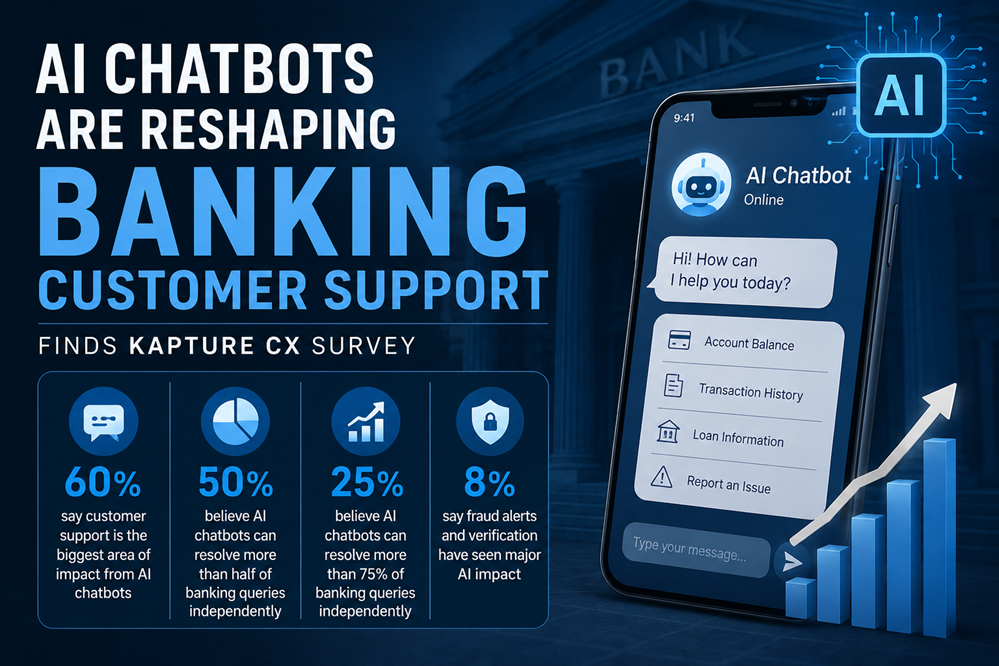
When respondents were asked which banking function has seen the biggest impact from AI chatbots today, customer support and FAQ management emerged as the clear priority area, with 60 percent of respondents identifying it as the primary function undergoing transformation. The findings highlight how banking leaders are increasingly relying on AI chatbots to streamline customer interactions, improve response times, and manage high volumes of routine queries efficiently.
This is not surprising when you consider the nature of the work. A large share of inbound banking queries, questions about account balances, branch timings, transaction limits, interest rates, and standard product features, follow predictable patterns. They are asked repeatedly, across thousands of customers, every single day. AI chatbots are well-suited to this category of interaction: the questions are defined, the answers are consistent, and the cost of handling them through a human agent is hard to justify at scale.
Account servicing requests came in second at 20 percent, covering tasks like address updates, statement requests, and service modifications. These requests involve a slightly higher degree of personalisation than standard FAQs, but they are still largely predictable in nature and well within what a well-trained AI system can handle. Loan and credit card assistance tells a more complicated story. At 12 percent, it reflects a category where customer questions tend to be more specific and varied. Someone asking about why a particular charge appeared on their credit card statement, or whether they qualify for a top-up loan, often needs a response that goes beyond a scripted answer.
Fraud alerts and verification registered the lowest perceived impact at just 8 percent. This finding is significant and, on reflection, entirely logical. Fraud detection and verification are security-sensitive functions where the consequences of an error are serious and where customer trust is most fragile. Banks are, understandably, keeping human oversight firmly in place here. Automation has a role in flagging anomalies and triggering alerts, but the final judgement call in a fraud scenario is not one most banks are willing to hand over to a chatbot.
How Much Can AI Actually Handle Independently?
The second question in the survey explored a more nuanced dimension: how much of the banking query load can AI chatbots resolve today without any human intervention at all?
The responses reveal a sector in meaningful transition. A third of respondents, 34 percent, believe that chatbots can currently resolve less than 25 percent of banking queries without human support. This group likely reflects either early-stage deployments or a more conservative view of where the technology stands today.
However, the majority tell a different story. Sixteen percent believe chatbots can independently handle between 25 and 50 percent of queries. Twenty-five percent put the figure at 50 to 75 percent. And another 25 percent believe AI chatbots can already resolve more than 75 percent of customer interactions without any human involvement.
Taken together, half of all respondents believe AI can independently manage more than half of all customer banking queries todayTaken together, half of all respondents believe AI can independently manage more than half of all customer banking queries today. Rather than signalling surprise at the technology’s capabilities, the finding reinforces a broader trend already visible across industries, including among leading BFSI players, where AI driven automation is steadily becoming central to customer engagement and service delivery.
“The data reflects something we are seeing consistently across our banking clients,” said Sheshgiri Kamath, CEO and Co-founder of Kapture CX. “The shift is not just about volume containment anymore. Banks are moving toward AI-led engagement as a core part of their customer experience strategy, not a supplementary layer. The institutions seeing the strongest results are those treating their chatbot not as a cost-saving tool but as a frontline experience layer.”
What the Numbers Mean for Banks
The poll findings point to a sector that is neither fully converted nor standing still. The 34 percent who believe chatbots can handle less than a quarter of queries independently represent a real and important segment: banks that are either in earlier phases of AI deployment or are navigating the complexity of legacy systems and diverse customer bases that make automation harder to scale quickly.
But the clear momentum is toward higher autonomous resolution rates. As natural language processing improves, as chatbots are trained on richer and more varied banking datasets, and as customers grow more comfortable resolving their queries digitally, the proportion of interactions requiring human intervention will continue to shrink.
The one area where that trend has a natural ceiling is security. The 8 percent figure for fraud alerts and verification is not a sign of AI’s limitations so much as a sign of prudent deployment. Trust in banking is hard-won and easily lost. The institutions that use AI most effectively in customer experience are likely to be those that understand where to deploy it confidently and where to keep a human firmly in the loop.
