


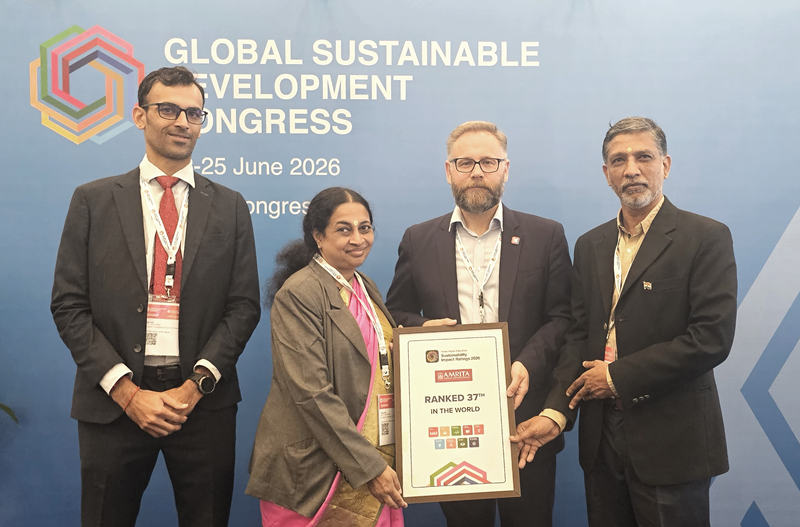
Amrita Vishwa Vidyapeetham has achieved the No. 1 position in India for Industry, Innovation and Infrastructure in the Times Higher Education (THE) Sustainability Impact Ratings 2026. This recognition is based upon the University’s contribution to the United Nations’ 9th Sustainable Development Goal (SDG), which focuses on building resilient infrastructure, promoting inclusive and sustainable industrialization, and fostering innovation.
Formerly the THE Impact Rankings, this prestigious assessment is the world’s only global performance table that evaluates how universities are working towards realizing the United Nations’ 17 SDGs. Amrita’s overall global standing of 37th places the University among more than 1,500 institutions from over 115 countries and regions. The results were unveiled today at the Global Sustainable Development Congress 2026 in Jakarta, Indonesia.
These results are decisively demonstrated in Amrita’s additional rankings. Globally, it placed in the Top 25 Worldwide for five SDGs—Quality Education (SDG 4), Gender Equality (SDG 5), No Poverty (SDG 1), Clean Water & Sanitation (SDG 6), and Affordable & Clean Energy (SDG 7).
Amrita is also among the Top 50 Worldwide for two more SDGs with the rating for Industry, Innovation and Infrastructure (SDG 9), alongside its contribution to Climate Action (SDG 13). As well, the University achieved a Top 100 placement for Good Health and Well-being (SDG 3), and in yet another milestone, was featured for the first time in No Poverty (SDG 1), Zero Hunger (SDG 2), and Affordable & Clean Energy (SDG 7).
Chancellor Amma, Sri Mata Amritanandamayi Devi, expressed gratitude to the THE Sustainability Impact Ratings for going beyond measuring universities and researchers via funding, publications, and intellectual caliber. Her vision for Amrita is compassion-driven research—a vision that has resulted in concrete humanitarian initiatives across rural India.
Amma said: “We should also consider how much we have been able to use research to serve the lowest and most vulnerable strata of society. This will make our impact more comprehensive and meaningful. In our approach to sustainable development, we should not forget that it is by strengthening the people at the base of the pyramid that the entire edifice of society becomes healthy and strong.”
Dr. Maneesha V. Ramesh, Pro Vice-Chancellor and Dean, School for Sustainable Futures, Amrita Vishwa Vidyapeetham, emphasized the alignment between the university’s values and these achievements.
Dr. Maneesha said: “Being ranked first in India for Industry, Innovation and Infrastructure affirms a conviction that has guided our work for years: technology earns its worth only when it reaches the people who need it most. From early-warning systems in landslide-prone hills to clean water in remote villages, we measure our research not by where it is published, but by the lives it safeguards. Through our outreach in 2,800 villages across India, we demonstrate that real impact comes from translating research into solutions that improve lives. This recognition belongs to every community that has walked this path of innovation and service alongside us.”
About Amrita Vishwa Vidyapeetham
Amrita Vishwa Vidyapeetham is a 10-campus, multi-disciplinary research University founded under the inspiration of Sri Mata Amritanandamayi Devi and recognised among India’s leading institutions, with the highest NAAC A++ accreditation and Category 1 Graded Autonomy by the University Grants Commission, Govt. of India. Through its 3 UNESCO Chairs, flagship Live-in-Labs® programme, and community outreach across 2800 villages in rural India, the University integrates research, innovation and compassion-driven service in pursuit of the UN Sustainable Development Goals.
About the Times Higher Education Sustainability Impact Ratings
The Times Higher Education (THE) Sustainability Impact Ratings are the world’s only global performance table that assesses universities’ contributions to the United Nations Sustainable Development Goals (SDGs). Unlike other world rankings, THE Impact Ratings do not measure research output or reputation, but rather how universities integrate the SDGs into teaching, research, operations, and community engagement. The ratings assess universities across all 17 SDGs, measuring tangible impact on society and the environment. The 2026 edition features more than 1,500 institutions from over 115 countries, making it the largest comparative assessment of universities’ contribution to sustainable development globally.
