


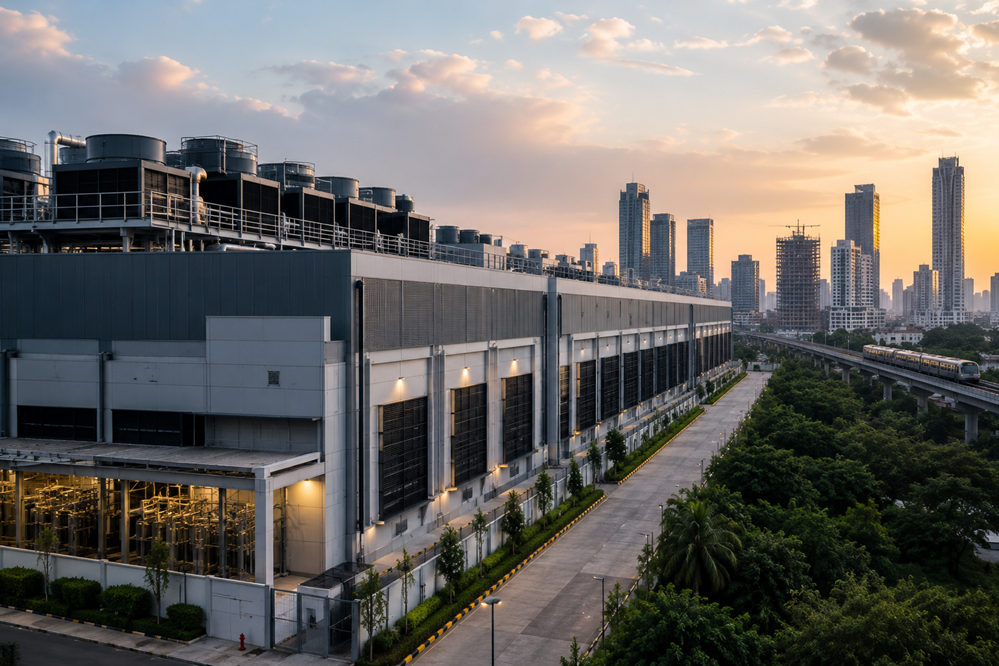
As India’s data centre market grows from USD 10 billion in 2025 to an estimated USD 22 billion by 2030, the impact on how our cities allocate land and plan commercial and residential corridors is far more significant than most developers and planners have acknowledged.
A new competitor for prime urban land
Data centres need large, well-connected, power-rich parcels. These are the same corridors that IT parks have historically occupied. India’s development pipeline now stands at 3.1 GW, with 1.6 GW already operational, making the country the second-largest data centre market in Asia-Pacific. Mumbai is set to surpass 1 GW of operational capacity by end-2026. Hyderabad has been ranked the top secondary data centre market in the region. This is, at its core, a land-use story.
Capital is following suit. Data centres accounted for 31 per cent of total global private real estate funding between Q1 and Q3 of 2025, up from a five-year average of 15 per cent. That capital rotation has a spatial consequence: it competes with, and in some locations displaces, conventional office-led development.
The office market: A measurable shift
While cloud computing has enabled businesses to operate more efficiently and optimise their real estate footprints, India’s Grade-A office market continues to witness strong demand, particularly from GCCs, technology firms, financial services, and flexible workspace operators. Data centres represent a complementary digital infrastructure asset class rather than a direct replacement for office development.
The residential equation
Data centres generate fewer direct on-site jobs per square foot compared to traditional office developments. However, their wider economic impact extends through construction activity, facility management, logistics, telecom infrastructure, power ecosystems, and ancillary services, which can contribute to residential and commercial demand in surrounding regions over time.
Tier-II cities: The new frontier
Cities like Vizag and Naya Raipur are emerging as serious contenders. They offer ample land for horizontal development, lower acquisition costs, and better scope to scale power infrastructure. When data centre investment anchors a tier-II location, it typically triggers demand for warehousing, logistics support, and workforce housing. Beyond this, the surge in data centres is boosting ancillary real estate more broadly, including warehousing systems, telecom infrastructure, substations, and energy parks. The data centre becomes an anchor of a new kind of industrial-digital real estate cluster.
Power, water, and the urban planning challenge
This is where data centres have their most complex impact. A single large facility can consume as much electricity as a small town, and efficient operation depends on dedicated substations and transmission lines. Poor planning strains city grids. Smart planning, with dedicated zones near high-capacity power corridors and incentives for renewable energy adoption, can offset much of that pressure.
Water is equally consequential. Large data centres can consume up to 5 million gallons per day, comparable to a town of 10,000 to 50,000 people. In water-stressed cities like Chennai, this directly competes with residential needs and strains municipal supply. Recycled water, treated sewage, and air-cooled or hybrid cooling systems are increasingly part of the mitigation toolkit, desalination plants in coastal regions are being considered and they need to be built into planning frameworks from the start, not retrofitted later.
On the land side, the second half of 2025 saw a surge in prices for data centre-ready plots, with developers prioritising pre-zoned land near power and fibre corridors. Hyper-scalers and REITs are aggressively acquiring parcels, paying premiums for sites with multi-phase expansion potential and minimal regulatory risk. In proven corridors, data centre-led appreciation is running at 15 to 25 per cent annually.
A new urban logic
Data centres now function as an institutional asset class. They offer ten-to-twenty-year leases, stable income, and renewal rates of 90 per cent or higher at well-utilised facilities. India’s land-stage pipeline exceeds 10.5 GW. For architects, planners, and developers, the message is straightforward: data centres need to be part of master planning conversations, not treated as outliers. Power availability must carry the same weight in location strategy as transit access. The cities that understand this now will be better positioned to manage what comes next.
