

India Makes History: Skyroot’s Vikram-1, Country’s First Privately Developed Orbital Rocket, Successfully Reaches Orbit

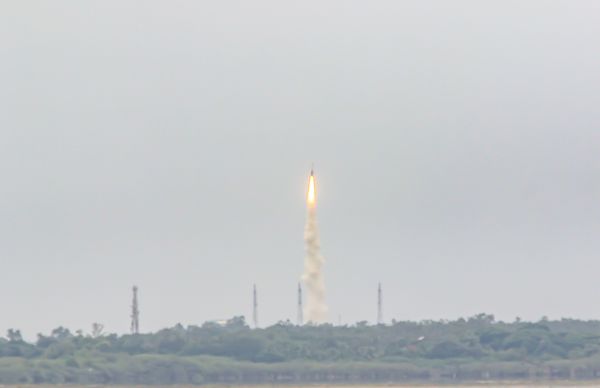
Sriharikota: In a landmark achievement for India’s private space sector, Skyroot Aerospace’s Vikram-1 rocket under Mission Aagaman successfully lifted off at 12:05 PM from the First Launch Pad at the Satish Dhawan Space Centre (SDSC) in Sriharikota, Andhra Pradesh. The rocket completed its planned sequence of stage separations, final burn, and injected its payloads into a ~450 km Low Earth Orbit (LEO), marking India’s first successful private orbital launch.
This milestone positions India as only the third country in the world—after the United States and China—to achieve private orbital launch capability.
Prime Minister Narendra Modi promptly congratulated the Skyroot team. He spoke by phone with Co-founder & CEO Pawan Kumar Chandana and the team, lauding the historic feat and inviting them to meet him. Modi highlighted the success as a defining moment in India’s space journey, crediting space sector reforms for unlocking innovation and private enterprise.
Union Minister of Science and Technology Jitendra Singh also celebrated the achievement.
About Vikram-1 and the Mission
Vikram-1 is India’s first privately developed orbital-class launch vehicle, fully designed and built by the Hyderabad-based startup Skyroot Aerospace (founded by former ISRO engineers). Named after Dr. Vikram Sarabhai, the father of the Indian space programme, the ~24-metre-tall, carbon-composite rocket features three solid-propellant stages (Kalam series) and a liquid-fuelled Orbit Adjustment Module (OAM) with the Raman engine for precise insertion and manoeuvres.
It is designed to deliver payloads of up to 350 kg to LEO in a cost-effective and responsive manner, supporting the growing small satellite market. The maiden test flight (Test Flight-1) focused on validating in-flight performance, propulsion, guidance, navigation, control, and stage separation systems.
The mission carried multiple payloads, including:
A lab-grown Diamond Lotus (Cosmic Bloom) from Bengaluru-based Cosmos Diamonds.
A handwritten postcard from Prime Minister Narendra Modi with the message “Vande Mataram.”
Micro-sculptures in an 18K gold miniature rocket honouring Indian scientific icons: Sir C.V. Raman, Dr. Vikram Sarabhai, and Dr. A.P.J. Abdul Kalam.
Technology demonstrators such as Grahaa Space’s SOLARAS S3 CubeSat, Cosmoserve Space’s “Embrace” robotic arm (for in-orbit servicing and debris removal), payloads from Germany’s DCUBED, and Skyroot’s own SCOPE satellite for flight data collection.
Skyroot Aerospace, which recently became India’s first space-tech unicorn, aims to offer reliable “cab service to space” for small satellites. Following this success and additional test flights, the company targets full commercial operations by 2027.
This achievement builds on Skyroot’s earlier milestone with the suborbital Vikram-S launch in 2022 and underscores the transformative impact of India’s space sector liberalisation, enabling private players to complement ISRO’s efforts toward a $44 billion space economy.
