


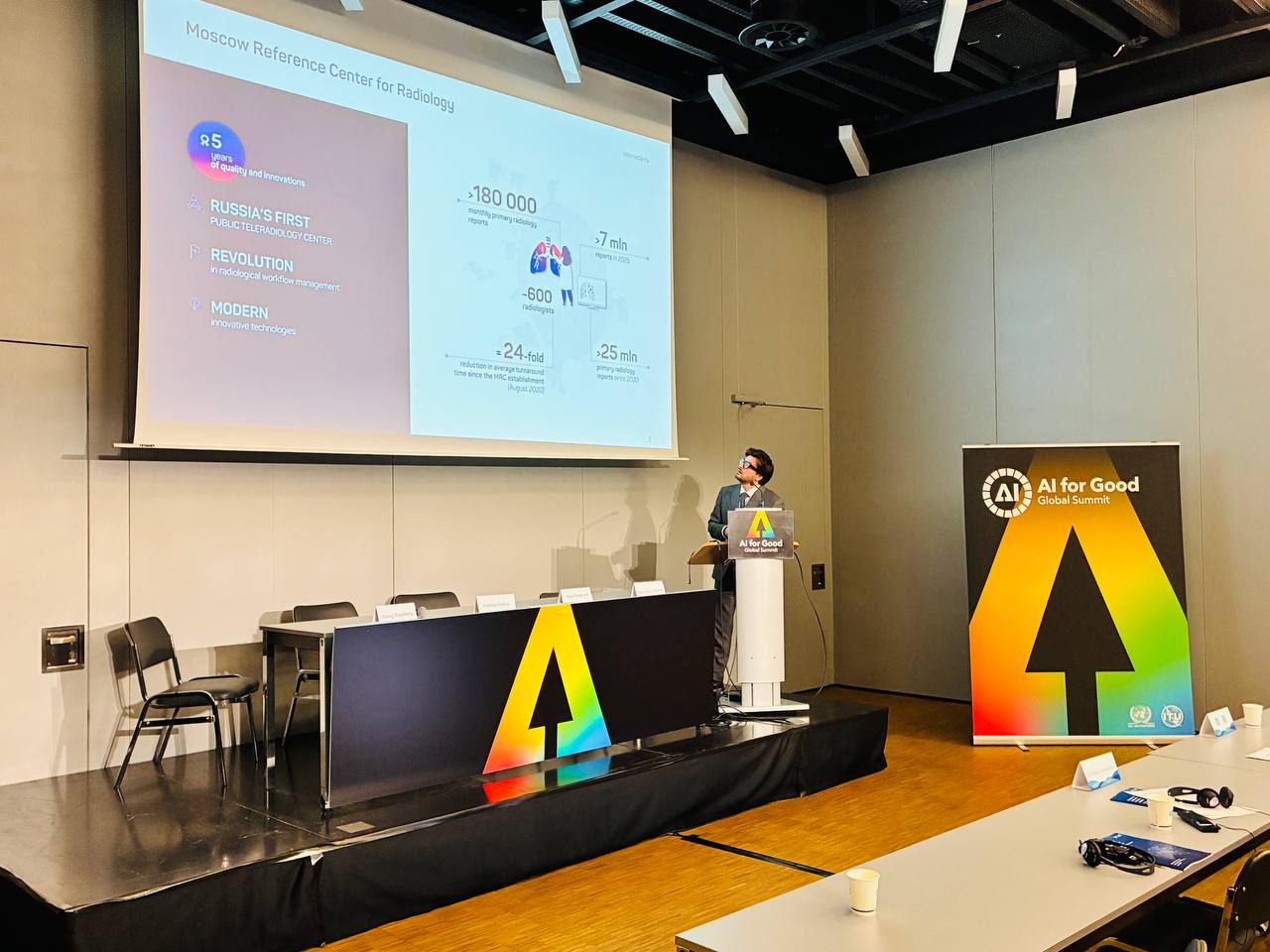
From July 6 to 11, 2026, the “AI for Good” Summit, a key platform of the UN and the International Telecommunication Union (ITU), was held in Geneva, Switzerland, dedicated to practical AI-based solutions for achieving the Sustainable Development Goals. The event brought together representatives of government agencies, international organizations, the scientific community, and the technology industry to discuss issues of standardization, regulation, and the application of AI in a wide range of areas, including healthcare.
“Participation in the summit is an important step in strengthening the international professional network of the Center for Diagnostics and Telemedicine. Such platforms allow us to compare our approaches to the development of radiology and digital services with global practices, as well as build partnerships aimed at improving the quality of medical care,” emphasized Yuri Vasilev, Chief Officer of Radiology at the Moscow Health Care Department and Medical Director of the Center for Diagnostics and Telemedicine.
As part of the summit’s business agenda, Yuri Vasiliev delivered a paper at a specialized seminar titled “Brain-computer interface: Technology for good and application cooperation.” His presentation explored the potential of neuroimaging, detailing the use of AI for detecting intracranial hemorrhages and ischemic changes, as well as for analyzing MRI studies in patients with multiple sclerosis. He underscored how neural networks facilitate faster and more accurate image interpretation for clinicians. Mr. Vasilev also noted the varying maturity levels of these technologies, with some already integrated into routine clinical practice and others still undergoing clinical trials.
During his presentation, Yuri Vasiliev presented the outcomes of a Moscow experiment on computer vision in radiology: Since 2020, AI has assisted radiologists in processing over 18 million studies The experiment has led to the development of a methodology for evaluating algorithms, the creation of an open library of medical datasets, and the development of a market for in-house AI services for healthcare. More than 2,000 medical organizations from 75 regions of Russia have gained access to verified AI services through the MosMedAI platform. This has enabled the dissemination of best practices for applying artificial intelligence in radiology at the national level.
During his presentation, Yuri Vasiliev presented the results of a six-year, large-scale Moscow experiment integrating computer vision technologies into radiation diagnostics. Since 2020, artificial intelligence has helped radiologists process over 18 million scans. The experiment has led to the development of a methodology for evaluating algorithms, the creation of an open library of medical datasets, and the development of a market for in-house AI services for healthcare. More than 2,000 medical organizations from 75 regions of Russia have gained access to verified AI services through the MosMedAI platform. This has enabled the dissemination of best practices for applying artificial intelligence in radiation diagnostics at the national level.
International colleagues praised Moscow’s approach to standardizing AI in healthcare, which addresses issues of development, data preparation, technical and clinical trials, monitoring, and quality control of AI services. To date, 28 national standards for the application AI in healthcare have been developed in Russia.
At the end of his presentation, Yuri Vasiliev presented the results of clinical studies demonstrating that maximum effectiveness can only be achieved through the collaboration of physicians and artificial intelligence. His key point remains unchanged: AI does not replace physicians, but rather becomes their reliable assistant, enhancing their expertise and helping to provide patients with more accessible and high-quality medical care.
A notable highlight of the mission was Mr. Vasiliev’s presentation at the World Health Organization (WHO) headquarters in Geneva. Alongside representatives of the Moscow Department of Information Technology, he detailed the methodologies for integrating AI into practical healthcare, introducing a “maturity matrix” developed in Moscow for assessing AI service readiness.
The “maturity matrix” evaluates technical stability indicators, including the proportion of technological defects, and diagnostic effectiveness, measured using the Area Under the Curve (AUC) for the Receiver Operating Characteristic (ROC). This tool allows medical organizations to objectively select the most effective solutions for clinical use, while developers can track the development of their services at all stages of the lifecycle: from participation in the Moscow experiment to market launch and widespread adoption in healthcare. The ability to continuously assess the development dynamics of AI services has been highly praised by international experts.
The Center for Diagnostics and Telemedicine of the Moscow Health Department is a leading scientific and practical organization within the city’s healthcare system. The center is focused on the development of radiation and instrumental diagnostics, the digital transformation of healthcare, the implementation of artificial intelligence technologies in practical medicine, and also conducts research and educational activities.
