
Gleneagles BGS Hospital Performs First-of-its-Kind Non-Surgical Treatment for Non-Cancerous Thyroid Lump

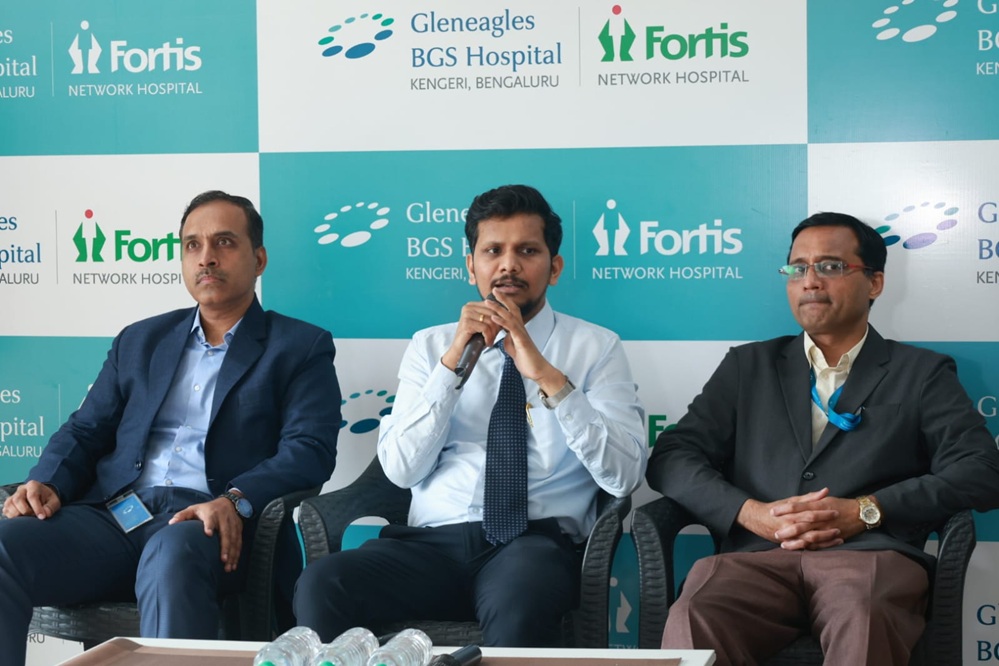
Bengaluru : Gleneagles BGS Hospital, Kengeri, Bengaluru (part of the Fortis Healthcare Network), has set a new benchmark in thyroid care by performing a first-of-its kind procedure combining Direct Puncture Embolisation, which blocks the blood supply to the thyroid lump, with Microwave Ablation, which uses controlled heat to destroy the lump, to treat a highly vascular benign thyroid nodule in a 41-year-old woman. While both procedures are established treatment techniques individually, this is the first reported case in which they have been combined in a single sitting by the Interventional Radiology team led by Dr Naveen Chandrashekhar, Consultant Interventional Radiologist, Gleneagles BGS Hospitals.
The 41-year-old software engineer had first noticed a painless swelling on the right side of her neck nearly three years ago. Further evaluation confirmed that the thyroid lump was non-cancerous, it gradually increased in size over time. A further evaluation at Gleneagles BGS Hospitals revealed that the nodule had grown to nearly 16 cubic centimetres and was being supplied by an unusually large blood vessel. This made conventional heat-based treatment alone less effective, as the increased blood flow could reduce its impact and increase the chances of the nodule returning.
Given the complexity of the case, the Interventional Radiology team decided to adopt a two-step approach. The enlarged blood vessel supplying the thyroid nodule was first blocked through Direct Puncture Embolisation, following which Microwave Ablation was performed during the same sitting to destroy the nodule using controlled heat. By treating both the blood supply and the nodule together, the team was able to improve treatment effectiveness while reducing the chances of recurrence.
Unlike regular procedure which requires specialised catheters and radiation laboratory, the entire procedure was performed under ultrasound guidance using a standard IV cannula. This reduced the need for specialised equipment, shortened the procedure time and eliminated radiation exposure. The procedure was completed in approximately 90 minutes under local anaesthesia, allowing the patient to remain awake throughout. As no surgery was performed, there were no stitches or visible scars, and the patient was discharged the same day in a stable condition. Later, the thyroid nodule reduced in volume from 16 cc to nearly 3 cc. The visible swelling almost completely disappeared, and the patient recovered without any complications.
Giving details of the case, Dr Naveen Chandrashekhar, Consultant Interventional Radiologist Interventional, Gleneagles BGS Hospitals, said, “Microwave ablation is an established treatment for benign thyroid nodules. However, this patient’s nodule had an unusually large blood vessel supplying it. If we had performed heat treatment alone, the high blood flow could have reduced its effectiveness and increased the chances of the nodule returning. We therefore decided to first block the blood supply and then perform microwave ablation during the same procedure. This is a first-of-its kind innovative procedure, where these two techniques have been successfully combined to treat a highly vascular benign thyroid nodule.”
He further added, “Another important advantage of this procedure is that it was performed entirely under ultrasound guidance using a standard IV cannula instead of specialised catheters and a catheterisation laboratory. This reduced the need for expensive equipment and radiation exposure while simplifying the procedure. At the same time, we were able to preserve the healthy thyroid gland, avoid surgery and help the patient recover faster. While this approach is suitable only for carefully selected patients, it has the potential to make advanced thyroid treatment more accessible and affordable in the future.”
The patient, said, “When I first noticed the swelling on my neck, I was worried I might eventually need surgery. Dr. Naveen and the team explained the treatment clearly and gave me confidence. I was relieved that I could avoid surgery, and my recovery was much quicker than I expected. Today, the swelling has almost disappeared, and I am grateful to the team at Gleneagles BGS Hospitals for their care”
Mr. Ravi Bagali, COO, Gleneagles BGS Hospital, Kengeri, Bengaluru, said, “This achievement reflects Gleneagles BGS Hospital’s commitment to clinical excellence and innovation. Successfully performing this unique procedure demonstrates the expertise of our Interventional Radiology team and our focus on delivering advanced treatments that improve patient outcomes while reducing the need for surgery. We remain committed to bringing world-class treatment options that are safer, more precise and more accessible for our patients.”
