

India’s Merchandise Exports to New FTA Partners Are Expected to Reach USD 1 Trillion by 2035: ASSOCHAM

New Delhi : As India holds efficient complementarities with new FTA partners, the liberalised trade is expected to scale India’s exports with 9 FTA partners from USD 233 billion in 2025 to USD 511 billion by 2030 and USD 1 trillion by 2035, said a recent study released by ASSOCHAM, “India’s Recent FTAs: Trillion-Dollar Export Opportunities”.
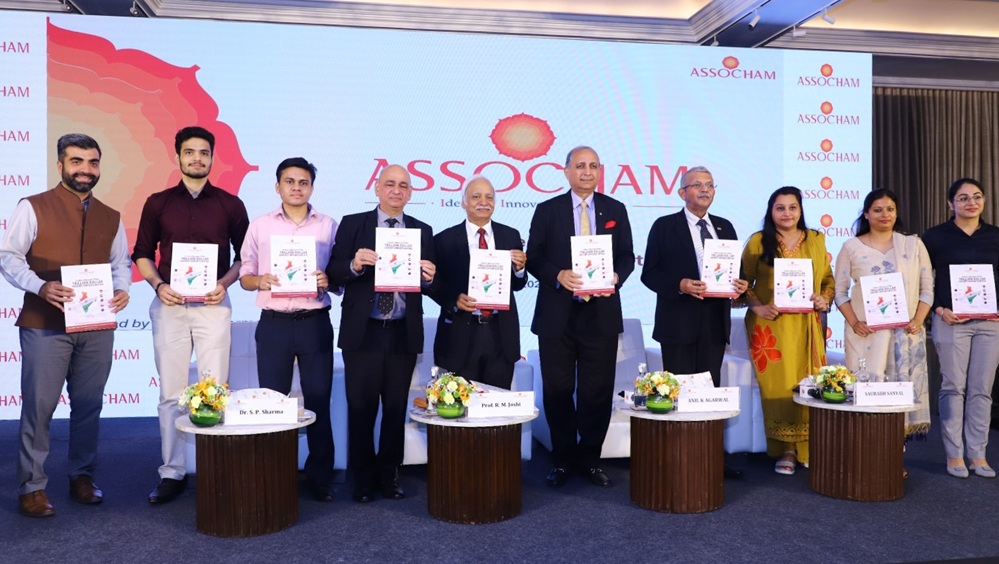
The study was released by the dignitaries: Prof. R.M. Joshi, Vice Chancellor, IIFT; Mr. Anil K. Agarwal, Past President, ASSOCHAM & President, COSMOS Group; Mr. Saurabh Sanyal, Secretary General, ASSOCHAM; and Dr. S.P. Sharma, Chief Economist, ASSOCHAM, during the event titled “India’s Recent FTAs: Trillion-Dollar Export Opportunities”.
The significantly high tariff liberalisation by the partner countries, at 99% and above for the trade value, reflects greater market access for Indian exports. Also, tariff liberalisation with respect to tariff lines is scored at more than 90% by India from its trading partners, said the ASSOCHAM study.
FTA Commitments for Tariff Elimination/Reduction: Merchandise Trade
| India’s FTA Partner (Agreement Signed on) | Partner Country’s Offer | India’s Offer | ||
| Tariff Lines | Trade Value | Tariff Lines | Trade Value | |
| New Zealand (27 Apr 2026) | 100% | 100% | 70.03% | 95% |
| EU (27 Jan 2026) | 97% | 99.5% | 92.1% | 97.5% |
| Oman (18 Dec 2025) | 98.08% | 99.38% | 77.79% | 94.81% |
| UK (24 July 2025) | 99% | ~100% | 89.5% | 91% |
| EFTA (10 March 2024) | 92.2% | 99.6% | 82.7% | 95.3% |
| Australia (2 April 2022) | 100% | 100% | >70% | 90% |
| UAE (18 Feb 2022) | 97.4% | 99% | >80% | >80% |
| Mauritius (22 Feb 2021) | The CECPA between India and Mauritius covers 310 export items for India. Mauritius benefits from preferential market access into India for its 615 products. | |||
| USA (Interim Trade Framework, Feb 2026) | The United States will apply a reciprocal tariff rate of 18 percent under Executive Order 14257 of April 2, 2025 as amended, on originating goods of India, including textile and apparel, leather and footwear, plastic and rubber, organic chemicals, home décor, artisanal products, and certain machinery. | |||
Source: Ministry of Commerce and Industry
The enhanced market access, tariff liberalization, India’s trade facilitation measures along with the strong handholding provided by the government to the exporters are expected to scale up India’s exports to a significantly higher level.
The FTAs trajectory so far and expectations going forward:
| Particular | Status/Projections |
| India’s Exports to new FTA Partners | USD 233 Bn |
| India’s Imports from new FTA Partners | USD 234 Bn |
| Total Trade with new FTA Partners | USD 467 Bn |
| New FTA Partners Global Imports | USD 13 Trillion |
| India’s share in new FTA Partners Global Imports | <2 % |
| India’s top 100 Products Exports to new FTA Partners | USD 324 Bn |
| New FTA Partners Global Imports of India’s top 100 export products | USD 6.4 Trillion |
| Share of top 100 exports in new FTA Partners Global Imports | <3% |
| Export Projections for 2030 with new FTA Partners | USD 511 Bn |
| Export Projections for 2035 with new FTA Partners | USD 1 Trillion |
Analysing the current trade trajectory with the trading partners, with which India has concluded agreements since 2020, ASSOCHAM report noted that these nine-trading partners constitute 39% of the India’s total trade (2025) which reveals the significance of these countries/regions for India.
India is no doubt one of the fastest growing economies in the present time. However, to assess the gains emanating from trade deals, it is significant to understand the emerging growth trends in partner countries and reflect on to global geopolitical developments, the report noted.
Prof. R.M. Joshi, Vice Chancellor, IIFT, Chief Guest at the report release event, in his keynote speech dwelt on the significance of free trade agreement in the era of globalization and reflected on the recent trade developments where India needs to become resilient to face the heightened unpredictability in trade policies.
He appreciated the India-EU free trade agreement which marks a notable achievement for India as it involves the concurrence of trade liberalization by 27 European Union countries at one go.
In his special address, Mr. Anil K. Agarwal, Past President, ASSOCHAM and President, COSMOS Group spoke about the transformative role of India’s recent Free Trade Agreements in expanding export opportunities, strengthening global partnerships, attracting investment, and positioning India as a trusted and competitive economy.
He also underlined the need for Indian industry to enhance productivity, invest in innovation, improve quality standards, meet global certifications and ESG requirements, and support MSMEs and labour-intensive sectors in becoming globally competitive.
Mr Saurabh Sanyal, Secretary General, ASSOCHAM noted that with strategic free trade agreements, trade deals, sectoral focus and policy changes, India looks forward to placing itself in an advantageous position on the global platform while dealing with trade dynamism.
India’s recent Free Trade Agreements have the potential to become a key driver of export growth. Sectors such as engineering goods, electronics, pharmaceuticals, textiles, gems and jewellery, automotive products and processed foods are well placed to benefit. Higher exports can support manufacturing, investment, employment and foreign exchange earnings, strengthening India’s long-term growth ambitions, said Mr. Sanyal.
Dr S.P. Sharma, Chief Economist, ASSOCHAM, noted that with greater market access, trade facilitation through supportive policies, and resilient global economic and trade growth, India can see exports to these partner countries increase by more than USD 250 billion, reaching USD 511 billion by 2030.
Since 2020, India has concluded agreements with Mauritius, the UAE, Australia, the European Free Trade Association (EFTA), the United Kingdom, Oman, New Zealand and the European Union (EU), in addition to the USA, where the contours of the agreement are yet to be finalised. A focus on enhancing competitiveness and economic cooperation through FTAs can surely bring renewed dynamism to Indian manufacturing.
