


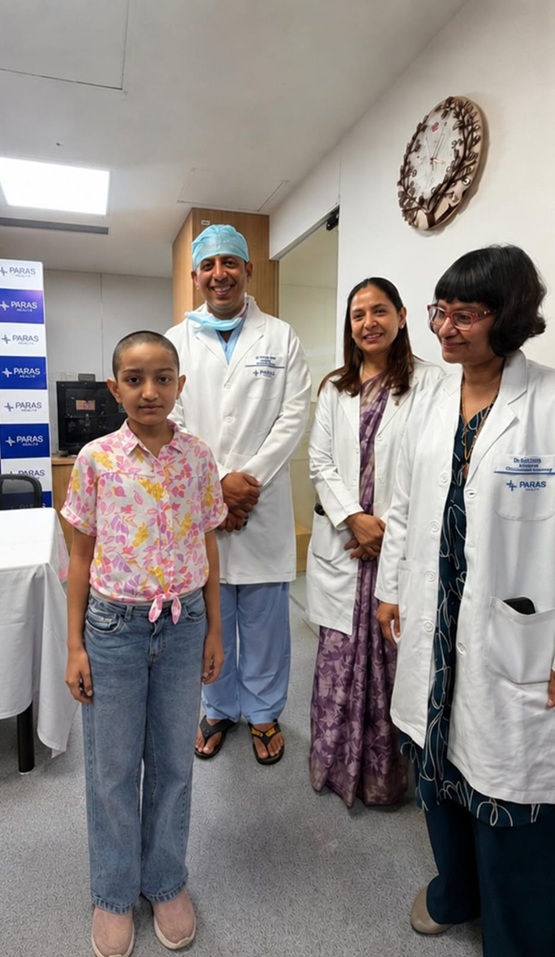
A 10-year-old girl who had spent nearly a decade battling recurrent seizures despite treatment with seven anti-epileptic medications has become seizure-free following a highly specialized epilepsy surgery at Paras Health Gurugram.
The child was brought to the Neurology OPD at Paras Health Gurugram by her mother with a history of recurrent seizures since the age of 10 months. Despite being on seven anti-epileptic medications, she continued to experience breakthrough seizures, significantly affecting her growth, development, learning abilities and overall quality of life. As a child with special needs, managing her condition was particularly challenging for both the medical team and her family. There was no family history of any significant neurological disorder.
The patient was admitted under the Department of Neurology in late July and underwent a detailed neurological evaluation led by Dr. (Prof.) M. V. Padma Srivastava, Chairperson – Neurology, Paras Health Gurugram. She was diagnosed with multidrug-resistant (intractable) epilepsy caused by left mesial temporal sclerosis, with part of the neocortex also identified as being involved in the seizure-generating zone.
Given the complexity of the case, the patient was evaluated by a multidisciplinary epilepsy team led by the Neurology and Neurosurgery teams. The team included Dr. Puneet Rana, Director – Neurosurgery, and Dr. Surbhi Pande, Director (Nuclear Medicine), at Paras Health Gurugram.
For precise surgical planning, the team used advanced diagnostic technologies, including epilepsy-specific MRI with neuronavigation and Diffusion Tensor Imaging (DTI), along with PET scan imaging, to accurately identify the seizure-producing area while preserving critical brain functions. One of the biggest challenges was that the seizure focus was soft and difficult to localize, making both surgical planning and execution highly demanding.
Speaking about the case, Dr. (Prof.) M. V. Padma Srivastava (Padma Shri), Chairperson – Neurology, Paras Health Gurugram, said,”Drug-resistant epilepsy is not merely a condition of uncontrolled seizures—it can severely affect a child’s brain development, education, behaviour, and future potential. Many families continue changing medications for years without realising that surgery may offer the best chance for seizure control in carefully selected patients. The key lies in accurately identifying the seizure-producing zone using advanced investigations such as video EEG, epilepsy-protocol MRI, PET scans, SPECT imaging and other specialised modalities, followed by meticulous multidisciplinary planning. When performed in the right patient at the right time, epilepsy surgery can dramatically improve quality of life and, in many cases, help children return to normal activities with significantly reduced dependence on medications.”
Dr. Puneet Rana, Director – Neurosurgery, Paras Health Gurugram, added,”This was a technically demanding surgery because the epileptogenic focus was difficult to localize despite advanced imaging. Neuronavigation and intraoperative ECoG played a crucial role in accurately identifying and safely removing the seizure-generating tissue while preserving critical brain functions. The successful outcome highlights the importance of advanced technology, multidisciplinary collaboration, and timely surgical intervention in carefully selected cases of drug-resistant epilepsy.”
Dr. Puneet Rana performed the nearly four-hour surgery using neuronavigation guidance. The procedure involved a minimally invasive 1.5 cm corticectomy followed by a selective amygdalohippocampectomy under continuous electrocorticography (ECoG) monitoring. Every step was carefully planned to preserve the language centres of the brain and the vital perforating branches of the middle cerebral artery supplying deeper brain structures.
The patient made an uneventful post-operative recovery, with no neurological deficits or complications, and was discharged in good condition five days after surgery. During subsequent follow-up visits, she has remained seizure-free, marking a significant improvement in her quality of life. Her doctors plan to gradually reduce her anti-epileptic medications over time, depending on her continued progress.
According to the treating team, only 12-15% of epilepsy patients are suitable candidates for lesionectomy-based epilepsy surgery. However, for these carefully selected patients, timely surgical intervention can provide long-term seizure control and significantly improve neurological outcomes and quality of life.
The experts also highlighted that while epilepsy triggers vary from person to person, factors such as sleep deprivation, missed meals, prolonged screen exposure and flashing lights can trigger seizures in susceptible individuals. Early evaluation at a comprehensive epilepsy centre is essential for patients whose seizures remain uncontrolled despite medication, as surgery may offer a life-changing solution.
