


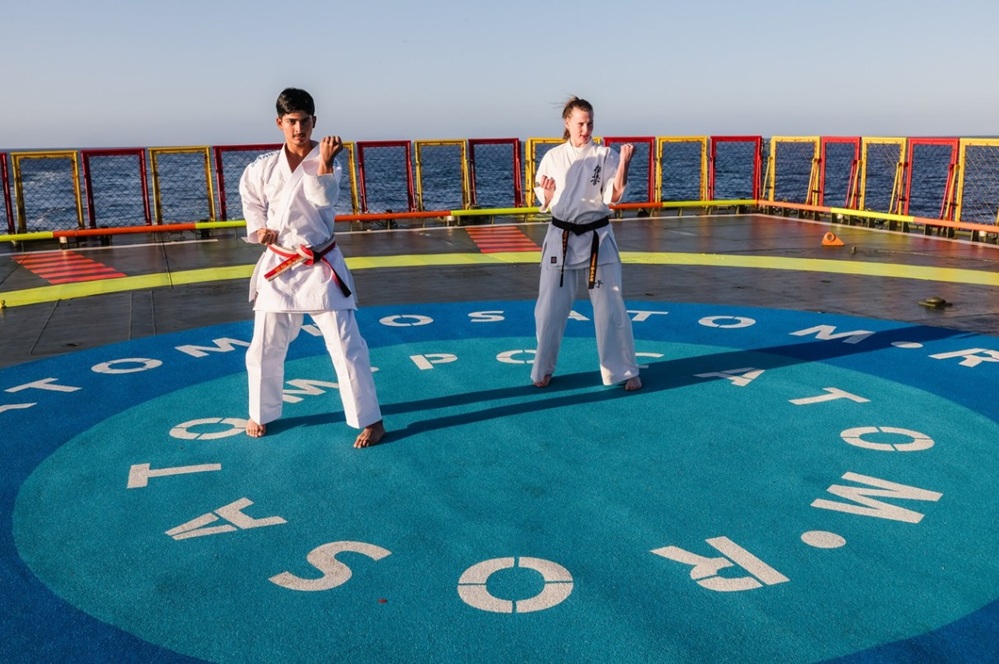
Mumbai : On 13th August, Rosatom’s 7th international scientific and educational expedition, Icebreaker of Knowledge, returned to Murmansk after a ten-day Arctic voyage aboard the nuclear-powered icebreaker 50 Let Pobedy. Among the participants was Lucky Rawat from Chakrata, Uttarakhand, India’s sole student representative on the expedition.
Before setting off on the expedition, Lucky had described the opportunity as almost unreal, saying it felt like a dream to be travelling to the North Pole as the only Indian student on board.
Now, having completed the journey to the North Pole and back, Lucky returns with first-hand experience of the Arctic, exposure to scientific experiments and advanced technologies aboard a nuclear-powered icebreaker, and the opportunity to learn alongside young participants and experts from around the world.
Over the course of ten days, the participants travelled along the route from Murmansk to the North Pole, then to Franz Josef Land, before returning to Murmansk. The voyage itself went down in history as the 200th expedition by a surface vessel to the North Pole.
“We have successfully completed the seventh voyage of the Icebreaker of Knowledge Arctic expedition. The crew always approaches this project with special enthusiasm: such voyages truly contribute to the development of the next generation. The brightest and most talented young people join the expedition—and once again, we’ve seen this for ourselves. Many of them dreamed of visiting the North Pole and seeing polar bears, and I am very glad that Rosatom and our crew helped them make that dream come true,” said Ruslan Sasov, captain of the nuclear-powered icebreaker 50 Let Pobedy.
A rich scientific and educational program was organized on board the nuclear-powered ship for the participants of the Icebreaker of Knowledge expedition, which included a real aerospace laboratory. As part of the expedition, the participants, together with scientists, prepared and conducted two unique experiments: the launch of a radiosonde to provide communication in hard-to-reach areas of the Arctic and along the Northern Sea Route, as well as the testing of the world’s first recoverable stratospheric platform.
“At Rosatom, we work every day on things that seemed like science fiction just yesterday. That’s why it’s especially important for us to show this to the kids in person, and it’s great that we can do it right on board the nuclear-powered icebreaker 50 Let Pobedy. During the expedition, the children saw that Russian science is about the future and real technologies that change people’s lives for the better,” noted Yegor Plakhotnyuk, an expert on the Icebreaker of Knowledge scientific and educational expedition and project manager at the Laboratory of Genomic Technologies and Tissue Engineering at the Research Institute of Technical Physics and Automation (NIITFA, part of Rosatom’s Scientific Division).
On the day the North Pole was reached, a symbolic event was held —the northernmost and most international circle dance around the 90° point. It took place to the live performance of AY YOLA, a musical group from Bashkortostan. During the voyage aboard the nuclear-powered icebreaker, expedition members, together with science fiction writer Sergey Lukyanenko, wrote a science fiction story that will be published on the social media accounts of Rosatom’s Rosatom’s Icebreaker of Knowledge.
Fact Sheet:
The scientific and educational project Icebreaker of Knowledge is organized with the support of Rosatom. It is aimed at promoting natural science disciplines and technologies of the nuclear industry, finding and supporting talented and gifted children, developing their abilities and offering career guidance. The project brings together school students and students of secondary vocational education programs aged 14–16 from around the world. The top performers join a scientific and educational expedition to the North Pole aboard the nuclear icebreaker 50 Let Pobedy.
About 5,000 students from 22 countries competed in the international selection process to participate in the voyage: Armenia, Bangladesh, Belarus, Bolivia, Brazil, Hungary, Vietnam, Egypt, India, Indonesia, Kazakhstan, China, Kyrgyzstan, Mongolia, Myanmar, Namibia, Rwanda, Serbia, Tanzania, Turkey, Uzbekistan, and South Africa.
The international selection process began on May 5 and consisted of three stages. During the first stage, participants answered questions in a science quiz, testing their knowledge of natural sciences, breakthrough technologies, nuclear energy, and Arctic exploration. The second stage included a series of webinars delivered by nuclear industry experts. Participants learned about Rosatom’s advanced solutions, including technologies used to ensure the safe and sustainable development of Arctic shipping, as well as the role of nuclear energy in the future of the global economy and science.
Based on the total scores for both stages, ten finalists in each country were selected. They advanced to the final round, where they presented creative projects on the theme “How Nuclear Technologies Are Changing the World Today.” In the final round, it was important for the participants not only to demonstrate their knowledge of the topic but also to demonstrate their ability to think outside the box, construct a compelling argument, and present the material in an engaging manner. The finalists’ works were evaluated by an international jury composed of representatives of the nuclear industry, science, education, Arctic affairs, and science communication.
The highest number of applications came from Kazakhstan, with 945 participants, followed by Kyrgyzstan with 827 and Belarus with 464. Bangladesh and Myanmar also ranked among the most active countries this year.
Over the course of seven seasons of the Icebreaker of Knowledge project, more than 470 talented schoolchildren from around the world have participated in Rosatom’s Arctic expeditions to the North Pole. The project offered them a unique opportunity to see an operational nuclear-powered icebreaker up close and learn about advanced scientific and technological developments in Russia’s nuclear industry.
The Northern Sea Route (NSR) is the shortest shipping route between the western part of Eurasia and the Asia-Pacific region and a historically developed national transportation artery of Russia. Russia’s history of developing the Northern Sea Route spans more than 500 years and dates back to 1525, when Russian diplomat Dmitry Gerasimov proposed the idea of using a shipping route through the seas of the Arctic Ocean.
In 2018, the Government of the Russian Federation granted Rosatom the authority of infrastructure operator of the Northern Sea Route. The corporation supervises the federal project “Development of the Northern Sea Route” and also participates in implementing the Northern Sea Route Development Plan through 2035 and the Russian Federation’s socio-economic development initiative through 2030 entitled “Year-Round Northern Sea Route,” approved by an instruction of the Government of the Russian Federation.
Russia is the only country in the world with a nuclear-powered icebreaker fleet. The fleet is operated by FSUE Atomflot, a Rosatom’s enterprise. At present, FSUE Atomflot operates eight nuclear-powered icebreakers.
