

Expect mid-teen aggregate Nifty earnings growth over the next two years: Franklin Templeton India MF


Mumbai — Franklin Templeton India Mutual Fund has released – Equity Market Snapshot detailing the development in the Indian equity market and MF industry. As per the press note, the geopolitical backdrop remain fluid, with the Iran conflict continuing to Influence crude oil prices and near-term market sentiment. Although intermittent signs of de-escalation have provided some relief, crude prices have remained volatile, renewing some concerns for India. Any durable resolution to the conflict could lead to a meaningful correction in oil prices and help ease the associated macroeconomic pressures.
The recovery
The recovery in aggregate demand that began at the start of calendar year 2026 remain intact. The Iran conflict has not meaningfully disrupted this momentum which in visible in high-frequency indicators and the quality of first quarter corporate results. Based on results so far, Nifty-level profit growth is ~11% on year. Excluding Oil and gas, where profitability was affected by higher crude prices the underlying, earnings picture appears stronger.
The recovery is more visible in the broader market, where profit growth is estimated to be in the mid-teens. The suggests that improving domestic activity has been relatively more supportive for mid and small-cap companies than in large cap. Banks, diversified financials, capital-market businesses, metals and industrials have reported healthy earnings.
Taken together, first quarter results indicate that the cyclical recovery in domestic demand continues to translate in broader corporate earnings. This could support the expectations of mid-teen aggregate Nifty earnings growth over the next two years, although the trajectory may remain uneven across sectors and quarters.
FCNR(B) an additional buffer to BoP
India’s external positions also appear relatively better placed. The promising initial response to the RBI’s Foreign Currency Non-Resident (Bank) (FCNR(B) programme could provide an additional buffer against balance-of-payments and currency pressures, which might make the present episode more manageable than the earlier phase of the conflict. The FCNR(B) programme has reportedly attracted ~36 billion USD as on 31st July 2026.
Inflation a risk, but RBI may not hike rates immediately
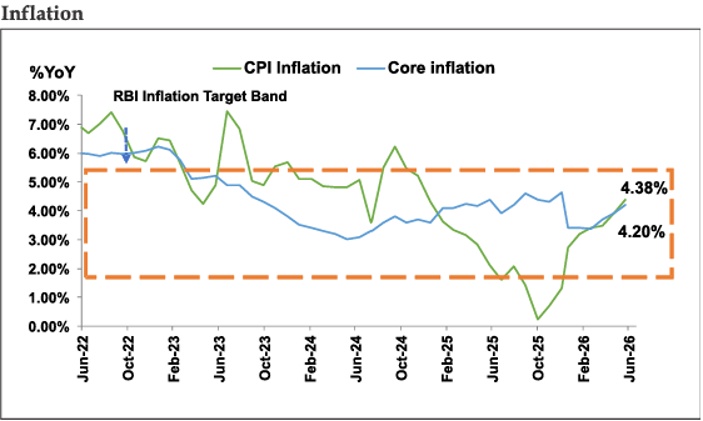
Inflation has emerged as a near-term risk, with higher energy prices, a weaker than normal monsoon and possible food and vegetable price press pushing inflation slightly above the midpoint of the central bank’s tolerance band. However, the RBI may look through the increase, provided inflation does not become persistent or broaden into demand led price pressures.
As a result, the recent uptick may not prompt the central bank to materially restrict the growth momentum built up during the year. The outlook could become mor challenging if global central banks raise rates later in the year, given the implications for capital flows and the rupee. For now, domestic policy conditions may remain broadly remain supportive of growth.
Global AI trade bet
Foreign investor sentiment has also improved. India had earlier been viewed as a counterweight to the global Al trade, with capital moving towards markets and sectors perceived as direct AI beneficiaries. More recently, investors have begun questioning whether the revenue opportunity can justify the large capital expenditure by global hyperscalers, while concerns around leveraged retail participation in market such as Korea and Taiwan has also moderated enthusiasm around the Al trade.
Valuations turn reasonable
FPI flows turned positive in July after four consecutive months of outflows. Valuations have also become reasonable compared with the elevated levels seen two years back, while India’s premium in other emerging markets has moderated. This could provide a relatively better starting point for medium-term returns particularly if earnings growth continues to normalise.
Overall, term uncertainty around geopolitics, crude oil, inflation and global monetary policy may continue to generate volatility. However, strengthening domestic demand, improving earnings, more reasonable valuation and the possibility of renewed foreign participation may provide support to the medium-term outlook for Indian equities.
Opportunities for investors
In the face of evolving macro risks and persistent volatility, maintaining a discipled and diversified investment approach remains critical. Mutual fund categories such as equity and hybrid funds schemes have different investment mandates and risk-in characteristics. We see opportunities across market cap segments and diversified equity categories such as Flexi cap and multi cap strategies could help investors navigate changing market conditions. Hybrid categories, such as Balanced Advantage, Multi Asset Allocation and Aggressive Hybrid participates in equities while aiming to manage near term volatility.
Larger focus will be on policy commentary
We may continue to face geopolitical uncertainties and rising interest rate a globally. Against this backdrop, focus will be on managing liquidity and inflation expectations, with policy commentary likely to be more important than near term rate action.
We remain constructive in native high-quality find it and expect yield movements to be driven more by global geopolitical developments and their potential impact on inflation, along with evolving domestic and global monetary policy conditions. Accordingly, our investment approach remains disciplined, with portfolios continuing to focus on relatively high-quality instruments while selectively evaluating duration opportunities where the risk reward appears favourable.
