

BJP’s Betrayal of RSS Philosophy: How Electoral Ambition Corrupted the Sangh’s Vision of Inclusive Hinduism

By Siddharthan
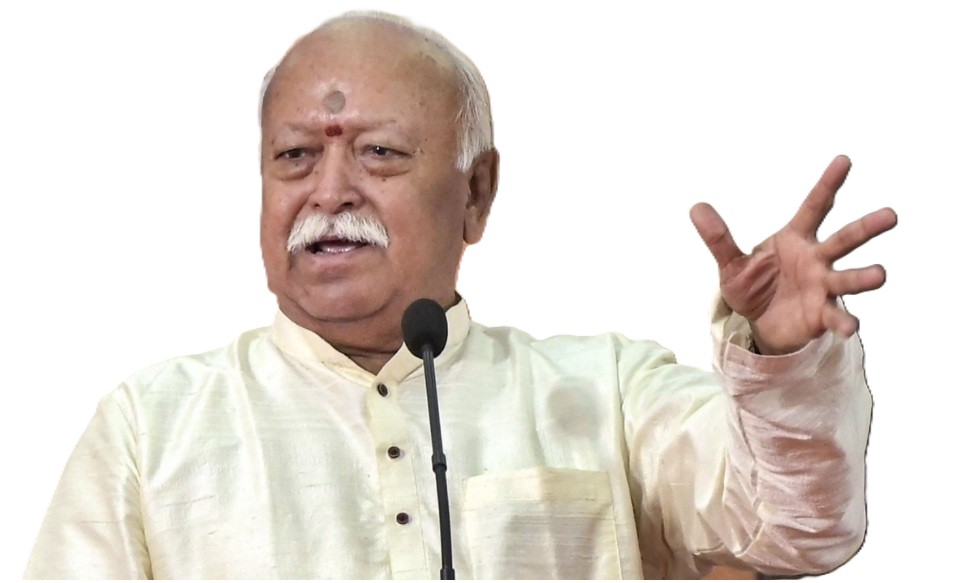
Mohan Bhagwat’s assertion at New York’s “One World One Humanity” event carries civilizational weight: “If any Hindu thinks that there should be no Muslims in Bharat, he will not remain Hindu.” This is not language for foreign consumption. It is the voice of the Rashtriya Swayamsevak Sangh, whose foundations rest on Vasudhaiva Kutumbakam — the Hindu principle that the world is one family. Heard against the Bharatiya Janata Party’s exclusionary rhetoric, it exposes a rupture. The BJP has abandoned the moorings the RSS laid down for it and chosen a politics of majoritarian anxiety that betrays what the Sangh stands for. The tragedy is not the RSS’s generous, plural philosophy but the BJP’s departure from it.
Caricatured for decades as the engine of Hindu exclusivism, the RSS treats Hindu thought as inherently plural — capacious enough to hold many faiths, practices and beliefs. Hinduism, in the Sangh’s telling, is defined not by doctrinal uniformity but by a shared inheritance of dharma, statecraft and the dignity of all beings. India’s greatness, it has long said, lies in sheltering the persecuted, the displaced and the different. The Upanishads, the Brahmasutra and the Bhagavad Gita speak of universal consciousness, the interconnection of existence and the spiritual equality of all souls. Bhagwat’s New York statement is therefore RSS orthodoxy. A Hindu who denies space to Muslims, Christians, Sikhs or any other tradition abandons, by the Sangh’s own measure, the heritage that defines Hinduism. The world has conflated that vision with the majoritarian politics the BJP now champions. The RSS is not the villain here. The BJP is.
The BJP was born from the RSS’s vision. Early leaders L.K. Advani and Atal Bihari Vajpayee kept a link to the Sangh’s framework. Since 2014 the party has become an electoral machine that mobilises majoritarian anxiety and turns Hindu identity into an instrument of control. Assam Chief Minister Himanta Biswa Sarma frames demographic diversity as a civilisational threat, invoking “infiltration” and “replacement” to justify policies that marginalise minorities — rejecting the RSS principle that India is a home for all traditions. Restricting minority space by administrative fiat does not defend Hindu civilisation; it betrays it. Union Minister Nishikant Dubey uses Parliament to amplify demographic anxiety in language that, short of explicit incitement, creates fear around religious minorities and tells India’s Muslims they are tolerated guests, not full members of the nation — the antithesis of Vasudhaiva Kutumbakam. Sambit Patra has built a media presence on communal division and remains a senior voice because that language is now the party’s default. These are not fringe figures. They are the party’s operational philosophy, and they speak against everything the RSS stands for.
Because the BJP is seen as the Sangh’s political wing, every act of communal exclusion by a BJP leader is attributed to RSS ideology. Inclusion is dismissed as PR; exclusion is treated as the movement’s real agenda. Bhagwat and the senior RSS leadership did not author the policies that have left minorities feeling vulnerable in BJP-governed states. Yet the Sangh’s reputation bears the scars, and cynicism answers that Bhagwat says one thing to the world and another is done at home. What is done at home is the BJP’s work. The party has captured the movement’s identity, rejected its values, and outgrown subordination to Nagpur. Across election cycles it learned that polarisation delivers votes more efficiently than philosophy. Calls for restraint are received politely and ignored, because the Sangh, fearing an unbridgeable rift, will not formally sanction its offspring.
When Bhagwat invoked universal oneness, he was stating a binding standard for political action, not a sentiment for New York and a silence at home. Every policy must answer whether it treats every citizen, of every faith, as a full member of the Indian home. By that measure the BJP’s exclusionary agenda fails. Silence, or only mild philosophical counterweights, makes the RSS complicit through inaction. If the Sangh is serious, it must publicly distinguish itself from the BJP’s exclusionary politics. It need not formally break with the party. It must formally repudiate the agenda pursued in its name — with the same clarity in Nagpur that Bhagwat used in New York. The world does not need a softer RSS. It needs an honest one: to say that the BJP’s exclusionary politics are not its politics; that inclusive Hinduism is incompatible with majoritarian fear-mongering; and that Vasudhaiva Kutumbakam is a binding standard, not a slogan. The RSS deserves better. India deserves better. And India’s minorities deserve a clear voice from the Sangh: you are not outsiders in this civilisation. You never were. Any politics that suggests otherwise has abandoned the deepest truths of what we claim to stand for.
