


By Suresh Unnithan
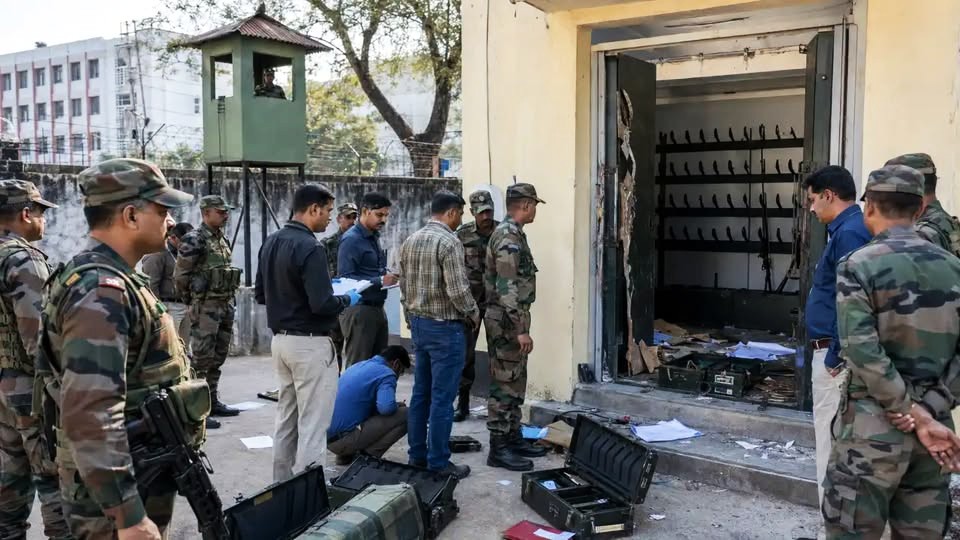
Something deeper than a lock gave way on the night of August 30–31, 2026. When Monday morning light fell on Secunderabad Cantonment, India was confronted with a report that cuts into the quiet confidence citizen’s place in those sworn to protect them. According to accounts that emerged on August 31, military weapons and ammunition were stolen from an Army establishment linked to the 20 Madras Regiment at Bollarum: reports speak of roughly eleven to twelve firearms — including four AK-203 assault rifles, an INSAS rifle, several 9 mm pistols, a civilian pistol, passive night-vision binoculars, about twenty-one magazines, and more than 1,800 rounds of live ammunition. Whether or not every detail survives the full inquiry, the core allegation is grave enough. A high-security military zone was breached. Arms meant for the defence of the Republic are, for now, unaccounted for. And a people long assured that the cantonment is sacred ground are entitled to feel shock, grief, and anger.
This essay is not a verdict of guilt against any named individual. Investigations are under way. What follows is a citizen’s critical reading of a reported security failure — and of the damage such a failure, if borne out, inflicts on public faith.
Secunderabad Cantonment is described as a restricted military area, not a soft civilian warehouse. Entry to the facility, reports say, involves multiple heavy security gates. Within that perimeter sits the Kote, the armoury, where the tools of national defence are supposed to rest under layered watch. Yet investigators have pointed to forced locks on the armoury and ammunition boxes. They have also flagged the possibility of insider involvement — personnel with authorised access, or others familiar with the premises — precisely because forcing a path through such controls is hard to imagine without knowledge from within. Media accounts state that four suspects, including Agniveers, have been detained. Detention is not conviction. Suspicion is not proof. Still, the very fact that an inside track is being examined should trouble every Indian who believes the uniform stands for trust earned daily, not assumed forever.
Other reported lapses deepen that unease. Coverage has claimed that CCTV covering the armoury entrance was not functioning as it should have — that cameras were switched off at night. The theft is said to have been executed during a night shift change, when guard strength was at its thinnest. If these findings hold, they describe not a single unlucky moment but a chain of weaknesses: surveillance that failed when it was needed most, manpower patterns that left a window open, and access controls that did not do their job. Operational failure of that order, in a military establishment, is not a minor administrative embarrassment. It is a wound to the idea of readiness itself.
For years the country has heard powerful public assurances on national security from the highest offices — the Prime Minister, the Defence Minister, the Home Minister among them — about vigilance, modernisation, and resolve. Those assurances are part of democratic leadership; so is scrutiny when reality appears to contradict the rhetoric. The induction and celebration of systems such as the AK-203 were meant to signal strength and self-reliance. That rifles of that class are now listed among items reported stolen is a bitter irony the public will not ignore. This is not a claim that any minister personally forced a lock. It is a demand, grounded in democratic accountability, that those who set the tone on national security answer for the performance of the defence and internal-security apparatus when a breach of this reported scale occurs on their watch. Eloquence is not a substitute for secure armouries. Slogans are not CCTV. Both defence and internal security, as systems of responsibility, stand under a cloud until hard questions receive hard answers.
Geography makes the anxiety sharper. The Bollarum military establishment, reports note, also houses Rashtrapati Nilayam, the President’s official winter residence. A weapons theft from a zone associated with such a sensitive presence is not a local footnote; it is a national concern. In response, authorities have sealed civilian access, placed the cantonment on high alert, and launched twin tracks of inquiry — a military Court of Inquiry alongside efforts involving Telangana Police counter-intelligence and the Malkajgiri Police Commissionerate. Schools in the cantonment area have been directed toward online classes. Those steps read less like routine caution and more like an admission that the risk is real: sophisticated firearms and live ammunition, if not recovered swiftly, could move into criminal or worse networks. Parents watching classrooms close do not need a lecture on strategy. They need the missing weapons found and the truth established without fear or favour.
Then there is the Agnipath shadow. That some of those detained are reported to be Agniveers will inevitably reopen a painful public debate about screening, belonging, and the human design of a short-service entry scheme. Fairness requires restraint: no cohort should be smeared for the alleged acts of a few, and no suspect should be condemned before inquiry and due process. Fairness also requires honesty. If the investigation establishes serious insider wrongdoing, the State cannot treat it as a sealed disciplinary file. It will have to ask whether policy choices about manpower, oversight, and institutional bonding left cracks that enemies of order — or simple greed — could exploit. That is a policy question, not a lynch-mob slogan.
Are we compromising our national security? On the reported facts, Bollarum forces the question into the open. An Army armoury is among the last places Indians expect to see in a theft narrative. That this episode is being widely described as unprecedented in independent India only heightens the sense of rupture — a claim that historians and the services must test, but one that already shapes public emotion. Trust, once shaken, is not restored by perimeter locks after the arms are gone. It is restored by transparency, by swift recovery of every weapon and round, by punishment where guilt is proved, and by reform where systems failed — without shielding rank, contract, or political comfort.
India does not need another performance of toughness. It needs the defence establishment to show that a Kote can still mean what it is supposed to mean; the internal security machinery to close every trail these weapons might travel; and the political leadership that has wrapped itself in the language of security to accept that language as a burden of proof, not a brand. Until the guns are back, the guilty — if any are proved so — are punished, and the gaps are closed in daylight, Bollarum will remain more than a place on a map. It will remain the night many Indians felt the fortress tremble, and wondered who was truly standing watch. The fear is human. The anger is legitimate. The demand is simple: protect the Republic in practice, not only in speeches — and let accountability be as loud as the claims that came before the silence of those switched-off cameras.
