


By Geetha VP
A voter in this country is asked, every few years, to treat the ballot as sacred. He is told that parties exist to contest, to persuade, to be judged. He is not told that a party can also exist as a letterhead: registered, audited on paper, rich in declared donations, and almost absent from the field. When that happens, it is not only an accounting curiosity. It is the public being taken for a ride.
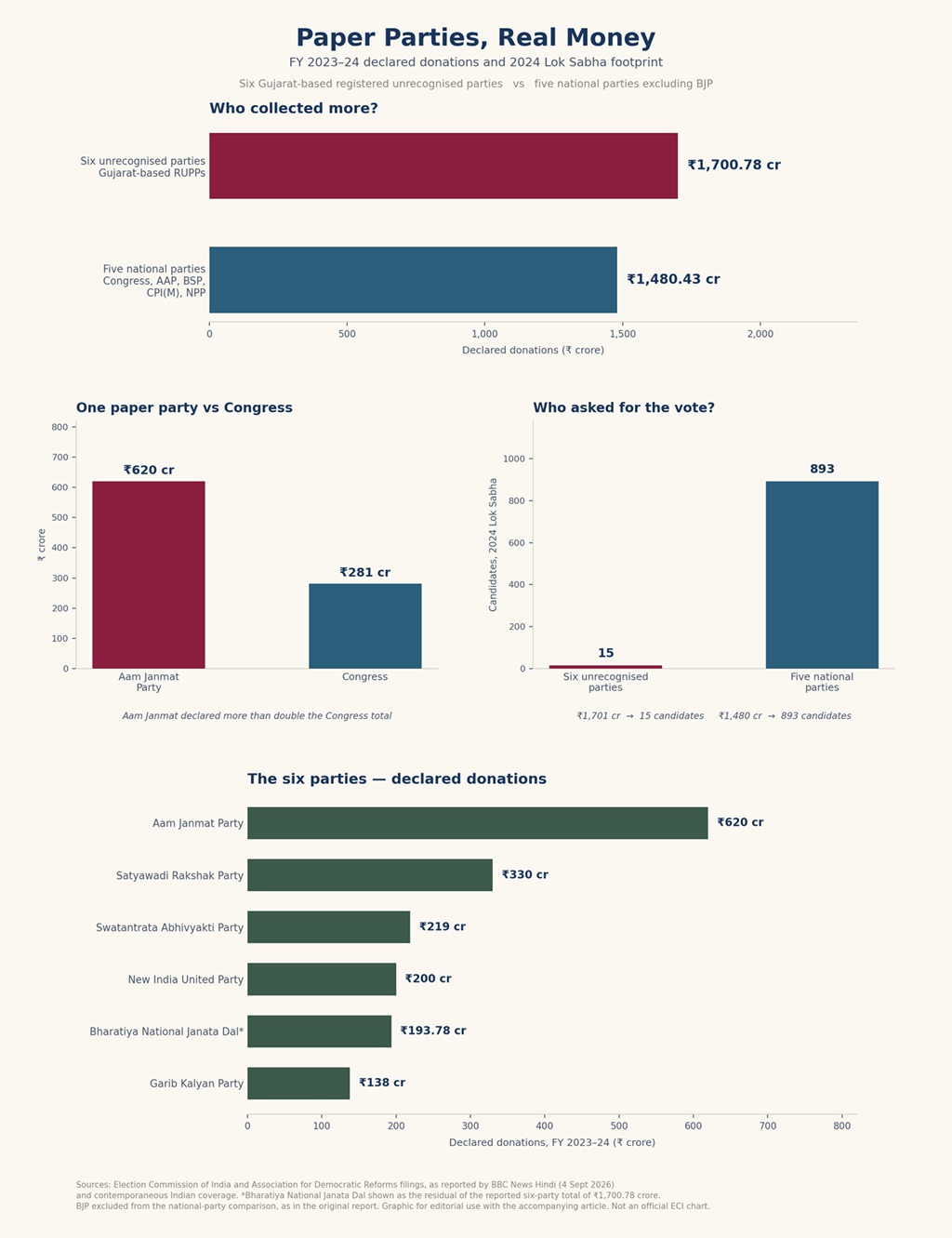
A BBC News Hindi investigation, reading Election Commission and Association for Democratic Reforms filings, has shown how far that ride can go. Six registered but unrecognised parties, almost all based in Gujarat, declared about ₹1,700 crore in donations in 2023–24. Five national parties other than the BJP — Congress, AAP, BSP, CPI(M) and the National People’s Party — together declared about ₹1,480 crore. Aam Janmat Party alone reported about ₹620 crore, more than double the Congress figure of about ₹281 crore. In the 2024 Lok Sabha election those six outfits fielded 15 candidates. The five national parties fielded 893.
The ordinary citizen is entitled to a simple question. If money on this scale is political, where was the politics? Who asked him for his vote? Who accounted to him for the spend? A donation that never meets a campaign, a welfare line that never meets a voucher, and an office that is a locked flat in Naroda are not pluralism. They are a transfer of privilege — tax relief for the giver, legal cover for the recipient — while the voter is left holding a fiction.
The six names in the report are Aam Janmat Party, Bharatiya National Janata Dal, Garib Kalyan Party, New India United Party, Satyawadi Rakshak Party and Swatantrata Abhivyakti Party. Four were traced to the same Ahmedabad belt. Ground checks described in the investigation found little that resembled a living party: shut premises, no boards, no cadre. Satyawadi Rakshak Party declared about ₹330 crore, fielded one Lok Sabha candidate, put a small sum on campaign work and the rest under public welfare. Its president, as attributed in that report, said the welfare money was spent and that records were not kept. A chartered accountant linked to more than one of these outfits indicated that the same circle sits behind several letterheads. Another office-bearer described “propaganda” being shown to clients hunting a tax deduction.
The Union government has kept a tight lip. That silence is not dignity. When an expose of this kind appears, a government that claims to protect the integrity of elections is expected to do a few unglamorous things at once. It is expected to treat the findings as a public-interest alert, not as an inconvenience. It is expected to ask the Election Commission, on record, what it has done with the contribution reports already in its custody. It is expected to let the tax department finish the 80GGC trail without political editing — and to say, without waiting for a television debate, whether the law that subsidises donations to any registered outfit is still fit for a democracy. It is expected to tell Parliament what it will change so that a paper party cannot out-earn a national party that actually asks for votes.
A responsible state does not begin with the raid van. The Enforcement Directorate is a money-laundering agency, not the returning officer of Indian politics. Sending it in first would turn a documented filing failure into a partisan spectacle, give every accused letterhead the cry of vendetta, and spare the regulator that created the registration. That is how governments avoid an expose, not how they answer one.
What they are expected to do is narrower and harder. The Election Commission already registered these parties. It already requires audits and disclosure of donors above ₹20,000. It has already struck hundreds of inactive registered unrecognised parties off the rolls. It holds the mismatch between declared election spend and audited “welfare.” Last year a Dainik Bhaskar investigation, also from Commission records, reported that ten little-known Gujarat outfits collected about ₹4,300 crore over five years, fielded 43 candidates across three elections, and secured about 54,000 votes. Several of those names overlap with the six now in public view. Rahul Gandhi asked then where the money came from and where it went. The Commission has still not issued a public, party-wise finding. A government that respects the voter would not treat that silence as someone else’s problem.
The tax side is already in motion: deductions claimed, cash alleged to have returned after a commission, accountants in Ahmedabad under professional scrutiny, recoveries from donors. That work should continue as tax work. What the political executive owes the public is the admission that Section 80GGC was written as if every registered outfit were a democratic actor. A loophole that does not threaten the ruling establishment is still a loophole. Leaving it open, while preaching purity of the ballot, is how the public is taken for a ride twice — once in the filings, and again in the hush.
The remedy is not midnight theatre. Publish the contribution reports of these six parties in a form a citizen can search. Match large donors to returns. Demand itemised proof for welfare lines that swallow hundreds of crores. Deregister any party that cannot show an office, a membership, and an electoral purpose equal to its income. Restrict the tax deduction to recognised national and state parties, or at least to parties that have contested a minimum number of seats and named every donor above a low threshold. Hold the auditor to account when “jan kalyan” has no vouchers.
The voter was not a party to this bargain. He was the audience. BBC News Hindi did not invent the letterheads; the Commission registered them, donors used them, auditors signed them, and tax law subsidised them. Fifteen candidates later, the least a government can do is speak. The least the Commission can do is open its own papers. An inquiry that begins with the ED will end as another file. An inquiry that begins with the voter’s right to know might still show who bought a party that never asked him for his vote.
(Donation figures, candidate counts and office descriptions are drawn from the BBC News Hindi investigation of 4 September 2026 and from ECI/ADR filings as reported in contemporaneous Indian coverage. Remarks by party office-bearers are those attributed in that investigation and are used only as the subject of comment.)
