


From Our Correspondent
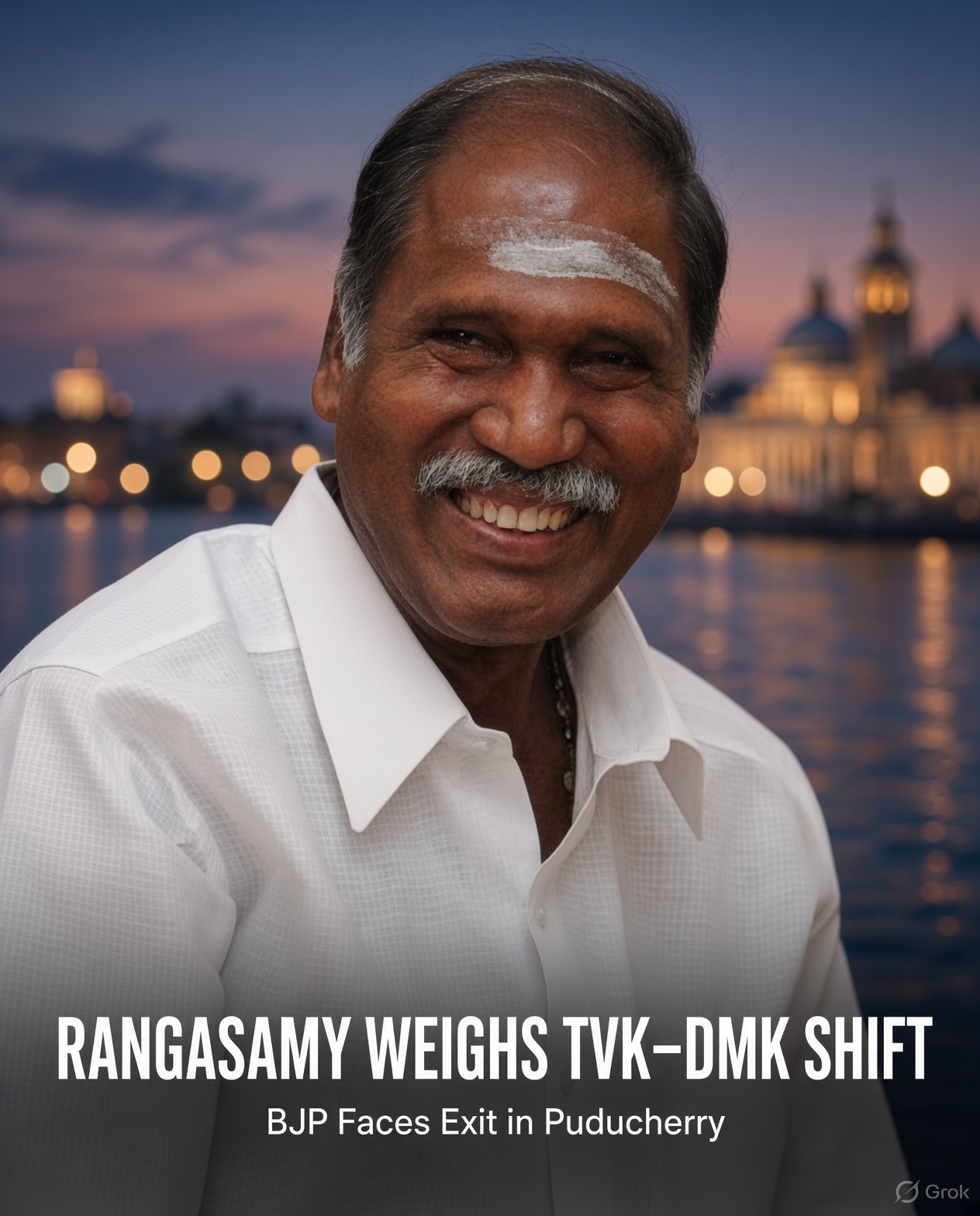
Puducherry: The political weather in Puducherry has turned sharper than the monsoon air. Sources close to Chief Minister N. Rangasamy say he is in discreet talks with the DMK, which holds five Assembly seats, and the Tamilaga Vettri Kazhagam, which holds two, to recast the ministry and drop the Bharatiya Janata Party from the ruling coalition.
On paper, the National Democratic Alliance still has the numbers. The AINRC won 12 of the 30 elected seats in May 2026; the BJP won four; the AIADMK and Latchiya Jananayaga Katchi one each. That combination produced Rangasamy’s fifth government. An understanding with the DMK and the TVK would give him a different majority and push the BJP out of office for the first time since it entered the Union Territory government in 2021.
The grievance, the sources say, is not a single disputed file. It is what they call the BJP’s highhandedness. Rangasamy is described as unhappy with the way he has been treated by the party leadership in New Delhi, by Union Home Minister Amit Shah, and by the state BJP president. Portfolio allocation after the election dragged on for weeks. The Home department, which the BJP insisted on retaining as in the previous term, went to A. Namassivayam only after a prolonged standoff. The Speakership is still unresolved. Insiders say the Chief Minister has concluded that a junior partner is dictating terms to the leader who still commands the largest single bloc in the House.
“The Chief Minister is not prepared to be lectured in his own capital,” a source familiar with the discussions said. “Talks with the DMK and the TVK are preliminary. They are not casual.”
A second fault line runs through the BJP itself. There are rumours that the party has been trying to poach legislators from other parties with lucrative offers. The charge is awkward because it describes the BJP bench. Most of the members now sitting as BJP legislators—elected and nominated—did not grow inside the organisation. They migrated. The Home Minister is the clearest example: a former Congress minister who crossed over in 2021 and now holds the most sensitive charge in a Union Territory government. Others followed the same route. Loyalty acquired once can be acquired again.
“They can shift the moment a better offer appears,” the source said. “That is the risk of a unit built on imports. What surprises workers is that those who built the party are ignored, while the newcomers take the chairs.”
The contrast is sharpest in the case of a woman leader who has worked to grow the BJP in Puducherry for more than fifteen years. She was given neither a ticket in the 2026 Assembly election nor a nominated seat. She was, however, considered reliable enough to be deputed to Kerala and other southern states whenever the party needed a campaigner who would travel, organise and speak without asking for office. Workers recall her on stages far from the Boulevard, carrying the party’s message in states where the BJP already had machinery and where a Puducherry face was useful only as extra labour.
That labour was never repaid. Cabinet lists, organisational posts and even a nominated berth passed her by. The high command that sent her south when votes were required appeared unable to see her when power was shared at home.
“They want her work in Kerala and the other southern states, but not a place for her at the table in Puducherry,” a senior party worker said, speaking on condition of anonymity. “Loyalists are locked out. Migrants get the chairs. Local talent is treated like rented property.”
If Rangasamy does break the alliance, two or three BJP legislators are already being spoken of as possible defectors. In Puducherry’s compact political class, family ties and old associations often cut across party lines. Those bonds, sources say, may prove stronger than the lotus if the Chief Minister decides the coalition is over. The BJP could then be reduced to a rump and forced onto the Opposition benches—a sharp reversal after two terms as a ruling partner.
No office has confirmed the talks. The DMK and the TVK have announced no understanding. The BJP has not answered the charge of highhandedness, or the charge that it rewards defectors while ignoring those who stayed when there was nothing to gain.
If the talks mature, they will do more than rearrange berths. They will show the BJP’s Puducherry experiment for what its own workers already call it: a ministry assembled from late converts, and a cadre that still sends its most loyal woman organiser to Kerala and the southern states when campaign work is required, then shuts her out of tickets, nominations and office when power is shared. A party that poaches MLAs with lucrative offers cannot complain when those MLAs treat loyalty as a bid. A party that ignores fifteen years of ground work cannot claim surprise if the organisation thins out the moment the Chief Minister looks elsewhere. By every account close to him, Rangasamy is already looking.
