


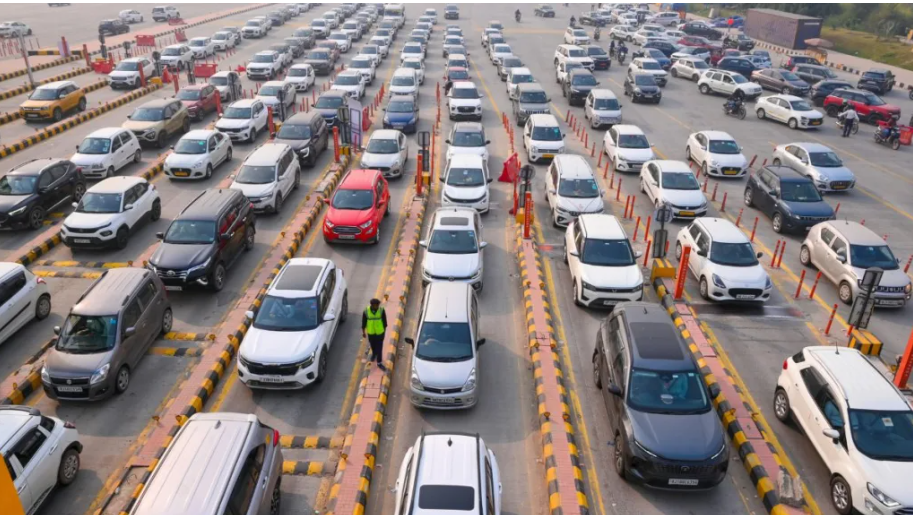
New Delhi: More than 34,000 traffic violations are recorded every hour at just two major junctions in Delhi—Govindpuri and Kotla Mubarakpur, highlighting the urgent need for a shift from conventional accident analysis to proactive road-safety management.
According to a study conducted by the Institute of Road Traffic Education (IRTE), around 26,000 vehicles pass through the Govindpuri junction every hour, resulting in approximately 16,791 traffic violations per hour. At the Kotla Mubarakpur crossing, nearly 24,000 vehicles cross the junction every hour, with around 17,931 violations recorded during the same period.
Sharing the findings, Dr. Rohit Baluja, President, Institute of Road Traffic Education (IRTE), said that the sheer scale of violations demonstrates the need for a more scientific and preventive approach to road safety.

“The increasing number of challans alone cannot address the underlying road-safety problem. There is a need to focus much more strongly on analysing traffic behaviour, near-miss incidents and potential conflict points so that crashes and fatalities can be prevented before they occur. We need to understand what is happening on our roads today and what could happen tomorrow if these risks remain unchecked,” said Dr. Baluja.
Dr. Baluja emphasised that road-safety assessments should not be limited to locations where accidents have already occurred. Instead, traffic authorities and road-safety professionals should systematically identify near misses, unsafe manoeuvres, conflict points and high-risk traffic interactions.
“We need to examine near-miss incidents and determine how many people could potentially lose their lives if the same unsafe conditions continue. A near miss is a warning signal. If we can identify these risks scientifically and intervene early, we can prevent them from becoming fatal crashes,” he said.
According to IRTE, the objective should be to develop a predictive road-safety framework that uses traffic behaviour and conflict analysis to identify high-risk locations before fatalities occur.
The findings from Govindpuri and Kotla Mubarakpur underline the scale of the challenge. With tens of thousands of vehicles passing through these junctions every hour and a very high number of violations being observed, there is a need for engineering interventions, enforcement, behavioural correction, better traffic management and targeted safety training.
IRTE stressed that road safety must increasingly move from a “reactive” model—studying crashes after they happen—to a “proactive” model that identifies and eliminates dangerous conditions before they result in death or serious injury.
The approach assumes greater significance with the rapid growth of powered two-wheeler delivery services, where riders are exposed to complex urban traffic environments and face heightened risks from congestion, time pressure, frequent lane changes, junction conflicts and interactions with other road users.
IRTE called for greater integration of scientific traffic studies, rider training, enforcement, road engineering and near-miss analysis to create safer urban mobility systems and move towards the long-term goal of reducing road fatalities.
