


By Akhilesh Satre, Director and Elevator Personality, Avinyatech Elevators
India’s Viksit Bharat vision has decisively made infrastructure and real estate sector progress a priority. It acts as a primary catalyst for India’s infrastructure development, from highways to energy to digital networks to Tier II and Tier III cities expansion. The growth is highly anchored in real estate development, with buildings touching the sky limit, driven by heavy demand and commercial requirements. As these numbers continue to grow, related industries such as construction equipment, material handling, heavy machinery, import and export, furniture, architecture, and elevators have also seen increased demand. While this reflects the country’s economic momentum, it is equally important to focus on quality control and product efficiency to ensure safety.

For builders, engineers, urban planners, and architects, selecting the right materials and products is one of the most challenging parts of any project. As buildings grow taller, safe vertical transportation becomes increasingly critical. This is no longer only about passenger elevators; it is also about choosing the right vertical transportation solutions, including goods lifts, car elevators, fire evacuation lifts, and home lifts.
Developers, architects, and interior designers often consider an elevator in terms of capacity, speed, aesthetics, price, and delivery timelines. But in today’s vertical buildings, that approach is no longer enough.
A lift is not just a machine that moves people between floors. It is a critical building service with immediate relevance to accessibility, traffic management, emergency response, operational continuity and, in high-rise developments, life-safety planning in general.
So the real question should be: “What should a developer and architect evaluate before selecting a lift system?”
START WITH THE BUILDING, NOT THE ELEVATOR
The first mistake is to select a lift without knowing the building.
Evaluate passenger traffic, building height, occupancy, number of floors, floor-to-floor height, peak traffic patterns, parking levels, service needs and future occupancy.
A residential tower, a commercial office, a hospital and a mixed-use development have very different needs in terms of vertical transportation.
The lift is then to be designed according to the operational profile of the building and not to be chosen from a catalogue. Don’t choose an elevator based on aesthetics or design patterns alone; it is a life-saving system. First, study the requirements, then select one that meets the required safety standards.
CAPACITY AND SPEED ARE JUST THE BEGINNING
Two lifts of equal rated capacity and speed can have widely different performance.
Architects and developers should examine:
· Peak hour traffic carrying capacity
· Travelling and waiting time
· Number and zoning of lifts
· Safety compliance and certificates
· Quality of the material used
· Door opening and closing performance
· Service and maintenance book
· Basement and parking requirements
· Accessibility requirements
· Power saving and consumption
· Availability of spare parts and technical support
· Long-term maintenance capability
The National Building Code of India 2016 specifically addresses the planning, design, installation, operation, maintenance and inspection of lifts, including requirements for high-rise buildings and fire evacuation lifts.
It stresses an important point: “lift selection is a lifecycle decision, not a procurement decision.”
FIRE AND EMERGENCY PERFORMANCE MUST BE CONSIDERED EARLY
In high-rise buildings, the conversation cannot be limited to traditional passenger lifts.
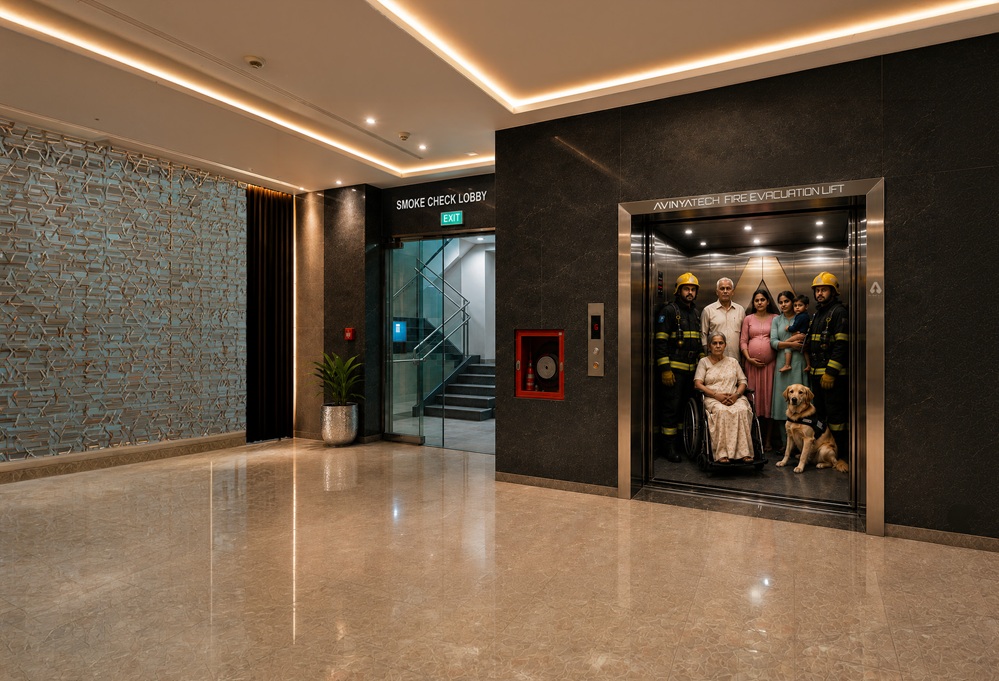
The provisions for Fireman’s lifts (fire evacuation lifts), emergency operation, protected lift lobbies, and communication systems should be addressed as part of the overall fire and life-safety strategy for the building.
The UDCPR of Maharashtra has provisions related to fire lifts, including capacity, emergency operation and communication with the control room of the building. It has special provisions for high-rise buildings too, with mandatory installation of the Fire Evacuation Lift.
Architects therefore need to coordinate lift planning with the fire consultant, structural consultant, MEP team and building-services engineers from the early design phase.
Attempting to accommodate these requirements after the building design is well underway can result in avoidable compromises to shaft dimensions, lobby layouts, machine spaces, electrical infrastructure and emergency access.
DON’T SELECT PURELY ON THE LOWEST QUOTATION
The cheapest lift quote may not be the lowest lifecycle cost.
Developers should evaluate the total cost of ownership.
This includes energy consumption, preventative maintenance, breakdown frequency, replacement parts, software and controller support, easily available parts, availability of trained technicians and expected equipment life.
A cost-saving lift at the time of procurement might turn out to be more expensive for the developer, society or facility manager due to repeated costly downtime.
Therefore, the after-sales ecosystem is as important as the equipment itself.
ASK THE MANUFACTURER DIFFICULT QUESTIONS
Before settling for a lift supplier, builders and architects should ask questions beyond brochures.
1. What standards is the equipment compliant with?
2. Do they have all certification needed for the installation?
3. Where are the main components produced?
4. Are replacement parts available easily?
5. What is the usual response time for breakdowns?
6. What are the emergency communications?
7. When there is a power outage, what happens?
8. How does the system integrate with the building’s emergency systems?
9. Does it include an Annual Maintenance Contract?
10. Who will provide technical support five or ten years after installation?
These questions reveal the difference between selling an elevator and supporting a vertical-transportation system.
INTEGRATION IS THE FUTURE OF ELEVATOR SELECTION
Modern lifts are increasingly interfacing with building-management systems, access control, fire alarms, emergency power and digital monitoring platforms.
That means architects need to consider lifts as part of the building’s bigger technology and safety ecosystem.
But technology should be an adjunct to, not a substitute for, engineering fundamentals, statutory compliance, proper installation and disciplined maintenance.
THE RIGHT ELEVATOR IS THE ONE THAT REMAINS DEPENDABLE
That said, the most important lift specification is one you won’t find in a glossy brochure: reliability under real-world operating conditions.
Builders and architects should therefore assess suppliers on five dimensions: safety, engineering capability, performance, lifecycle support and accountability.
The right lift partner understands what happens when the building is crowded, when power fails, when a key component needs replacement or when an emergency requires a coordinated response.
Vertical buildings are becoming taller, more complex and more technology-driven. Elevator selection must evolve accordingly.
The future of buying lifts is not about asking “Which lift is cheaper?”
It is about asking: “What vertical-transportation system will provide this building the safest, most reliable and sustainable performance over the entire course of its lifecycle?”
Akhilesh Satre is Director and Elevator Personality, Avinyatech Elevators
