

Chandigarh Cab Restrictions Leave Drivers Without Earnings, Commuters With Just One Option, Raising Concerns about Monopoly

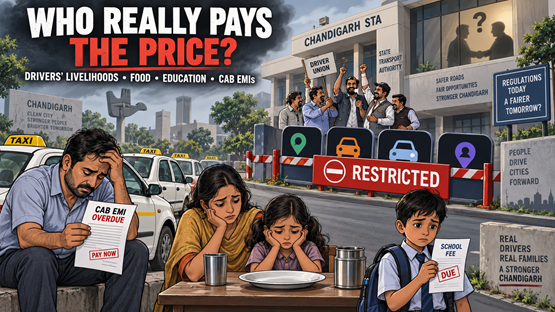
Chandigarh: With major private ride-hailing platforms currently facing restrictions in Chandigarh, thousands of drivers and commuters are dealing with the consequences. But the situation raises an even bigger question: is Chandigarh effectively moving towards a monopoly in ride-hailing, with only one major platform allowed to operate while private competitors remain restricted?
The city’s mobility landscape has changed significantly. Several established private ride-hailing platforms are unable to facilitate rides, while government-backed Bharat Taxi continues to operate. This has left commuters with fewer choices, drivers with fewer earning opportunities and the market increasingly dependent on a single ride-hailing option.
Drivers bear the immediate cost
For many drivers, ride-hailing is their primary source of income. Restrictions on multiple platforms mean fewer opportunities to earn, while vehicle EMIs, fuel, maintenance, insurance and household expenses continue.
The impact extends to their families. Every additional day without regular rides adds financial pressure. Drivers are also losing something fundamental to the platform economy, the freedom to choose where they work and which platform offers them the best earning opportunity.
Chandigarh commuters are losing choice
Ride-hailing apps are now an important part of everyday mobility across the Chandigarh-Mohali-Panchkula Tricity.
From office and college commutes to hospital visits, railway station and airport transfers, late-evening journeys and first- and last-mile connectivity, residents depend on on-demand mobility throughout the day.
Multiple platforms allow passengers to compare fares, availability and waiting times. When several competitors disappear and commuters are left increasingly dependent on one platform, that choice disappears too.
Is Chandigarh creating a ride-hailing monopoly?
The situation becomes particularly significant because private ride-hailing operators remain restricted over regulatory and fare-related requirements, while Bharat Taxi continues to operate despite questions around whether its pricing structure meets the same prescribed fare requirements.
If comparable regulatory concerns exist, why is one platform able to continue operating while its private competitors remain restricted?
The result risks creating an effective monopoly for a single ride-hailing service in Chandigarh, a situation that deserves scrutiny in a market where competition has traditionally given both passengers and drivers multiple choices.
A monopoly or near-monopoly is not healthy for a dynamic market like India, particularly for a modern and future-focused city like Chandigarh. Healthy competition pushes operators to improve service quality, availability, pricing, safety and technology.
Most importantly, no commuter should be forced to depend on a single platform simply because competing choices are unavailable.
Chandigarh needs competition as well as regulation
Regulation is essential, and every mobility operator should comply with applicable rules. But those rules should be transparent and consistently applied across the market.
A timely resolution is now important not merely for ride-hailing companies, but for the drivers whose incomes have been disrupted and Chandigarh residents whose everyday mobility choices have narrowed.
