

In an era of AI where everything is automated, how can companies remain people-centric?

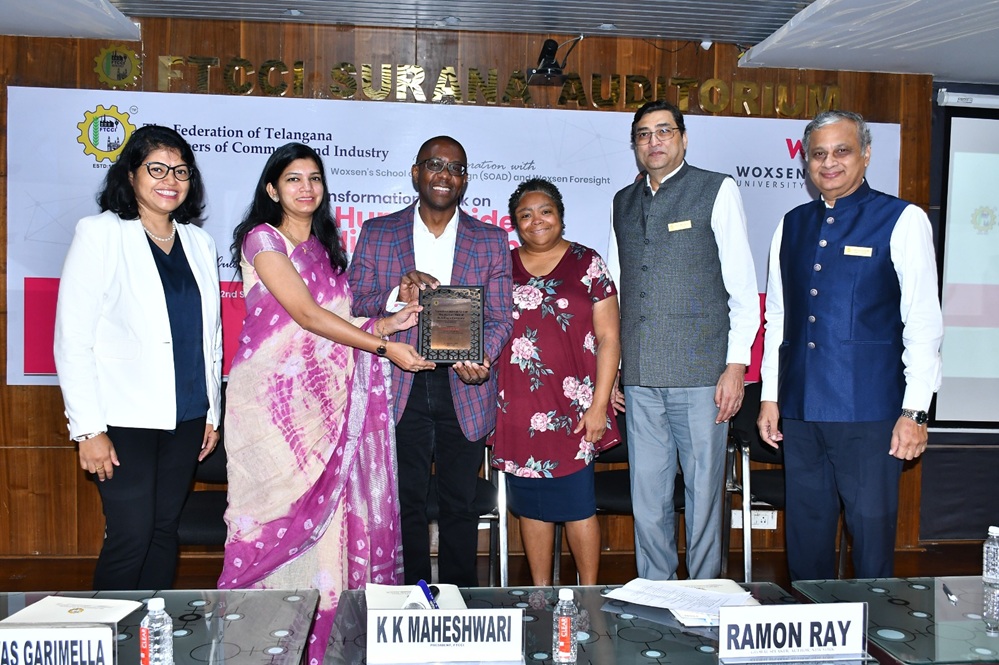
Hyderabad: Technology can help businesses move faster, operate efficiently and serve millions of customers, but culture determines whether employees, customers and partners feel respected, trusted and valued, said Mr. Ramon Ray, Global Keynote Speaker, 5x Entrepreneur and Author, New York, while addressing a transformational talk on “The Human Side of Building a Company – Culture, Resilience, and Human-Centred Growth in the Age of AI” organised by the Federation of Telangana Chambers of Commerce and Industry (FTCCI) in collaboration with Woxsen’s School of Arts & Design (SOAD) and Woxsen Foresight, at Federation House, Hyderabad, on Tuesday.
Ramon Ray said that while companies own assets such as buildings, technology, systems, processes and intellectual property, people activate every one of those assets. “A company is fundamentally a system of human relationships,” he emphasised, pointing out that employees, customers, suppliers, partners and leaders are all people.
Drawing on his 25 years of entrepreneurial experience, he said businesses need to move beyond the traditional question of whether they want to be the cheapest or fastest and ask whether they are creating an experience that people remember.
Using examples from companies including United Airlines, Ritz-Carlton, Microsoft, Zappos, Chick-fil-A, Zoho, Keap/Infusionsoft and Savannah Bananas, Ramon Ray demonstrated how seemingly simple acts of appreciation, empowerment, empathy and personal connection can become powerful elements of organisational culture.
“Technology builds capacity. Culture builds trust,” he said, explaining that technology can enable speed, scale, consistency, personalisation and routine transactions, while human interaction remains particularly important for emotion, complexity, vulnerability, judgement and important decisions.
He described culture as “how people behave when the leader is not in the room”, adding that culture is shaped by what leaders repeatedly model, reward, tolerate and correct.
Referring to Microsoft and Satya Nadella’s leadership transformation, Ray said the company’s transformation was not merely about adopting new technologies. It also involved changing how people thought, learned and worked together.
The shift from “Know-it-Alls to Learn-it-Alls”, greater collaboration, empathy and customer focus, he said, illustrated how cultural transformation can complement technological transformation.
He also highlighted the Ritz-Carlton approach of empowering frontline employees to resolve customer problems, saying that culture becomes powerful when employees are trusted to act.
Human-centric does not mean compromising performance
Ray clarified that being human-centric does not mean accepting poor performance, avoiding difficult decisions, eliminating automation or trying to make every customer happy.
“It means treating people with dignity, clarity and care, even when the answer is no,” he said.
He urged organisations to examine both their internal and external practices—whether employees feel seen, heard, trusted and appreciated, and whether customers can reach a human being when a human conversation is genuinely required.
