

When the Cradle Becomes a Quarry: An Artist’s Cry for Bharatapuzha, the Nila of Malabar

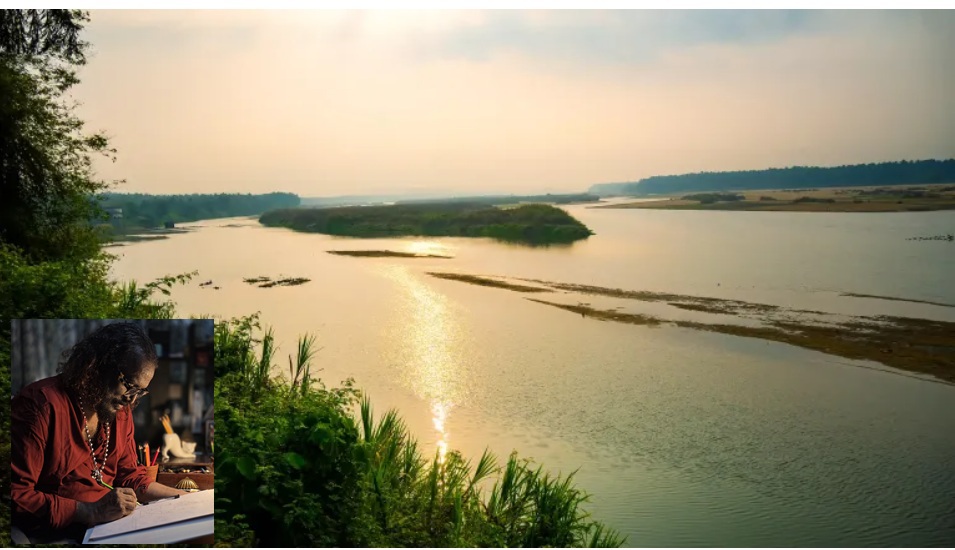
By Artist Nandan Pillai
I have stood on riverbeds that once were rivers. I have stood on the Nila when She was no longer water but a memory of water—sand, scrub, a thin silver thread pretending to be a stream, and the ghost of a current that once taught a people how to speak, how to pray, how to dance, and how to remember their dead.
An artist who loves nature does not look at a dying river as a “resource problem.” He looks at it as a ruined manuscript. Pages torn out. Ink faded. The hand that wrote the culture of Keralam-Malabar still visible in the margin, while the body of the book is being sold by the lorry-load.
I have loved Her the way one loves a mother who is still breathing but can no longer lift her head. Bharatapuzha—Nila, Perar, Ponnaniyar, the Dakshina Ganga of the south—is not merely Kerala’s second-longest river. She is the cultural cradle of Malabar. From the Anamalai hills She comes, crossing the Palakkad Gap, and after two hundred and nine kilometres She meets the Arabian Sea at Ponnani. Geography is only Her skeleton. Her flesh is story, ritual, metre, mudra, and the long patience of paddy.
She is older than our names for Her. The name Bharatapuzha itself is a civilisational claim: the river of Bharata, tying a west-flowing Kerala stream to the larger memory of the land. Some literary tradition even hears the word Nila in the Bhishma Parva of the Mahabharata; others hear the blue of the Nilgiris in Her name. Either way, She is not a modern invention. In older records She is Perar.
On Her banks the land remembers Parashurama, the axe-bearing Rama of the Bhargava line, who in Kerala’s founding myth drew this coast from the sea and settled it with gramas and temples. Local tradition holds that at Tapasunnur—today’s Thavannur, near Thirunavaya—a great yaga was performed at Parashurama’s asking, with Brahma as the ritual presence, for the welfare of the world. The Magha month, when sacred rivers are said to converge in Perar, became the season of Mahamagha. From that yaga-memory grew Mamankam. An artist does not need a carbon date to know that a people have washed their dead and their living in the same water for longer than any ministry has existed.
The Ramayana entered Malayalam on these banks through Ezhuthachan. Thirunavaya stands as Dakshina Kashi, where pitrukarma and tharpanam are performed through the year. If the Ganga is the north’s great washer of sins, Nila has long been papa nashini for this coast. The grammar of remembrance here is a river grammar.
At Thirunavaya the Mamankam was staged every twelve years on Her sandbed. Under the Zamorins it became a theatre of sovereignty and suicide-valour. The chaver warriors of Valluvanad crossed the river to challenge the Rakshapurusha. Bodies went into the Manikkinar. The river watched piety and power on the same sand. That sand is now a commodity. That is the obscenity.
If one were asked to draw the map of Malayalam with a single line of water, that line would be Nila. Ezhuthachan, Poonthanam, Melpathur and Kunchan Nambiar belong to this basin. Vallathol planted Kerala Kalamandalam at Cheruthuruthy on Her shore, so that Kathakali and Koodiyattam would drink from the same water that had nourished the language. When a river that fed those arts is reduced to a quarry, the eye of Chakyar is asked to look upon a desert and call it sacred.
Then came the modern masters who made Nila a character, not a backdrop. Edasseri already suspected what “development” would do to Her soul. M.T. Vasudevan Nair, born at Kudallur on Her banks, said he loved his Nila more than the great oceans. In his fiction the wide water of boyhood shrinks to a trickle among dunes, because sand had been stolen from under the story. He wrote a requiem while the river was still officially alive. That is what artists do. They hear the death-rattle before the certificate is issued.
Ponnani, where Nila becomes estuary, held Arabi-Malayalam and the Ponnani Kalari of writers. A river that could nurse both Ezhuthachan’s kilippattu and the Mappila song is a commons. Her dying should shame every community that drinks from Her name.
Speak without metaphor for a moment, because metaphor has become an alibi.
For three decades and more, incessant sand extraction has peeled the river of Her bed. Sand is the river’s slow memory: the aquifer’s sponge, the fish’s shade, the well’s secret ally. When the sand goes, wells collapse into drought. Banks crumble. The channel becomes stagnant pools in summer and a violent, rootless flood in monsoon. After 2018, the sand bed near Kuttippuram had dropped by metres. Shrubs stand in the middle of what was once the stream. A river that grows trees in Her own throat is being strangled with Her own silence.
Dams and regulators were raised in the name of agriculture and drinking water. Some of that need is real. Nearly half a million hectares lean on Her. But a river is not a tank. When every upstream thirst stops the flow, the downstream river becomes a rumour. In January and February, Nila is often a sequence of puddles connected by courtesy. Then we invite thousands to bathe in those puddles and call it holiness.
Pollution completes the insult. Untreated sewage, hospital waste, household refuse, ashes and offerings—Thirunavaya has been flagged as a pollution hotspot. A sacred river that cannot dissolve what is thrown into Her is no longer a tirtha. She is a drain with a Sanskrit name.
And still the lorries come. Agriculture needs water; construction needs sand; ritual needs a ghat; politics needs a festival. The river is asked to supply all four and receive none of the care any of those interests would give their own house.
This is the part that should burn.
Where are the organisers of Mahamagha when the water they glorify cannot breathe? A festival on a dying river without a restoration protocol is not revival. It is costume. Where are the mutts and sanyasis who flourish in the name of dharma? Dharma that will not defend the tirtha is recitation, not religion. A pundit who recites Dakshina Ganga and cannot speak one hard sentence against sand mafia and sewage is a custodian of words, not of the world those words describe.
Some have worked. Honour them. They are still a minority against eloquent indifference. We have written Nila into novels, filmed Her into nostalgia, danced Her into brochures, and then gone home. The river cannot eat a poem. Hope without a mission is another kind of sand mining: it extracts feeling and leaves the bed empty.
Why is there no mission equal to Her stature? Because each interest takes a piece. No one is paid to want the whole river. A man will do tharpanam for his father and vote for the contractor who stole the bed on which the tharpanam was done. A living river is slow politics. A festival is fast politics.
A mission to retrieve Nila would be a long obedience. Stop illegal and excessive sand mining; bind royalty to restoration. Treat sewage before it reaches the ghats. Re-examine regulators so agriculture is served without assassinating summer flow. Afforest the banks as a twenty-year covenant. Restore tributaries. Create a statutory Nila Conservancy with teeth.
If Nila is papa nashini, then to kill Her is papa. Let every Mahamagha and Karkidaka Vavu carry a restoration tithe. Let the artist refuse to romanticise a corpse. Write the river, yes—but also stand in the panchayat, in the court, on the kadavu at dawn.
No one who loves Her is asking for a museum of 1942. The “original Nila” is a river that still behaves like a river: sand in Her bed, fish in Her pools, wells that answer the bucket, and a culture that spends as much intelligence on Her life as it has spent on Her legends.
Retrieve Her glory and you retrieve Malayalam’s metaphor, the honesty of tharpanam, and a child’s right to see a river that is not a construction site.
I am only an artist. I have no battalion and no ministry. I have a debt that will not let me sleep. Every sentence I have ever trusted in this language was washed, somewhere upstream, in water that came through Palakkad’s gap and past Cheruthuruthy’s lamps and Thirunavaya’s steps. She held my childhood before I had words for Her. To watch Her fail, and to keep writing as if the failure were only weather, would be a blasphemy no temple can wash.
I have seen Her summer bed and felt as if I were standing inside a desecrated shrine—the sanctum still named, the presence gone, the steps leading down to absence. I have heard the lorries at night and felt them as a theft from the throat of a living being. If She dies in our time, we will not merely lose a river. We will lose the first audience of our civilisation—the water that carried Parashurama’s coast-myth and the older echo some still hear in the Mahabharata. A people that cannot keep its audience alive will soon find that its own voice has nowhere to go—only sand, only names, only festivals performed upon a grave.
Let the pundits speak one practical word before they speak another verse. Let the festival become a vow to Her, not a performance upon Her. Let the writers who took Her name take Her side. Let there be a mission, not another seminar. Stand at the kadavu at dawn. Look at what remains. If your heart does not break, you have not loved Her. If it breaks and you still do nothing, you have loved only the idea of Her.
The river is still there—thin, insulted, waiting, like a wounded woman who has not yet closed Her eyes. That is the only mercy left. Mercy expires. After that there will be only the name, and the name without water is a lie we will leave to our children. I cannot bear that lie. Neither should you.
Edited By Suresh Unnithan
