


Kerala’s anti-drug storm fills lock-ups and front pages. The Karachi–Makran network that feeds the coast is barely named.
By Suresh Unnithan
Operation Toofan was launched on 2 June 2026 as weather that would change the map. Senior officers were posted. Seizures were paraded. Four months later the Home Minister could recite a ledger that looks like victory: more than 11,700 cases, over 12,500 arrests, some 24 kilograms of MDMA, 1,572 kilograms of ganja, besides hashish oil and heroin. A second phase opened on 28 September with the claim that abuse and peddling had fallen by a fifth to a third. The celebration is loud. The result is thin. A storm that books the last mile and leaves the organiser untouched is not a hunt. It is a harvest of small fish.
Who is in the net is the first fraud. The daily catch is the retailer, the migrant courier, the boy with a half-burnt beedi, the schoolgirl sent to Thalassery because a uniform draws less suspicion than a grown man. In Kochi, monthly NDPS registrations rose from a few hundred to more than five hundred after the drive began—proof of activity, not of demolition. From Ernakulam the street report is harsher: suppliers now promise lawyers and bail; peddlers return within days; the market only goes quieter, with rotating phones and micro-drops. Financiers stay a district away. Assets bought with narcotics money are still being “examined.” Efficiency at the bottom of the pyramid is inventory, not strategy.
The children make the fraud visible. Excise cases against minors rose from 23 in 2021 to 55 in 2024; the first two months of 2025 alone produced 36. Some 170 minors have been caught since 2022 in smuggling or trading. A father in Tiruvalla used his twelve-year-old as a delivery boy. Till August 2025, Excise had arrested 312 students; of 18 seizures inside campuses that year, 13 were in Ernakulam. At Vimukthi centres, minors seeking help numbered 681 in 2021 and 2,880 in 2024; 588 arrived in January–February 2025. An Excise survey found nine per cent had tried drugs before ten and seventy per cent by fifteen. Since 2021, eighty-six minors have been “convicted” in excise NDPS cases—almost all guilty—yet the Juvenile Justice Act turns the sentence into counselling and a fine that can be four thousand rupees. The adult who sent the child is the person the statute meant to reach. He is the person least often produced.
The 2023 Azhiyoor case is the template the State treats as an episode. A Class VIII Student Police Cadet was given laced biscuits, then MDMA, then taken with other girls to Thalassery and Mahe as a carrier. Marks were put on her toe. Her mother sought a CBI inquiry in the High Court. The corridor did not close.
Kerala did not invent the market. Police NDPS cases exploded from 4,968 in 2020 and 5,695 in 2021 to 26,619 in 2022, 30,697 in 2023, 27,530 in 2024 and 36,314 in 2025. Adult conviction rates stay above 96 per cent because the system is excellent at the receipt, not at the factory.
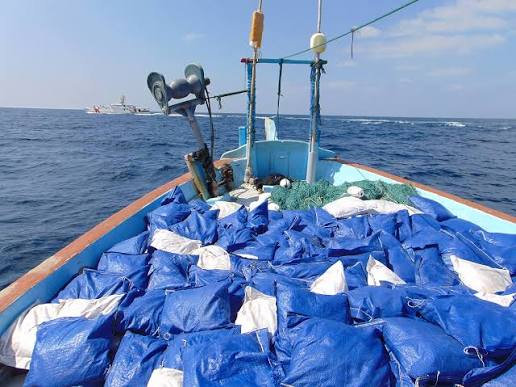
The factory is the Golden Crescent—Afghanistan, Iran and Pakistan—and the conveyor is the Southern Route to the Makran coast, then the Arabian Sea. The Taliban’s 2022 ban cut recorded Afghan poppy from about 232,000 hectares to roughly 10,200 by 2025. The pipeline did not die. Pre-ban stocks of some 12,000–13,200 tonnes have fed heroin into 2026. Cultivation walked into Balochistan—more than 9,000 hectares identified in 2025—and Iran’s Sistan-Baluchestan. Methamphetamine scaled in the same belt. UNODC listed Afghanistan as Asia’s leading reported departure country for seized meth in 2021–24. On 25 September 2026, the Coast Guard and Gujarat ATS boarded an Iranian dhow west of Lakshadweep and took 526 kilograms of heroin and methamphetamine, with a Pakistani crew. That load was not born in a Kozhikode hostel.
Indian agencies have, across charge-sheets and briefings, placed Haji Salim—also rendered Shaikh Kaneghi—at the centre of a large share of this eastern sea fan. A Balochistan-and-Karachi organiser, last placed by intelligence around Karachi and Turbat, with a brother and brother-in-law named in the same web, he is described as the man who buys Afghan supply, runs processing in the Baloch hinterland, and puts commercial quantity on the water from the Gwadar–Pasni–Jiwani rim. Officers have said his consignments have moved under marks such as 555 and 999; that motherships wait in international waters; that smaller craft from India, Sri Lanka and the Maldives close the last stretch on a code. The May 2023 interception off Kochi of more than 2,500 kilograms of high-purity methamphetamine was attributed to that architecture. The March 2021 Vizhinjam haul of heroin and rifles pointed investigators toward the same Karachi–Colombo geometry, later an NIA file. Briefings have also tied the network to older D-Company logistics and to attempts to move both narcotics and arms toward the Palk and the south-west coast. These are allegations for the courts. The pattern they describe is not in dispute: the big ticket does not live in a police-station lock-up.
When pressure rose off Gujarat and Kochi, later reporting said the same cartel thinned the load and probed quieter water—Kasargod, Malappuram, Kochi rural, the Palk belt. That is adaptation by a named network, not the defeat Toofan claims.
Kerala’s 590-kilometre shore is the ramp. Sri Lanka is the warehouse next door. Officials have said 60 to 70 per cent of illicit drugs still enter India by sea. Toofan invited the Coast Guard and the NCB to meetings. Invitation is not a doctrine. A campaign that photographs MDMA on a parade ground will not see a transfer twelve nautical miles out.
Name the organiser. Follow the money. Attach the boat and the bungalow. Measure success by landings disrupted, not by children processed. Until Haji Salim’s sea is treated as the case—and not the courier in Thalassery—Toofan will remain what it has become: a storm of paper, and a breeze where it matters.
