


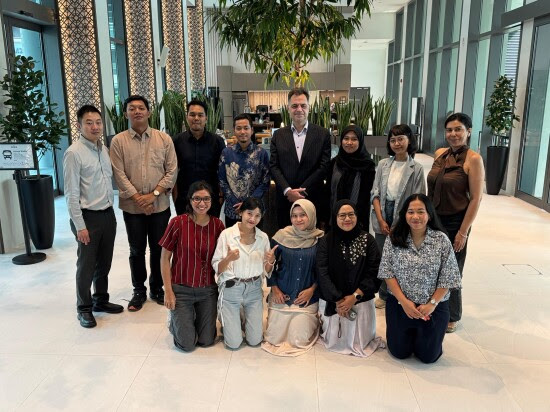
Singapore : As businesses across Indonesia and Southeast Asia accelerate their use of artificial intelligence (AI), NUS Business School is exploring a different question: as AI gets better at providing answers, how can leaders get better at asking questions?
For more than a century, case-based learning has put students in the shoes of business leaders by giving information they need to analyse a problem, and then ask them how they would solve it.
Now, artificial intelligence (AI) is changing what it means to solve a case. Since January 2026, NUS Business School has been piloting an AI-enabled approach in which students are given an AI-simulated problem where they must determine what information they need, decide whom to ask, evaluate the answers they receive and make a recommendation under uncertainty.
The simulation is built on ScholAIstic, a generative AI platform developed by the NUS AI Centre for Educational Technologies (AICET) to support roleplaying and simulation-based learning.
Dr Emir Hrnjić, a Senior Lecturer in Finance at NUS Business School, has been working with AICET to adapt and refine these capabilities for management education, developing executive personas around the business case.
To date, the tool has now been used by close to 100 MBA and Executive MBA students across Singapore and Jakarta, many of whom are senior executives.
Sharpening the human instinct behind good decisions
In the pilot, students interview AI-simulated executives, including a Chief Executive Officer, Chief Financial Officer and Chief Product and Technology Officer, each offering a different perspective to the same business situation. Students must navigate these perspectives, assess the information they gather and reach their own conclusions.
After each interview, students receive personalised feedback on on their questioning, allowing them to reflect and adapt their approach in subsequent interviews.
Dr Hrnjić said: “Students must decide what they need to know, ask the right questions, challenge what they hear and exercise judgement without having the complete picture. The aim is not to replace that human instinct with AI, but to sharpen in by helping students become more discerning about what to ask and trust. That is much closer to how leaders make decisions in the real world.”
Early findings suggest that effective use of AI is not about asking more questions but about asking the right ones. Analysis of interview transcripts showed found that stronger interviews had more targeted questions, follow-ups and adaptation as new information emerged, rather than simply working through a prepared list.
The findings point to a broader role for generative AI in management education. Rather than using AI primarily to search for information or generate answers, the technology can recreate the real-world scenarios, sharpening executives’ judgement to better navigate uncertainty and competing perspectives they face in real organisations.
NUS Business School sees potential for similar AI-simulated tools to be applied to other areas of business education where students need to question stakeholders, negotiate competing interests and make decisions under uncertainty. The ambition is to move beyond the largely static information environment of the traditional case towards a dynamic one where students actively acquire information, pursue emerging lines of inquiry, challenge assumptions and exercise judgement as the problem unfolds.
The simulation is one part of NUS Business School’s broader approach to integrating AI into education. The school is exploring how AI can enhance, rather than replace, meaningful learning, thereby helping students develop the judgement, critical thinking and adaptability needed to navigate an increasingly AI-enabled workplace.
This becomes increasingly important as AI takes on a greater role in business. Companies across Asia, including Indonesia, are rapidly adopting AI across their operations, making the ability to question and assess AI-generated information an increasingly important leadership skill. For Indonesia, the economic stakes are significant. A 2020 study by Kearney and EDBI projected that AI could contribute US$366 billion to the country’s GDP by 2030, equivalent to 12 per cent of projected GDP.
