


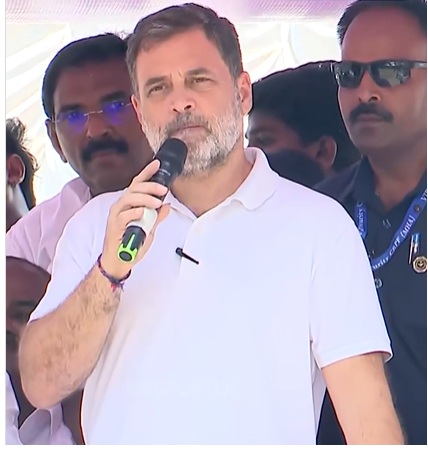
New Delhi: At Indira Bhawan on Monday, Rahul Gandhi did not merely allege vote theft. He framed the heavy police presence across Delhi as evidence that the Modi government was shielding Chief Election Commissioner Gyanesh Kumar. Addressing the media, the Leader of Opposition said a resistance that had been building for years had finally crystallised into an open movement, and that the capital’s conversion into a police fortress was, in his view, a strategic error by the government.
“Why is Delhi jailed?” he asked, pointing to stopped trains, halted buses and people being prevented from entering the city. He claimed between 20,000 and 30,000 police personnel had been deployed. Far from seeing this as a setback, Gandhi said the Opposition wanted the force visible on the streets. “The more they protect Gyanesh Kumar,” he argued, “the closer we get to their controller.”
He also claimed that sections of the police itself were uneasy. According to Gandhi, personnel in the Delhi Police, CRPF and ITBP were questioning why they were being ordered to stop “patriotic youth” while, he alleged, RSS workers moved freely. He went further, asserting that roughly half the force had privately indicated support for the Opposition’s position. Video clips were screened showing journalists under restriction, women protesters being handled roughly, and demonstrators being bundled into police vehicles—images Gandhi linked directly to the demand that Gyanesh Kumar resign, a demand he said had also been raised by two Election Commissioners.
Addressing the Chief Election Commissioner by name, Gandhi delivered a blunt warning: the Commission knew the questions being asked about Kumar’s past and conduct, and those questions would not stop. “You will not survive as an Election Commissioner,” he said.
He described successive attempts by Opposition leaders to hold peaceful protests—at the Election Commission office, at Jantar Mantar, and at Rajghat—as having been blocked with force. The next step, he said, was the Supreme Court. Congress President Mallikarjun Kharge and he had written to the Chief Justice of India expressing concern over the “murder of Indian democracy and election fairness.” Gandhi claimed the Chief Justice had directed them to file a formal petition, which INDIA Bloc leaders would now do jointly.
Throughout the briefing, Gandhi insisted the agitation was not a one-day event but an open-ended resistance. “Patience and perseverance,” he repeated. He claimed that around 200 officers across agencies including the Enforcement Directorate, CBI and the Ministry of External Affairs were already in contact and sharing information. Until the Constitution was upheld, the Election Commissioner removed, the election system overhauled and justice delivered, he said, India’s youth would not stop. “Five criminals will face justice.”
He ended by inviting people of all parties and backgrounds to join the “Chalo Delhi, March for Democracy”, describing the fight as one for the Constitution rather than a personal contest between himself and the Prime Minister.
