


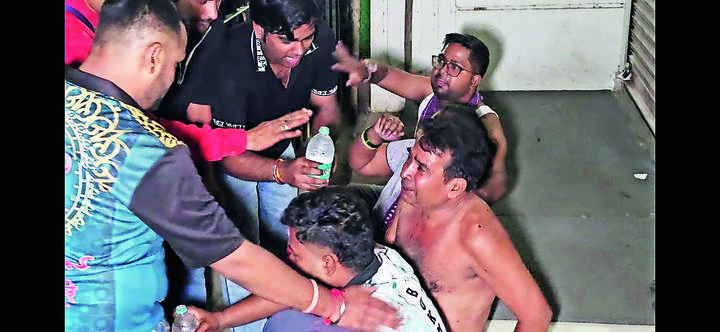
NALASOPARA: The fire at the 14-storey Imperial Heritage building in Achole, Nalasopara East, has brought the challenges of high-rise firefighting, building safety compliance and evacuation infrastructure into sharp focus. Two women died, and six people were injured in the blaze, while firefighters rescued more than 25 residents, including four family members who were stranded on a narrow ledge after escaping the flames and smoke.
Speaking about the incident, Vasai-Virar City Municipal Corporation (VVMC) Chief Fire Officer Rohan More said the fire brigade responded promptly, but the initial emergency call did not convey the full extent of the situation.
“The first call was received at 12.10 am, but we were not informed that people were stranded on the ninth, 11th and 14th floors. We were initially told that the fire was on the lower floors. Accordingly, we immediately dispatched a fire engine, which reached the spot in nearly three minutes. Once our first team assessed the situation, we mobilised every possible resource, including a turntable ladder (TTL), for rescue operations,” More said.
He added that he was personally present at the site and highlighted the dedication of the firefighting personnel, including two off-duty employees who voluntarily reported for duty to assist in the rescue operation.
More said the fire brigade’s first principle is to save lives and prevent casualties. Accordingly, the team prioritised the evacuation of residents while firefighting operations continued simultaneously from inside the building.
Fire towers and dedicated lifts essential in high-rises
More said that misconceptions about firefighting operations and equipment had contributed to questions about the department’s response. Explaining the functioning of fire engines, he said the water-delivery system has different modes, including spray and jet functions. The initial use of the spray function was reportedly mistaken by some onlookers for a failure of the water supply. The jet function was subsequently deployed to intensify firefighting operations.
He also said that a temporary electricity connection for a Navratri pandal outside the building, reportedly drawn directly from the meter box, was a possible contributing factor in the incident. Electrical overloading, multiple wiring connections and improperly installed power supplies can increase fire risks. However, the exact cause of the blaze remains subject to investigation.
Emphasising the importance of fire safety infrastructure, More said high-rise buildings must incorporate the fire tower concept, fireman evacuation lifts and dedicated fire lifts in accordance with applicable development regulations and fire department requirements.
He stressed that these facilities must not exist merely to fulfil compliance requirements but must be adequately designed, properly maintained and operational during emergencies. We are issuing the Fire NOC if the building has a Fire Tower design in the plan.
VVMC to initiate action against non-functional firefighting systems
The incident has raised concerns about the maintenance of fire safety installations, with residents alleging that systems such as sprinklers, fire extinguishers and firefighting pipelines were not operational during the emergency.
More said obtaining a Fire NOC does not absolve builders and housing societies of their responsibility to maintain these installations.
“After receiving the Fire NOC, it is the responsibility of the society and builder to ensure that the firefighting systems remain functional. Form B, certifying the maintenance of these systems through an authorised agency, must be submitted every six months. Wherever non-compliance is found, we are initiating action,” he said.
Fire ladders have limitations in high-rise rescue operations
More also highlighted the limitations of aerial rescue equipment, stating that the maximum ladder height available to fire services is approximately 90 metres. According to him, the maximum ladder height available to fire services across the nation is around 90 metres. Meaning, rescuing occupants or extinguishing fires on floors beyond the effective reach of a ladder can become extremely difficult. The department must assess the location of the fire, access conditions, smoke spread and the safety of both occupants and firefighters before deciding on its response.
The Imperial Heritage incident highlighted these challenges when four members of a family reportedly used sarees and clothes to descend from an upper floor before taking refuge on a narrow ledge. They were subsequently rescued by firefighters.
More said the fire was brought under control at around 3.30 am. However, he explained that bringing a fire under control does not mean the entire operation is complete, as search and rescue, cooling operations and police investigation may require additional time.
The question it left was: How can firefighters safely enter a burning building, reach the affected floors, and extinguish the fire before it spreads, while simultaneously ensuring the safe evacuation of occupants in high-rises?
****
