

Padma Bhushan Uma Sharma revisits the devotional roots of Kathak with ‘Maharaas Leela’

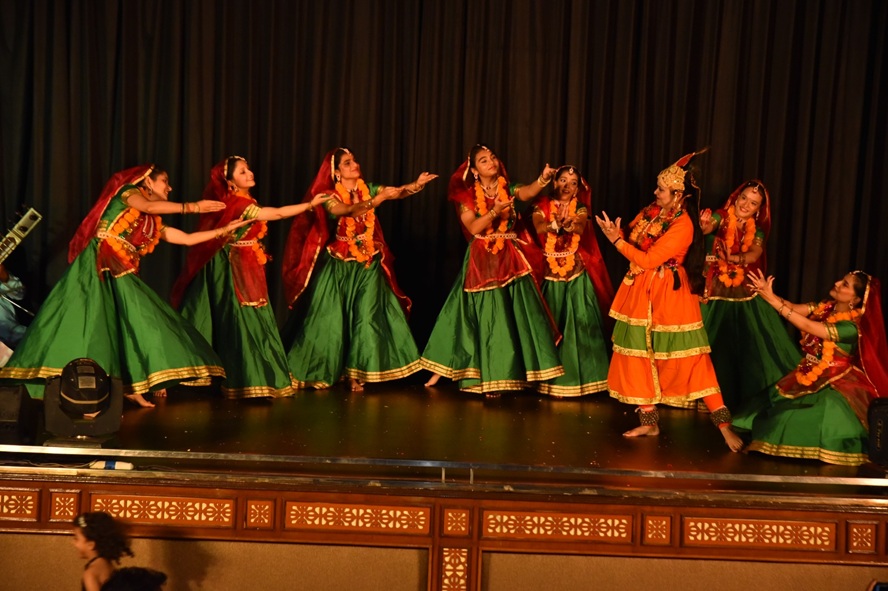
India : The dance ballet draws from the traditional Raas of Brindavan and the Shreemad Bhagavat to explore Krishna’s relationship with the gopis through Kathak
The story of Krishna and the gopis, interpreted through the vocabulary of Kathak, forms the basis of Maharaas Leela, a dance ballet conceptualised and choreographed by Padma Bhushan awardee and Kathak exponent Dr. Uma Sharma.
Drawing upon the traditional Raas of Brindavan, the production brings together classical Kathak, narrative traditions and devotional poetry to explore the idea of bhakti and the relationship between the individual soul and the divine.
Based on the 10th chapter of the Shreemad Bhagavat, Maharaas Leela begins on a full-moon night, when the sound of Krishna’s flute draws the gopis away from their everyday lives. Their delight at being in Krishna’s presence gradually turns into a sense of pride. Krishna then disappears, taking Radha with him, leaving the gopis to confront the pain of separation.
As they search for him, the gopis recall and recreate episodes associated with Krishna’s life. The ballet moves through familiar narratives such as Makhanchor Leela, the slaying of Putana, the lifting of Govardhan Parvat and Krishna’s subjugation of Kaliya.
The separation, however, is not merely dramatic. It becomes central to the spiritual idea underlying the production. When Krishna returns, his disappearance is understood as a means of deepening the gopis’ devotion and dissolving their sense of self.
The ballet culminates in the Maharaas, with Krishna assuming multiple forms so that each gopi experiences his presence beside her. The image of Krishna dancing simultaneously with every gopi transforms the Raas from a tale of earthly love into an expression of the relationship between the jivatma and paramatma.
Sharma’s engagement with Maharaas goes back several decades and was encouraged by the late cultural activist Kamaladevi Chattopadhyay. Her research into the subject has also informed her attempt to trace Kathak to its narrative and devotional traditions.
Through Maharaas Leela, Sharma revisits this spiritual dimension of Kathak, allowing movement, poetry and storytelling to come together in an interpretation of love, longing and surrender.
****
