

Bhagwat’s Centenary Vijayadashami Address: Regime Change Won’t Work in India; RSS Flags External Designs

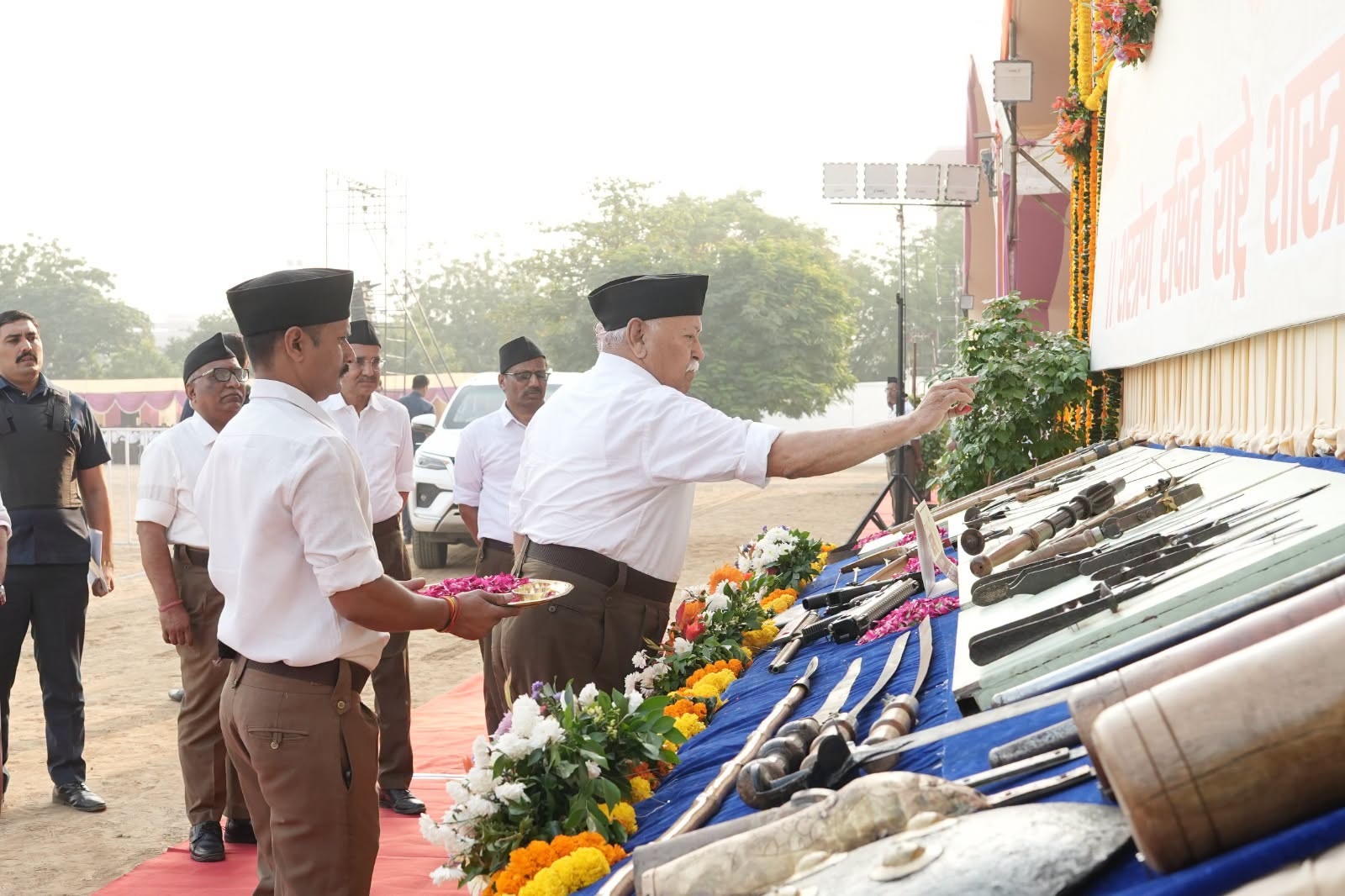
Nagpur: As the Rashtriya Swayamsevak Sangh concluded its centenary-year programmes on Vijayadashami, Sarsanghchalak Mohan Bhagwat delivered a pointed address at the Reshimbagh ground that blended cultural invocation with sharp political signalling. Speaking before a large gathering that included former Vice-President Jagdeep Dhankhar, Maharashtra Chief Minister Devendra Fadnavis, Union Minister Nitin Gadkari and other leaders, Bhagwat declared that “regime change will not happen in India” and warned that global forces seeking to keep India subdued were attempting to weaken the country, Hindus and the Sangh itself.
Marking the 101st foundation year of the organisation founded by Dr K.B. Hedgewar in 1925, Bhagwat performed the traditional Shastra Puja and recalled the contributions of Sant Ravidas (whose 650th birth anniversary falls this year), Swami Shraddhanand (centenary of his martyrdom) and Swami Lakshmanananda Saraswati. He positioned these figures as exemplars of faith, social harmony and the defence of dharma during periods of adversity. The core of his message, however, turned to contemporary challenges.
Bhagwat argued that movements demanding regime change—citing recent experiences in France, Albania, Nepal and Bangladesh—rarely resolve underlying problems. “They say changing the regime will change the situation. But that has never happened anywhere,” he said. He described a “storm” rising from the West aimed at destroying order, decency and cultural values, adding that India had become the ultimate target because a stronger India would constrain the influence of these forces. While some powers wished India to develop, they did not want it to become too powerful.
He acknowledged that protests were inevitable in a democracy facing problems, but insisted their purpose must be solutions rather than the creation of hostility, victimhood or division. When agitations turn into instruments of political interests driven by antagonism toward individuals, groups or ideologies, he cautioned, external forces seeking to undermine Bharat take advantage. “Deepening differences of opinion and turning them into mutual hostility… creating faithlessness towards the systems of the country” was their method, he said. He urged protesters, authorities and political leaders to remain within constitutional limits, the norms of civilised discourse and standards of decent conduct.
Bhagwat noted that similar attempts had been made in India but were blunted by “strong policies” and “strong leadership” of recent decades, combined with growing national pride among the younger generation. He alleged that some ambitious leaders, driven by petty power interests and lack of wisdom, had joined such efforts. In political circles, these remarks are being read as a clear endorsement of continuity under the present dispensation and a caution against narratives that frame protests primarily as regime-change tools.
The address also reinforced the Sangh’s long-term organisational narrative. Bhagwat credited the RSS’s discipline and cultural work with preserving Hindu dharma through centuries of adversity and with contributing to the organisational strength that underpins the BJP’s electoral success. He stressed that unity amid India’s diversity rests on Sanatan philosophy and awareness of “Swa”—self-identity and shared national belonging. As long as society places this shared identity above narrower considerations, the country will remain strong and self-reliant.
A central strand of this vision, Bhagwat underlined, is the Sangh’s Panch Parivartan (Five Transformations) programme, which he said has received a positive response across sections of society. The five initiatives—Samajik Samarasata (social harmony), Kutumba Prabodhan (family awakening and values), Paryavaran (environment), Swa-Bodh and Swadeshi (self-awareness and self-reliance), and Nagarik Anushasan (civic discipline)—are intended as practical, everyday pathways for societal change. He emphasised that ordinary, consistent efforts in these areas, rather than grand gestures, can strengthen the emotional bond reflected in the Constitution’s “We, the People of India” and help build a self-reliant, organised society. Political observers note that this framework is likely to guide RSS outreach and coordination with the BJP on social and cultural issues in the coming years.
Contemporary social concerns featured prominently. Bhagwat described drug addiction as a serious national problem requiring coordinated action by government, administration, parents and society. He called for greater discernment among the young in consuming social media and OTT content, noting that other countries had introduced regulations and that India needed to consider similar steps. He also stressed responsible use of technology, including artificial intelligence, so that it serves human welfare rather than deception.
The speech has already drawn public appreciation from Prime Minister Narendra Modi, who described it as “very motivating” and highlighted its emphasis on national progress, social unity, self-reliance, seva and the Panch Parivartan. In Sangh and BJP circles, the address is being interpreted as a post-centenary reaffirmation of the RSS’s ideological role: consolidating social cohesion, cautioning against destabilising politics, and preparing the ground for sustained organisational influence ahead of future electoral contests.
Yet the concluding political message is harder to miss. By repeatedly invoking “strong leadership” of recent decades as the shield against external designs and regime-change plots, Bhagwat’s address effectively places the RSS’s organisational weight behind the continuity of the Modi government, without any corresponding scrutiny of governance failures, economic distress, or institutional concerns that have fuelled public discontent.
