

Hyderabad : As Hyderabad’s real estate sector increasingly competes on luxury amenities, lifestyle facilities and premium living experiences, experts called for greater attention to an essential but often overlooked aspect of residential development: wastewater management.
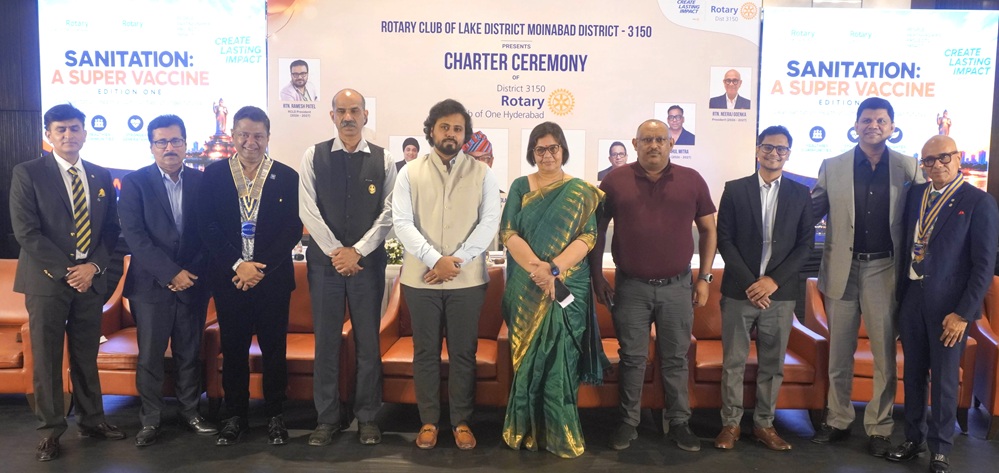
At a panel discussion titled “Sanitation: A Super Vaccine”, organised by the newly formed Rotary Club of One Hyderabad (RC1H) held at The Leela, Banjara Hills last week, experts highlighted the need for builders, homebuyers and residential communities to treat wastewater management as a critical component of sustainable housing rather than merely a regulatory requirement.
Girish Mallpani, Chairman and Managing Director of MPM Group, urged prospective homebuyers to look beyond visible amenities when evaluating villas and luxury apartments and ask pointed questions about how wastewater will be managed. Ask them about the wastewater treatment plan.
“Whenever you buy a villa or a luxury apartment, do not ask only about amenities and luxuries. Ask the builder: What is your wastewater treatment plan? Is the treatment plant adequate, functional and properly maintained?” he suggested.
He observed that modern residential projects increasingly offer premium lifestyle features, such as resort-style living: private pools, rain showers, landscaped gardens, spas, clubhouses and elaborate water features some of which can significantly increase water consumption. Unless wastewater is managed responsibly, such developments risk placing additional pressure on freshwater resources and urban sewage infrastructure.
Mallpani emphasised that installing a wastewater treatment plant is not enough; it must have adequate capacity, function effectively and receive regular maintenance. Residential Welfare Associations (RWAs) must ensure that sewage and wastewater are treated before discharge or reuse, in accordance with applicable standards.
He called for greater awareness among homebuyers and RWAs (Residents Welfare Association) so that wastewater management becomes an important consideration in property selection, project planning and the long-term maintenance of residential communities.
Treat wastewater where it is generated
Vivek Pandey, WASH professional and consultant to the Gates Foundation, advocated a shift from conventional, centralised wastewater management towards solutions that treat wastewater as close as possible to where it is generated.
He pointed out that conventional sanitation systems often use large volumes of water to transport human waste over long distances. This approach can increase freshwater demand and place considerable pressure on sewerage infrastructure.
Pandey recommended decentralised treatment systems that enable wastewater to be treated locally and the recovered water to be reused for suitable non-potable purposes, such as toilet flushing. Such systems can reduce freshwater consumption and dependence on conventional sewer networks when appropriately designed, operated and maintained.
Citing the ReFlow model toilet at Lumbini Park, Hyderabad, he highlighted an approach in which wastewater is treated on-site and the recovered water is reused, demonstrating how sanitation infrastructure can be designed around resource recovery rather than waste disposal alone.
He stressed that innovative, practical and scalable wastewater solutions are needed to make water reuse an integral part of sustainable urban development.
Wastewater management: a real estate responsibility
The discussion underscored the need for the real estate sector to place wastewater management alongside other essential features of a residential project. While amenities contribute to residents’ comfort, effective wastewater treatment is fundamental to environmental protection, water conservation and public health.
For homebuyers, this means asking not only about clubhouses, swimming pools, landscaping and other lifestyle facilities, but also about the capacity and operational status of the wastewater treatment plant, maintenance arrangements and the intended reuse or disposal of treated water.
For builders and developers, it means planning wastewater infrastructure according to the needs of the project and ensuring that it can be operated and maintained effectively over the long term.
For RWAs, it means treating the plant’s continued operation and maintenance as an essential responsibility after residents take possession of their homes.
The panel discussion called for stronger collaboration among developers, residents, RWAs, technology providers and public authorities to promote responsible water use and sustainable residential communities.
The programme was moderated by Prof. V. Srinivas Chary, former Director of the Administrative Staff College of India (ASCI) and advisor to T-Works, Dasra and the Gates Foundation, along with Abhishek Nath, founder of LooCafe and ReFlow.
The panel also included Dr. T. K. Sridevi, IAS, Secretary of the Municipal Administration Department and Commissioner and Director of Municipal Administration, Government of Telangana; Dr. Zelalem Birhanu Tafesse, Chief of Field Office, UNICEF India; Rohit Chandragiri, FCDO, British Deputy High Commission; and Col. M. Chandan Kumar, Head of Engineering at T-Works. District Governor Uday Pilani, Rotary District 3150, also addressed the gathering.
The discussion formed part of RC1H’s focus on Water, Sanitation and Hygiene (WASH) as a priority area for its first two years.
****
