

ITBP Chief Confirms Ongoing Face-Offs with Chinese Forces Along Arunachal LAC; Opposition Accuses Centre of Silence and Concessions

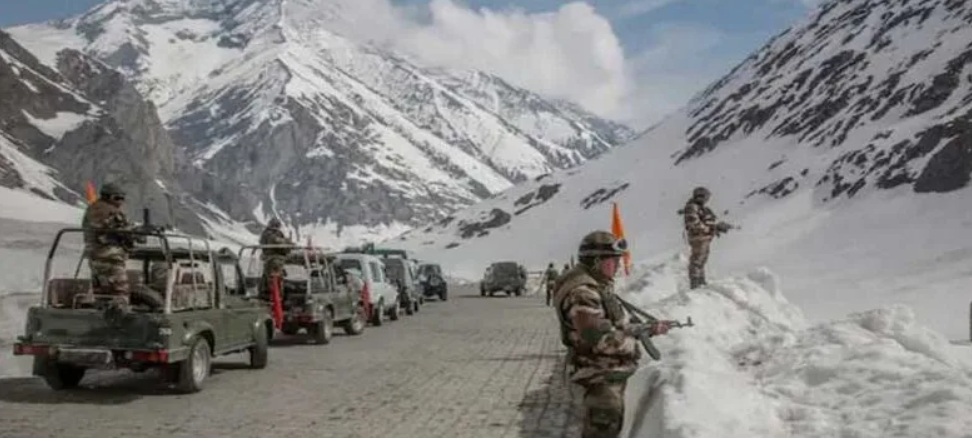
New Delhi: Indo-Tibetan Border Police (ITBP) Director General Shatrujeet Singh Kapur has publicly confirmed that face-offs between Indian and Chinese forces along the Line of Actual Control (LAC) in Arunachal Pradesh remain ongoing and have occurred at multiple locations in recent days. His remarks, made on Thursday at an annual felicitation ceremony for ITBP personnel in Alwar, Rajasthan, ahead of the force’s 65th Raising Day, mark the first official acknowledgement of the scale of these confrontations since reports of tensions emerged in July.
“In the past few days, a situation arose where face-off happened at several locations in Arunachal and it still continues,” Kapur said. He praised the force’s newly raised Shaurya Commando teams for their “exemplary” role in handling the situations and reiterated that the ITBP, raised as a mountain guerrilla force and assigned border-guarding duties along the China frontier in 2004, should not abandon its core mandate. The ITBP is responsible for the 3,488-km LAC.
Government sources cited by media reports indicate that the most prominent standoff has been at Asaphila near Taksing in Upper Subansiri district since late July. Chinese People’s Liberation Army (PLA) personnel are said to have pitched tents at an elevation roughly 6–7 km within India’s perception of the LAC, near the Maja company operating base in Taksing circle. According to these accounts, Indian and Chinese troops came face-to-face during routine patrolling near Maja in July; after a brief confrontation both sides withdrew, but PLA forces returned in larger numbers and established positions. India has increased its deployment in the area. The tensions reportedly persisted even during Chinese President Xi Jinping’s visit to New Delhi for the BRICS Summit in September.
Military and diplomatic channels have been active. Corps Commander-level talks were held on September 6 at the Wacha-Damai border meeting point on the Indian side, following earlier local commander meetings and other high-level engagements since July. Kapur also highlighted the evolving nature of the challenge, noting China’s heavy investment in military modernisation and the limitations of traditional methods. The ITBP is expanding specialised capabilities, including drone platoons, anti-drone systems, specialised high-altitude training for Galwan-like contingencies, and underground shelters.
The disclosure has renewed political debate over the government’s past characterisation of Chinese actions. On June 19, 2020, days after the Galwan Valley clash in which 20 Indian soldiers were killed, Prime Minister Narendra Modi told an all-party meeting that there had been no Chinese aggression or intrusion. He stated: “न वहां कोई हमारी सीमा में घुस आया है और न ही कोई घुसा हुआ है, न ही हमारी कोई पोस्ट किसी दूसरे के कब्जे में है” (“No one has entered our border there, nor is anyone present inside, nor has any of our posts been captured by anyone else”). The Prime Minister’s Office later clarified that the remarks referred to the situation after Indian troops had foiled a Chinese attempt to erect structures, and that the government would not allow any unilateral change of the LAC. Opposition leaders have repeatedly cited this 2020 statement as a “clean chit” that understated Chinese activity.
Congress general secretary (communications) Jairam Ramesh, responding to Kapur’s comments, posted on X: “While the self-styled Vishwaguru’s calibrated concessions to China continue, the DG, ITBP, has lauded—and rightly so—its performance in recent face-offs with the PLA in Arunachal Pradesh, on which there has been a deafening silence from the PM and his establishment.” He claimed Corps Commander talks were held at Wacha and Damai last month after the Taksing face-off, and that “locals had reported that patrolling points had been lost once again, as in Ladakh.” Ramesh further accused China of renaming towns in Arunachal and building a 60,000-MW dam that “threatens our ecological and water security.” He linked the situation to economic concerns, stating that India’s trade deficit with China had “zoomed even further to a record $112 billion in 2025–26, up from $99 billion the previous year,” crushing MSMEs and turning “Make in India” into “Import from China.” Ramesh specifically cited Modi’s 2020 statement as an “infamous clean chit” for which India continues to pay the price.
Congress president Mallikarjun Kharge echoed the demand, posting: “Enough clean chits to China. PM Modi must come clean before India!” He questioned whether patrolling access had been compromised and why the nation was being “kept in the dark.” Congress MP Jebi Mather, speaking to ANI, said: “We appreciate ITBP, but the fact is he is saying this has been happening since July, which means we are in October and now it took for the nation to know about this when an ITBP Director General revealed it. We have not heard anything about this from our Prime Minister. We have not heard anything about this from our Home Minister.” CPI general secretary D. Raja called for differences to be resolved through dialogue. The ruling BJP has characterised such incidents as localised interactions on a dynamic border rather than a broader conflict. The government has previously maintained that Arunachal Pradesh is an integral and inalienable part of India. No immediate detailed official response to Kapur’s specific remarks was available at the time of reporting. The development underscores the continuing friction along the eastern sector of the LAC even as both sides maintain engagement channels.
