

“Don’t Question Me”: Cheranalloor Benz Crash and the Arrogance of a Judicial Officer, as Media Reported

By Nanditha Subhadra
In the early hours of 25 October 2026, a lady relative of the man who lay dead on the road walked into the Cheranalloor police station and put a question to the father of the accused. The father, who also happens to be a judicial officer, was asked whether he did not know that a 17-year-old is forbidden by law to drive a motor vehicle. According to her account, reported across multiple media outlets, the answer was not an explanation, not regret, not even ordinary silence. It was a rebuke. He told her not to question him. In the words she gave the press, the warning ran roughly: “Don’t you dare to question me. You are not in a position to do that.” The satire is almost too perfect for the occasion. A man whose professional life consists of telling others what the law requires informed a grieving citizen that she was unfit to remind him of the most elementary traffic rule when the rule concerned his own son. The robe, it seems, had momentarily convinced its wearer that the public who pays his salary had lost the right to ask simple questions.
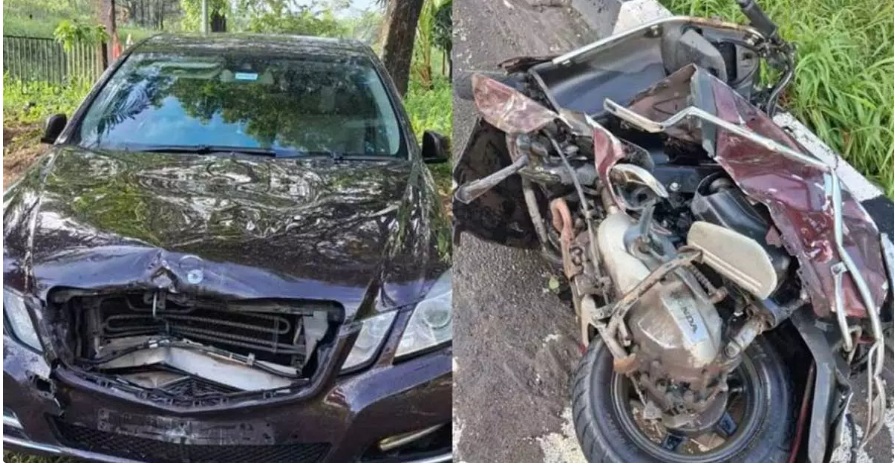
A Mercedes-Benz (registration KL-46-F 0333) travelling on Container Road near Maraparambu in Cheranalloor, Ernakulam, rammed a scooter from behind around 2:20–3:00 am. The scooter rider, Jayabalakrishnan (variously reported as 54–56 years old), a roadside eatery (thattukada) owner from the South Chittoor/Manjali/Chittur area, died on the spot. He was returning home after closing his shop. The impact wrecked the scooter; items he was carrying, including rice, were scattered for metres. The car was registered in the name of Reno Francis Xavier (also referred to as Rino Francis), Additional District Judge / First Additional District Judge linked to the Irinjalakuda court. The driver was his 17-year-old son.
Police initially registered the case under Bharatiya Nyaya Sanhita (BNS) Sections 281 (rash driving or riding on a public way) and 106(1) (causing death by negligence). The minor was taken into custody. Preliminary reports indicated he was alone in the car and had not consumed alcohol. He later told police, according to media reports (including Manorama News and Kerala Kaumudi), that he had taken the parked Benz from the family’s Aluva flat without his parents’ knowledge because of a “desire to drive,” and that heavy rain prevented him from seeing the scooter clearly. He was initially released on station bail as the first charges were bailable. Following public and political outrage, and directions from the Home Minister, police added Section 105 of the BNS (culpable homicide not amounting to murder), a non-bailable offence. Reports also indicated police moves to book the father under the Motor Vehicles Act for permitting or negligently allowing an underage person to drive.
What the family told the media
Relatives of the deceased, including Jayalakshmi, spoke to multiple outlets (The Indian Express, The News Minute, Mathrubhumi, Times of India and others). They alleged that when they asked the judicial officer at the police station whether he did not know a 17-year-old is prohibited from driving, he became agitated and replied along the lines of “Don’t question me,” “Don’t you dare to question me,” or “You need not question me.” They said they insisted on meeting the parents after police told them the father was a judicial officer. The family further alleged that the car was removed quickly (claiming it was to destroy evidence), that police initially hindered access, and that they were pressured to delete photographs. They described the behaviour as arrogance from a person holding a judicial post and said they would fight the case.
These are the family’s allegations as reported by the media. The judge’s exact words have not been independently recorded in official statements available in the reports; they rest on the relatives’ accounts.
The larger issue the reports raise
Media coverage of the Cheranalloor crash has highlighted not only the fatal collision and the minor’s statement but also the family’s charge of arrogance at the police station. The episode, as narrated in the press, feeds a wider public perception that some holders of powerful public offices treat ordinary citizens as subjects rather than as the people who fund their salaries through the exchequer. Judicial officers, like other public servants, are paid by the taxpayer. They occupy the chair to serve, not to lord it over grieving families who ask elementary questions about the law. They remain public servants. They are not above the law—not the Chief Justice of India, and certainly not a judicial officer of a Motor Accidents Claims Tribunal.
The legal position (unchanged by the media narrative)
The law does not grant judicial officers personal immunity for private acts:
- The Judicial Officers Protection Act, 1850 protects only against civil suits for acts done or words spoken in good faith while discharging official judicial duties. It does not shield criminal offences.
- Section 197 CrPC / Section 218 BNSS requires prior sanction only when the alleged offence is connected to the discharge of official duty. The Supreme Court has repeatedly held that no sanction is needed where there is no nexus with official functions. Allowing (or failing to prevent) an unlicensed minor to take a family car is a private act, not judicial duty.
- Guidelines in the Delhi Judicial Service Association case regulate the procedure for arrest or investigation of judicial officers so as to protect institutional independence from arbitrary police action. They do not create a personal sanctuary or bar investigation and trial if an offence is made out.
- Under Article 235, the High Court exercises administrative control over subordinate judicial officers and can initiate disciplinary proceedings for misconduct, including any misuse of position.
The lady who asked the question was not challenging judicial independence. She was asking the father of the accused whether the law on underage driving applied to his son. The correct response was humility or, at minimum, silence. The response she described was a warning not to question. That warning is the sound of a public servant who has forgotten that the public is the master and that he occupies the chair only to serve.
Jayabalakrishnan is dead. His relative’s question remains legitimate. No robe, no title and no salary drawn from the public exchequer answers it with “Don’t you dare.” The judicial officer was the father of the accused. That is the beginning and the end of the matter. Media reports show police considering action against the father under the Motor Vehicles Act and upgrading charges against the minor after public pressure. The family’s account of the exchange at the station, as published, underscores the demand for accountability: public servants remain servants. The public is the master. When a holder of judicial office is reported to have rebuked a relative of a dead man for asking whether the law on underage driving applies to his son, the correct institutional response is transparent investigation, not silence or institutional protection of private conduct. The chair does not place its occupant above the law he is paid to uphold.
