


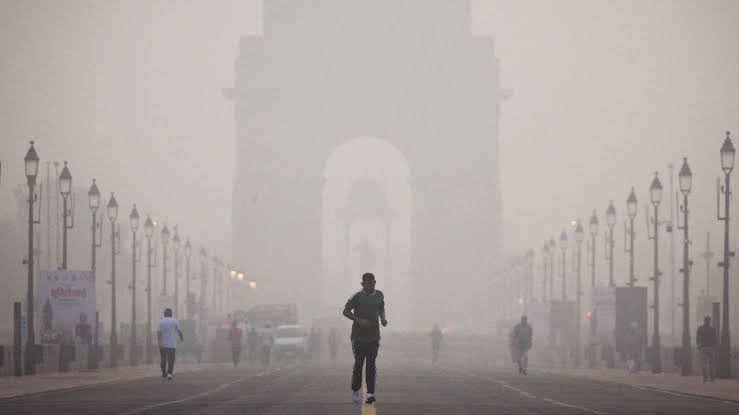
New Delhi: As November settles over Delhi, the familiar grey haze and acrid smell have returned. On 6 November 2026, the city’s average Air Quality Index stood at 389 — firmly in the “very poor” category — with roughly half the monitoring stations recording “severe” levels. Stations at Rohini and IIT Delhi registered readings above 470. Fine particulate matter (PM2.5) concentrations were many times higher than the World Health Organization’s safe limit, turning the capital into a pollution trap once again.
This is not new. Every winter, falling temperatures and weak winds create an inversion that locks pollutants close to the ground. Local sources — vehicle exhaust, road and construction dust, industrial emissions, and open waste burning — combine with residual crop-residue fires from neighbouring states. Firecrackers during Diwali, just days away, are expected to add another spike. The result is air that doctors treating patients in the city describe as capable of penetrating deep into the lungs and bloodstream.
Delhi-based experts are already seeing the human cost in their clinics and emergency rooms. “Air pollution is a silent killer; it kills by worsening underlying diseases and other health problems,” says Dr Randeep Guleria, Chairman of the Institute of Internal Medicine, Respiratory and Sleep Medicine at Medanta. “Every year, when the AQI hits the severe range, we see an increase in the number of patients coming to the emergency with breathing difficulties and coughs, many of whom have to be admitted to the ward or ICU. Even normal people start experiencing chest tightness, breathlessness, watering eyes, and coughing.” He warns that prolonged exposure decreases lifespan and stunts lung growth in children.
Renowned pulmonologist Dr Arvind Kumar has highlighted avoidable road dust and poor construction practices as major contributors. He advises residents to avoid outdoor exercise, use air purifiers indoors, and wear properly fitted N95 masks when stepping outside, warning that prolonged exposure can increase the risk of lung cancer even among non-smokers. Dr Manoj Goel, pulmonology unit head at Fortis Memorial Research Institute near Delhi, notes that these tiny particles “can penetrate deep into the lungs and enter the bloodstream, triggering inflammation and affecting multiple organs.” At Indraprastha Apollo Hospital, Dr Nikhil Modi reports cases of asthma rapidly worsening into pneumonia after prolonged exposure to AQI levels above 300.
This year the Delhi government moved earlier than usual. Its 10-point Winter Action Plan 2026-27, effective from 1 November to 28 February, includes a “No PUC, No Fuel” rule, a ban on older non-BS-VI vehicles registered outside the city, 50 per cent work-from-home, staggered timings, doubled parking charges, and phased construction bans. Stage II of the Graded Response Action Plan (GRAP) is also active across the National Capital Region. Officials present this as a shift from reactive panic to proactive management.
Yet the same doctors and environmental experts argue that the measures still reflect a deeper lack of sustained commitment by successive governments. Anumita Roychowdhury of the Centre for Science and Environment has said GRAP “is an emergency response mechanism, not a mitigation plan” and can only blunt peaks rather than reduce baseline emissions. Sunita Narain, one of GRAP’s architects, has stressed that it “was never a substitute for year-long tough action, which it has become today sadly.” Parthaa Bosu of the Environmental Defense Fund notes positive changes in planning but says “when it comes to execution, we probably still stand at the same level.” Sunil Dahiya of Envirocatalysts adds that implementation remains inadequate and that measures focused mainly on Delhi do not address the wider airshed.
Hospitals are already filling with the consequences. Residents speak of closed windows, air purifiers, and a resigned sense that escape is possible only for those who can leave the city. Delhi is better prepared on paper this winter than in many previous years. Whether that preparation translates into lasting improvement depends on whether governments treat clean air as a year-round structural priority rather than a seasonal inconvenience. So far, the experts treating the city’s patients see little evidence that the political will matches the scale of the crisis.
