

India’s Strategic Tightrope: Balancing Israel Ties and Iran Risks Amid Looming US-Iran Crisis

By Suresh Unnithan & nanditha Subhadra
As of now, the Middle East stands on the brink of a potentially devastating escalation. Two U.S. aircraft carrier strike groups—the USS Abraham Lincoln in the Arabian Sea and the USS Gerald R. Ford en route via the Mediterranean—along with over 150 additional fighter jets, bombers, refuelling tankers, and supporting warships, are positioned within striking range of Iran. President Donald Trump has publicly demanded that Tehran abandon its nuclear ambitions entirely, warning of “bad things” and even floating regime change as an outcome if diplomacy fails. Iranian officials, meanwhile, describe U.S. strikes as “inevitable and imminent,” even as both sides insist they prefer a negotiated settlement. Last-ditch indirect talks continue in Geneva, but satellite imagery, flight tracking data, and official statements paint a picture of rapid military preparation.
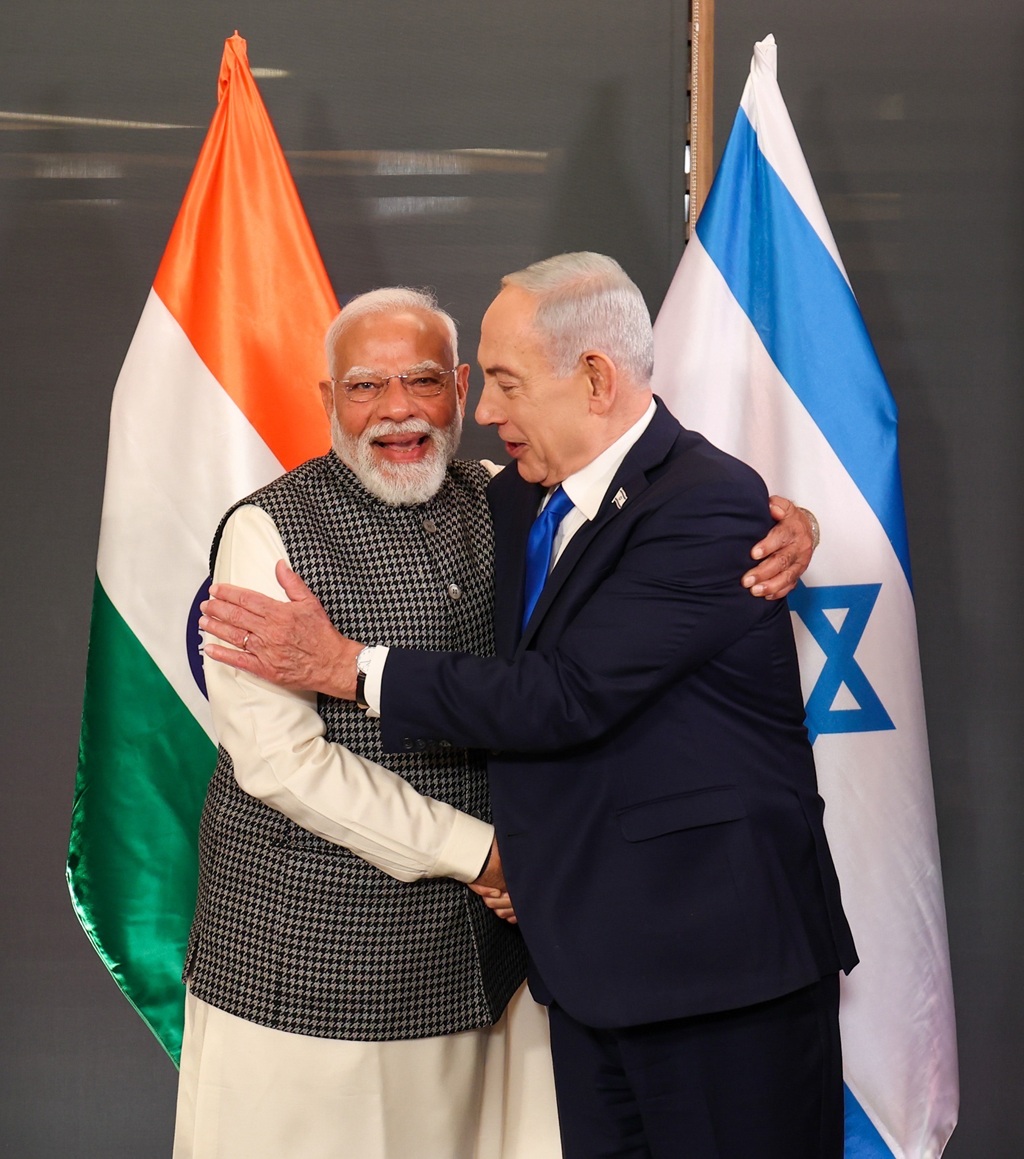
In this volatile context, Israeli involvement appears almost certain. Any direct U.S. strike on Iranian nuclear sites or military infrastructure would likely trigger Iranian retaliation against Israel, either directly or through proxies like Hezbollah or the Houthis. The timing of Indian Prime Minister Narendra Modi’s two-day visit to Israel (February 25-26, 2026)—his second since the landmark 2017 trip—and his historic address to the Knesset has thrust India’s foreign policy into sharp focus. During the speech, Modi declared that “India stands with Israel firmly, with full conviction, in this moment and beyond,” condemned the October 7, 2023 Hamas attacks as “barbaric,” and stated that “no cause can justify the murder of civilians.” He received a standing ovation and was awarded the Speaker’s Medal. The visit also advanced defence, trade, and technology agreements, including progress toward a Free Trade Agreement and deeper cooperation on AI, quantum computing, and counter-terrorism.
The question arises naturally: Where does India stand if armed conflict erupts between the U.S.-Israel axis and Iran? Has New Delhi’s deepening embrace of Israel—exemplified by Modi’s unambiguous Knesset pledge—placed it on the “opposite side” from a long-time partner like Iran? And was this strategic tilt a miscalculation that could inflict economic pain by alienating the broader Middle East?
India’s Multi-Alignment Tradition and Evolving Ties
India has long pursued “strategic autonomy” and multi-alignment in West Asia, refusing to join exclusive camps. Full diplomatic relations with Israel were established only in 1992, yet cooperation remained discreet until the Modi era. The 2017 visit elevated ties to a “strategic partnership.” Today, Israel is India’s second-largest defence supplier after Russia, with deals worth billions in drones, missiles, radar systems, and joint production under “Make in India.” Bilateral trade reached approximately $3.6-3.75 billion in FY 2024-25, with diamonds, pharmaceuticals, and high-tech dominating. The India-Middle East-Europe Economic Corridor (IMEC), unveiled in 2023, further binds India, Israel, UAE, Saudi Arabia, and Europe in an ambitious connectivity project bypassing China’s Belt and Road.
With Iran, relations are older and civilizational. India was among the first to recognize the Islamic Republic post-1979 revolution and has maintained strong people-to-people links. Energy has been central: Iran supplied up to 10-12% of India’s crude before U.S. sanctions forced cuts after 2018-19. The Chabahar Port project, developed by India since 2016, remains a strategic gateway to Afghanistan and Central Asia, circumventing Pakistan. Cultural and diaspora ties persist, though trade has shrunk to under $2 billion annually amid sanctions.
Recent years show a clear tilt. India halted Iranian oil imports under U.S. pressure, voted against Iran at the IAEA on nuclear issues multiple times, and in 2025 reportedly seized tankers linked to sanctioned Iranian oil. During the 12-day Israel-Iran conflict in June 2025, India refrained from joining SCO condemnations of Israel but aligned with BRICS statements. Chabahar operations have faced delays due to sanctions, though India continues limited engagement with waivers.
The Economic Stakes: Why Neutrality Remains Imperative
A full-blown U.S.-Iran war would hit India hard economically, regardless of diplomatic posture. India imports nearly 85% of its crude oil. The Strait of Hormuz, through which 20% of global oil passes, is vulnerable; even limited disruption could spike Brent crude by $20-50 per barrel initially. Economists warn of immediate fuel price hikes, transport cost surges, and inflation pressures that could derail India’s growth targets. Remittances from over 9 million Indian workers in the Gulf—exceeding $100 billion annually—form a lifeline; any Iranian retaliation targeting U.S. bases in UAE, Saudi Arabia, or Qatar could destabilize those economies and prompt evacuations or job losses.
Direct trade with Iran is minuscule (less than 0.2% of India’s total), so secondary U.S. sanctions under Trump’s threatened 25% tariffs on Iran-linked business pose limited direct risk. However, broader regional instability could disrupt shipping, raise insurance premiums, and complicate the IMEC project.
Crucially, the “Middle East moving away from India” scenario is overstated. Gulf Arab states—UAE, Saudi Arabia, Bahrain—have themselves normalized or warmed to Israel via the Abraham Accords and share deep concerns over Iran’s nuclear program and regional proxies. India’s massive market, labour exports, and defence purchases make it indispensable to them. Trade with the Gulf exceeds $200 billion annually. Iran, increasingly isolated and economically strained, cannot offer comparable leverage. Tehran’s Foreign Minister Abbas Araghchi recently called India a “historic friend” and urged Modi to raise Palestinian issues, acknowledging India’s sovereign choices while hoping for a “constructive role” in de-escalation.
India has already signalled caution: The Ministry of External Affairs stated it is “closely monitoring” the situation, remains in touch with the small Indian community in Iran, and issued an advisory urging citizens to leave immediately via all available means. No military alignment or rhetorical escalation has been offered to either side.
Was Modi’s Knesset Pledge Faulty?
Critics may argue that Modi’s unequivocal “full conviction” support for Israel, delivered precisely as U.S. carriers massed, risks signalling one-sidedness and complicating backchannel diplomacy with Tehran. Domestic opposition and some analysts have questioned whether this alienates the wider Islamic world or endangers energy security.
Yet a closer examination suggests pragmatism, not fault. India’s foreign policy under Modi prioritises national interest over ideological consistency. Strengthening Israel ties delivers tangible benefits: advanced defence technology critical for border security against China and Pakistan, agricultural innovation (drip irrigation, seeds), and cybersecurity. It aligns with the Quad and Indo-Pacific strategy without formal alliances. The Gulf states, key to India’s energy and remittances, are not monolithic; many quietly prefer a weakened Iran.
Historical precedent supports this. During the 1991 Gulf War or post-9/11, India maintained balanced outreach. In the current crisis, New Delhi can leverage its good offices—perhaps quietly urging restraint in backchannels with all parties—precisely because it enjoys credibility across divides. Abandoning the Israel partnership would forfeit strategic gains without guaranteeing Iranian reciprocity; Tehran’s alignment with China and Russia limits its flexibility.
Moreover, Modi’s visit focused overwhelmingly on bilateral deliverables—defence co-production, FTA momentum, IMEC revival—rather than grandstanding on the U.S.-Iran standoff. The speech’s emphasis on counter-terrorism and shared democratic values resonated without naming Iran.
Likely Indian Stand: Principled Neutrality with Pragmatic Tilt
If conflict erupts, India’s position will almost certainly mirror past crises: strong condemnation of terrorism, call for immediate de-escalation and return to diplomacy, emphasis on civilian protection, and safeguarding of its nationals and economic interests. It will not commit troops or bases, consistent with non-alignment. Humanitarian aid to affected civilians (on all sides) and support for UN efforts are probable.
Behind the scenes, India may quietly facilitate dialogue, leveraging its relations with Oman, UAE, and even Russia (a key Iran partner). Energy diversification—boosting Russian, U.S., and Saudi imports, plus strategic reserves—will mitigate shocks. Long-term, a post-conflict Middle East with a diminished Iran could open opportunities for India in reconstruction and connectivity.
Modi’s Israel embrace is not a zero-sum betrayal of Iran but a reflection of India’s rise as a pole in a multipolar world. It bets on shared interests with Israel and the Gulf against common threats (terrorism, radicalism, over-dependence on any single power) while preserving diplomatic space with Tehran. Economic injury is possible from war itself, not from India’s stance; neutrality maximises resilience.
In an era of great-power rivalry and regional flashpoints, India’s approach exemplifies “multi-alignment in action.” It will urge peace, protect its people and economy, and emerge—whatever the outcome—positioned to deepen partnerships across a stabilising Middle East. The coming days will test this tightrope walk, but New Delhi’s track record suggests calculated realism over risky partisanship.
