


By Suresh Unnithan
Prime Minister Narendra Modi’s remarks yesterday, on April 16, 2026, in the Lok Sabha were strangely candid and politically revealing. While defending the Constitution (131st Amendment) Bill and the linked Delimitation Bill, he declared: “If you oppose this, it is natural that I will get political benefit.” He added that consensus would mean “no one will suffer” and even offered the opposition a “blank cheque” of credit, suggesting he would publicly acknowledge their role if the bills passed. This admission from the Prime Minister — framing opposition to a women’s empowerment measure as a personal political windfall — stripped away the veneer of solemn reform and exposed the underlying electoral calculus. It was an unwarranted lapse in a House debating one-third reservation for women, turning a constitutional issue into an open acknowledgement of partisan gain.
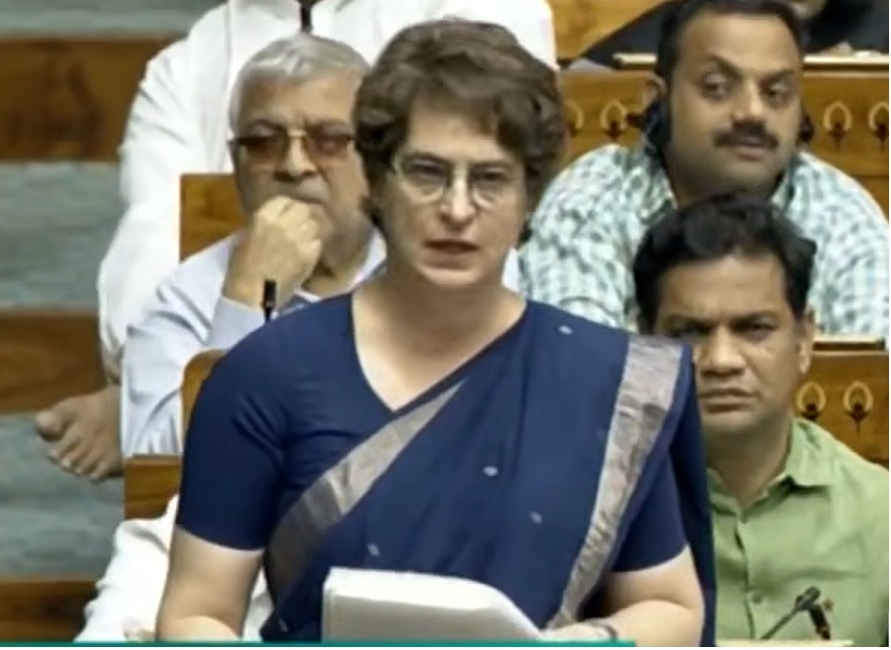
Congress MP Priyanka Gandhi Vadra rose to the occasion with a sharp, substantive counter that effectively held up a mirror to Modi and the BJP’s strategy. She dismantled the Prime Minister’s narrative, refuted his selective history on who opposed the women’s reservation bill three decades ago, and laid bare what she described as a “well-planned conspiracy” designed not to empower women immediately but to reshape India’s electoral landscape in time for the 2029 general elections. Her speech was one of the most pointed critiques of the day, exposing the hidden political agenda behind the haste, the linkage to delimitation, and the selective use of outdated data.
Priyanka began by reaffirming Congress’s consistent support for women’s reservation. The party pioneered 33% quotas for women in panchayats and municipalities through the 73rd and 74th Amendments. It backed the 2023 Nari Shakti Vandan Adhiniyam and has repeatedly pushed for implementation. Yet she firmly rejected the “duplicitous” structure of the current package. The bills do not enable immediate 33% reservation in the existing 543 Lok Sabha seats. Instead, they tie the quota to a fresh delimitation exercise that could expand the House to over 850 seats (815 from states and 35 from Union Territories), drawing primarily on 2011 Census population figures. This linkage, she argued, is not about faster justice for women but a calculated delay and reconfiguration of constituencies to suit the BJP’s strengths in the northern Hindi heartland.
Her rebuttal to Modi’s historical claims was particularly effective. The Prime Minister had suggested that someone opposed the bill 25-30 years ago, implying the current opposition was repeating old sins while positioning the BJP as the consistent champion. Priyanka countered by recalling the bill’s chequered history: first introduced in 1996 by the United Front government, it faced disruptions and demands for an OBC sub-quota from parties like the Samajwadi Party and RJD. BJP-led governments under Atal Bihari Vajpayee reintroduced it multiple times but failed to secure passage in the Lok Sabha. The 2010 version passed the Rajya Sabha under UPA but lapsed in the lower House due to lack of consensus. Congress leaders, including Rahul Gandhi, had written letters urging early implementation. By selectively blaming “someone” from 30 years ago while glossing over the BJP’s own record of stalled attempts, Modi was rewriting history to paint the opposition as perpetual obstructors. Priyanka exposed this as unfounded allegation, reminding the House that women’s reservation has been a bipartisan yet repeatedly deferred aspiration, not a sudden BJP discovery.
The core of her critique targeted the hidden political agenda. Introducing such far-reaching bills during a special session coinciding with sensitive assembly election cycles in states like West Bengal and Tamil Nadu raised obvious questions of timing. Linking women’s reservation to delimitation creates a classic pincer movement: opponents are forced into a no-win trap — support the package on the government’s terms or risk being branded anti-women. Priyanka called it an “open attack on democracy,” arguing that the real aim is to redraw constituencies ahead of 2029 using 2011 data, which favors populous northern states where the BJP has deeper organizational roots. Southern states with better population control and development records — Tamil Nadu, Kerala, Karnataka, Andhra Pradesh — could see their relative parliamentary influence diluted even if absolute seats increase proportionally. Assurances from Modi that “no state will be discriminated against” and that proportionality will be maintained remain just that — assurances — without ironclad constitutional safeguards in the bill itself.
She questioned why the government cannot implement the 33% quota right away in the current 543 seats, with sub-quotas for SC/ST women if needed. The 2023 Act had already deferred implementation until after the next Census and delimitation (potentially 2031 onwards). The new amendments accelerate delimitation using 2011 figures while bypassing a fresh, comprehensive caste census. This omission, Priyanka warned, threatens OBC representation. OBCs constitute roughly 40-52% of the population according to various state surveys and the limited 2011 socio-economic data. Without updated caste demographics, the women’s quota risks disproportionately benefiting general category and forward communities, sidelining OBC, Dalit, and Adivasi women who form a substantial section of the marginalized. “This is an attempt to snatch away the rights of OBCs,” she asserted, arguing that genuine empowerment must be inclusive across castes, not a selective numbers game.
In a memorable barb aimed at Home Minister Amit Shah’s political craftsmanship, Priyanka remarked that if Chanakya were alive, he would be shocked by the BJP’s “political shrewdness.” The line drew laughter from the treasury benches, but it underscored a deeper point: the bills create a sophisticated electoral architecture. By expanding the Lok Sabha dramatically while embedding delimitation based on older population data, the government can claim historic credit for women’s representation while potentially engineering boundaries and seat distributions advantageous in its strongholds. This is not reform born of conviction but political engineering timed for maximum advantage. The haste, the selective data, and the deliberate linkage suggest the exercise is less about “Nari Shakti” and more about consolidating power for the next electoral cycle.
Critics of the opposition might argue that Priyanka’s intervention was itself politicized, and that any expansion of the Lok Sabha after decades of freeze (since the 1971 Census) is long overdue to reflect demographic realities. Women’s representation in Parliament remains abysmally low — around 14-15% in recent Lok Sabhas — far below the global average in many democracies. The panchayat-level quotas have demonstrably improved women’s leadership at the grassroots. If implemented transparently, the 33% national quota could be transformative. However, the manner of its packaging — rushed amid elections, tied to delimitation without caste census safeguards, and accompanied by the Prime Minister’s own admission of political benefit — invites legitimate suspicion. It undermines public trust and reduces a vital social justice measure to another arena of partisan maneuvering.
Priyanka Gandhi Vadra’s speech succeeded because it refused to let rhetoric overshadow substance. She did not oppose women’s reservation; she opposed its weaponization for electoral gain. By directly confronting Modi’s remarks, correcting the historical record on past opposition, highlighting the risks to federal balance and OBC equity, and demanding immediate implementation in existing seats, she exposed the gap between the government’s lofty claims and its calculated strategy. In doing so, she showed the mirror not just to the Prime Minister but to the entire architecture of the bills.
True empowerment of women requires more than expanded numbers and redrawn maps. It demands transparency, immediate action where possible, and policies that address intersecting inequalities of caste, region, and class. On April 16, 2026, Priyanka’s intervention reminded Parliament that when a Prime Minister openly links legislative reform to his own political benefit, scrutiny is not obstruction — it is the duty of a vibrant democracy. Whether this critique forces greater safeguards or merely sharpens the battle lines for 2029, it underscored an uncomfortable truth: behind the celebration of “Nari Shakti” lies a carefully calibrated political project.
