


By Suresh Unnithan
In the early hours of January 3, 2026, U.S. forces launched a large-scale military operation in Venezuela, codenamed Operation Absolute Resolve. The strikes targeted air defences and other sites around Caracas, enabling special operations forces to raid a compound and capture sitting President Nicolás Maduro and his wife, Cilia Flores. The pair were flown out of the country—first to a U.S. naval vessel and then to New York—where they face federal indictments on charges including narcoterrorism, drug trafficking conspiracy, and weapons offenses. President Donald Trump described the action as a success against a “narco-state” and stated the U.S. would “run” Venezuela temporarily to ensure a “safe, proper and judicious transition,” while emphasizing involvement in the country’s oil sector.
Domestic Reaction: Division and Scrutiny in the U.S.
The operation has deepened political divides at home. Democrats in the Congress have criticized the lack of prior consultation or congressional oversight, with figures like Senate Minority Leader Chuck Schumer calling it a “dangerous precedent” that risks American lives and bypasses checks on executive power. Investigations into intelligence assessments and potential overreach are underway in the House.
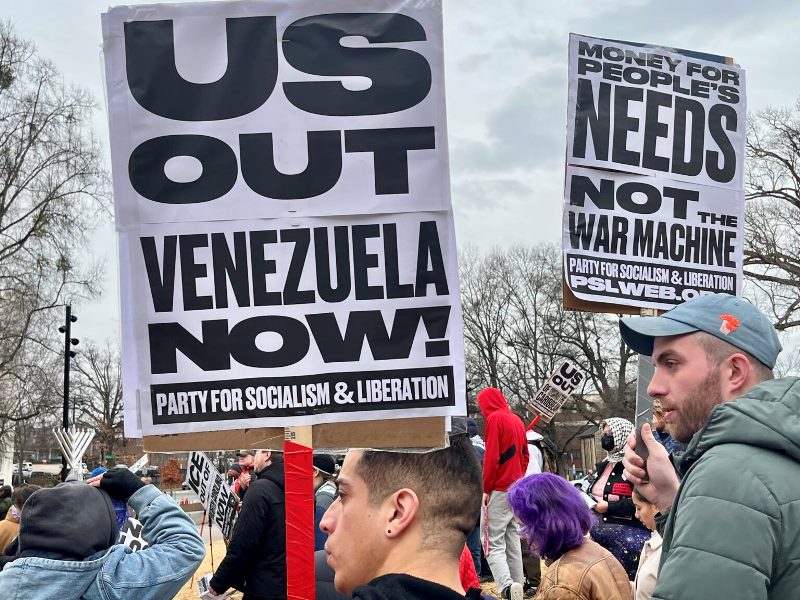
Public opinion remains split. Polls show unease among many Americans over escalation in Latin America, with concerns about costs, potential refugee flows, and parallels to past interventions. Some in Trump’s base support decisive action against alleged drug networks linked to Venezuela, while isolationist voices question the intervention. Protests have erupted in U.S. cities, echoing anti-war demonstrations of earlier eras, amid accusations that oil interests—given Venezuela’s vast reserves—motivated the move despite the administration’s focus on counternarcotics.
International Response: Condemnation, Protests, and Diplomatic Fallout
Reactions abroad have been largely negative. Protests against the U.S. action have broken out in Caracas, other Latin American capitals, Europe, and beyond, with demonstrators decrying it as an assault on sovereignty. Traditional U.S. partners in the region, including Colombia and Brazil, have voiced reservations over potential instability, while leftist governments and human rights groups have condemned the capture of a head of state.
Russia and China—longtime backers of Maduro—have strongly denounced the operation as “international banditry” and “hegemonic bullying,” vowing to raise it at the UN Security Council. The UN Secretary-General and human rights officials have called for restraint and respect for international law. European leaders have expressed concern about the precedent, with some describing the legality as “complex.” Comparisons to past U.S. captures (like Manuel Noriega in Panama) have surfaced, though fears of an immediate “Saddam Hussein-style” outcome remain speculative.
A Breach of International Norms?
Critics argue the operation violates the UN Charter’s Article 2(4) prohibition on the use of force against a state’s territorial integrity or political independence. The U.S. justified it as a law-enforcement action against indicted individuals involved in drug trafficking and terrorism, supported by military force under inherent executive authority—without UN Security Council approval, self-defence claims, or humanitarian consensus. No imminent threat to U.S. security was publicly established, raising questions about unilateralism.
Legal experts warn this could erode multilateral frameworks and invite reciprocal actions by adversaries. The administration counters that targeting narcoterrorism networks aligns with U.S. interests, but skeptics point to historical precedents where resource access shadowed such claims.
Potential Consequences: Economic Risks, Regional Shifts, and Long-Term Legacy
The fallout is unfolding rapidly. Global oil markets face uncertainty, with possible disruptions to supplies or prices affecting U.S. consumers. Diplomatically, the U.S. risks strained ties in Latin America, where anti-American sentiment is rising and Chinese/Russian influence could grow. Acting President Delcy Rodríguez has denounced the action as aggression while assuming interim leadership.
Broader risks include accelerated multipolar alignments, potential proxy conflicts, or renewed migration pressures. If mishandled, the episode could tarnish U.S. credibility and embolden challengers.
In summary, the capture of Maduro represents a bold but highly controversial U.S. intervention. Framed by the administration as necessary action against criminal networks, it has ignited fierce debate over legality, motives, and wisdom. Whether it leads to stability, further chaos, or a lasting shift in hemispheric dynamics remains uncertain, but the world is closely watching the aftermath.
