

89% of Indian Consumers Have Bought a Counterfeit Product: ASPA–CRISIL Report Calls for Greater Consumer Awareness

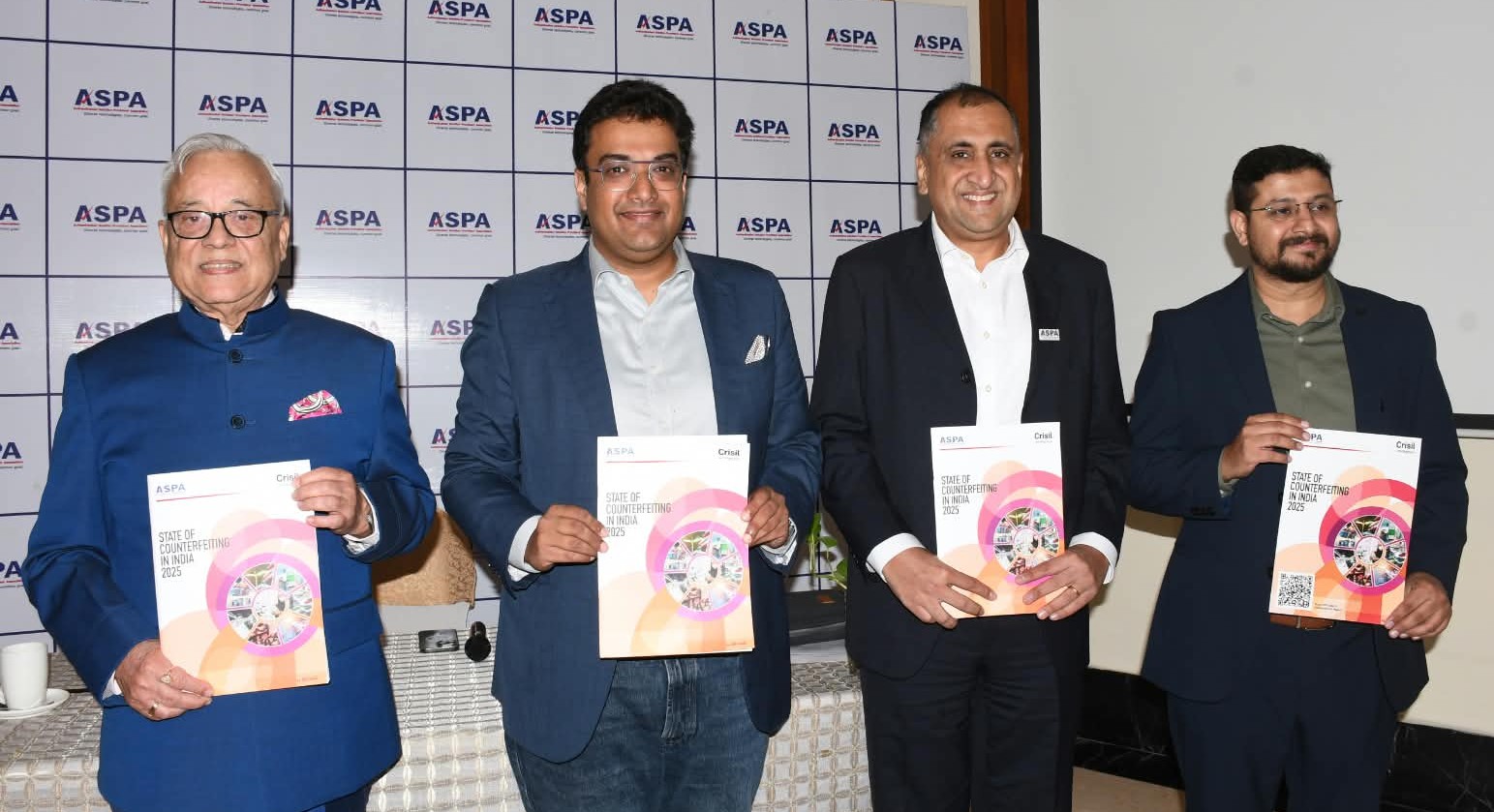
The Authentication Solution Providers’ Association (ASPA) today called for greater consumer awareness and easier product-verification mechanisms to help consumers identify counterfeit products, as it presented the findings of the ASPA–CRISIL State of Counterfeiting in India 2025 report at its “Fake Free India” event in Hyderabad. The findings were presented by Mr. Ankit Gupta, President, ASPA.
Based on a survey of 1,639 consumers across nine Indian cities, covering six key sectors — apparel, FMCG, automotive parts, consumer durables, healthcare products and agro-products — the report found that 89% of consumers had purchased a counterfeit product at least once in their lifetime, while 35% reported encountering a counterfeit product in the past 12 months. Consumers estimated that nearly 29% of products available in local markets could be counterfeit, and 74% believed counterfeiting had increased in their region over the past year. Encouragingly, 50% of consumers said they would never knowingly buy a counterfeit product — a sharp rise since the report’s 2022 baseline — while 93% said more consumer awareness campaigns are needed.
Highlighting the regional spread of the findings, the report notes that Hyderabad – one of three South Indian cities covered in the survey, along with Chennai and Bengaluru – recorded the highest share of consumers (46%) who encountered a counterfeit product in the past 12 months, among all nine cities studied. Chennai (39%) and Bengaluru (33%) also recorded meaningful shares on the same measure, pointing to a broader South Indian trend worth watching.
The report finds that counterfeiting cuts across every sector studied, with perceived prevalence highest in apparel (34%), followed by consumer electronics (31%), healthcare products (28%), FMCG (25%), agrochemicals (23%) and automotive parts (22%) — underlining that the problem is not confined to any single category but spans the breadth of everyday consumer purchases.
On consumer behaviour, the report finds that while 62% of consumers say they now always check product authenticity before purchase, only 34% check holograms, 23% check QR codes and 13% check digital identities to do so. As many as 59–66% of consumers still rely only on packaging quality and branding to judge authenticity — a gap ASPA believes needs urgent attention through wider consumer education on authentication and traceability solutions such as secure packaging, serialization, QR-based verification and track-and-trace technologies.
ASPA also pointed to the report’s expanding regional footprint as part of its continuing awareness efforts: the ASPA–CRISIL State of Counterfeiting in India 2025 report was first launched in Mumbai in March 2026, and ASPA, headquartered in Delhi, is now taking its “Fake Free India” consumer awareness campaign to Hyderabad — reflecting the association’s pan-India push to build awareness of counterfeiting’s impact across regions. ASPA requested continued media support in taking this consumer awareness message to a wider audience.
The report is part of ASPA’s continuing efforts, across its four pillars of Awareness, Advocacy, Research and Innovation, to generate greater consumer awareness around counterfeiting and provide stakeholders with data-driven insights to strengthen India’s response to illicit and counterfeit products.
Ankit Gupta, President, ASPA, said, “Our survey of 1,639 consumers across nine cities shows that counterfeiting is deeply embedded in the everyday consumer experience across sectors, and that has to be a wake-up call for consumer awareness. 62% of consumers say they check product authenticity before purchase, yet a large share are still relying only on packaging quality and branding to judge whether a product is genuine — that is the real gap we have to close. It will take brands, regulators and consumers acting together — our Trishul approach — to move towards stronger authentication, greater confidence and a safer tomorrow for every consumer.”
Nakul Pasricha, Vice-President, ASPA, said, “The role of authentication and traceability is becoming increasingly important in bridging the gap between consumer awareness and actual verification. Secure packaging, serialization, digital authentication, QR-based verification and track-and-trace technologies can provide multiple layers of protection. The objective should be to make authentication accessible and intuitive for consumers while creating greater visibility across the supply chain.”
Prof. Bejon Kumar Misra, International Consumer Policy Expert & Honorary Member, ASPA, said, “Counterfeiting is not merely an intellectual-property problem or a problem for brands — it is, first and foremost, a consumer protection problem. When a consumer unknowingly buys a counterfeit product, three victims are created simultaneously: the consumer, the legitimate trader and the nation. The last mile of authentication is the consumer, and the ultimate measure of success is consumer confidence. Consumers must be empowered with simple, accessible and affordable means to identify, verify and report suspicious products, not merely be told to buy genuine. This fight against counterfeiting must become a national consumer movement.”
