


By Suresh Unnithan
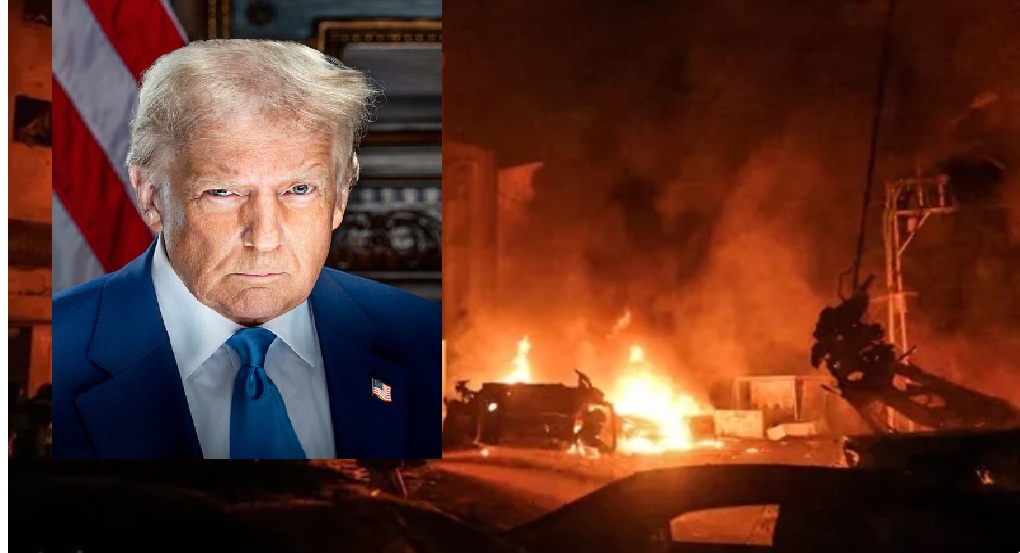
In a move widely condemned as unprovoked aggression, President Donald Trump’s joint U.S.-Israeli strikes in early 2026, which resulted in the assassination of Iran’s Supreme Leader Ayatollah Ali Khamenei, have plunged the region into chaos. Framed by the administration as a preemptive measure against alleged threats, the operation—dubbed “Operation Epic Fury”—was thrust upon Iran without clear justification, largely at Israel’s urging amid its own escalating tensions with Tehran. Far from weakening Iran, this act has ignited fierce retaliation from Tehran, unified the nation against external invaders, and triggered a severe oil crisis with devastating economic ripples worldwide. As Iran stands resilient, refusing to succumb to U.S. threats, Trump faces mounting backlash within his own Republican Party and the broader American public, raising questions about the sustainability of this ill-advised conflict.
The strikes, launched on February 28, 2026, killed Khamenei and over 49 top Iranian officials, including senior military leaders. Iranian President Masoud Pezeshkian swiftly denounced the attack as a “heinous” violation, vowing “legitimate revenge” and forming a leadership council to maintain stability. Contrary to U.S. predictions of regime collapse, Iran has not buckled; instead, it has mounted a ferocious counteroffensive. Tehran has fired over 400 ballistic missiles and nearly 1,000 drones targeting U.S. bases in the region, including 27 facilities across Iraq, Syria, Jordan, Bahrain, Kuwait, Qatar, the UAE, and Saudi Arabia. Retaliatory strikes have also hit Israeli targets and Gulf allies, resulting in casualties in Israel, the UAE, Kuwait, and Oman, with Iran’s Islamic Revolutionary Guard Corps (IRGC) pledging to continue operations in self-defence. Massive rallies in Iran have transformed grief into national resolve, with state media reporting millions in funeral processions for Khamenei, now revered as a martyr. Protests against internal issues have been supplanted by unified anti-U.S. and anti-Israel sentiment, bolstering hardliners and the IRGC’s grip on power. As one Iranian official stated, “This aggression has only strengthened our determination—we will not yield to bullies.”
Domestically, the U.S. is fracturing under the weight of this controversy. Trump bypassed Congress entirely, drawing ire even from within his party. Prominent Republicans like Senator Rand Paul have labeled the strikes a “potential trigger for endless conflict,” echoing fears of an Iraq-like quagmire. Representative Thomas Massie opposes the war outright, aligning with bipartisan efforts to invoke the War Powers Act. MAGA influencers, once Trump’s staunchest supporters, are turning: Tucker Carlson called the bombing “absolutely disgusting and evil,” while former Representative Marjorie Taylor Greene accused the administration of betraying promises of “America First and zero wars,” labelling officials “sick liars.” Public polls reflect this unease—only about 25% of Americans support the strikes, with Republican approval dipping below 75% amid rising U.S. casualties (at least six service members killed so far). Trump, reportedly worried about eroding base support ahead of midterms, has dismissed critics as out of touch, but the backlash signals growing isolation within the GOP’s anti-interventionist wing.
Fuelling conspiracy theories, the timing coincides with renewed scrutiny from the Epstein files, released under the 2025 Epstein Files Transparency Act signed by Trump himself. Tapes from author Michael Wolff revive allegations of Trump’s ties to the late sex offender Jeffrey Epstein, prompting Democrats to accuse the president of using the war as a deflection tactic. One senator remarked, “This isn’t about national security; it’s a desperate bid to bury personal scandals.”
The economic fallout has been catastrophic, amplifying an already fragile U.S. economy and igniting a global oil crisis. Brent crude prices surged 7-13% immediately after the strikes, jumping from around $70 to $80-82 per barrel by March 2, 2026, with analysts warning of spikes to $100+ if disruptions persist. Iran’s threats to close the Strait of Hormuz—a chokepoint for 20-25% of global oil and 15% of liquefied natural gas (LNG)—have materialized in partial disruptions, pushing U.S. gas prices up 10-30 cents per gallon and wholesale gasoline futures by 25 cents. Prolonged conflict could add 0.8% to global inflation, tip economies into recession, and elevate shipping insurance costs dramatically. Direct U.S. military costs are projected at $40-95 billion, with broader losses reaching $50-210 billion from trade interruptions and energy market volatility. The Penn Wharton Budget Model estimates these figures, noting exacerbated inflation and slowed growth. Domestically, unemployment has risen from 4% in January 2025 to 4.4% by December, with 638,000 jobs lost; 2025 private-sector growth hit a low of 584,000 additions amid supply chain chaos. CEO confidence has plummeted, with 60% citing geopolitical tensions as a disruptor, per The Conference Board. Stock markets tumbled 1% initially, and sectors like manufacturing and construction—touted as Trump policy wins—face further job losses.
Gulf allies, caught in the crossfire, are hedging bets amid Iran’s retaliation. Saudi Arabia, denying U.S. strike access, urged restraint and pursued diplomacy with Iran via Oman, reflecting a 2023 Beijing-brokered détente that prioritized de-escalation over escalation. The UAE and Qatar intercepted missiles but emphasized self-defense without full U.S. endorsement, fearing oil infrastructure damage. Bahrain, Kuwait, and others condemned Iran’s actions but privately pressed Washington for moderation, highlighting perceptions of U.S. unreliability under Trump.
Europe has been unequivocal in its rebuke. Leaders from France, Germany, and the UK deemed the strikes “unlawful” and a breach of international norms, calling for immediate de-escalation to salvage the fragile Iran nuclear deal. The EU foreign policy chief warned of heightened risks, with U.S. favourability ratings dropping 20+ points in nations like Sweden and Poland. This stems from Trump’s unilateralism, straining NATO and prioritizing Israel’s provocations—widely seen as the prime instigator—over multilateral stability.
As Iran continues its resilient defence, the wanton war exposes the perils of aggressive foreign policy. Trump’s gamble, provoked by Israel and lacking rationale, has not only failed to intimidate Tehran but has sown division at home, economic hardship globally, and a perilous oil crisis that threatens to engulf the world in prolonged instability.
