


By Suresh Unnithan
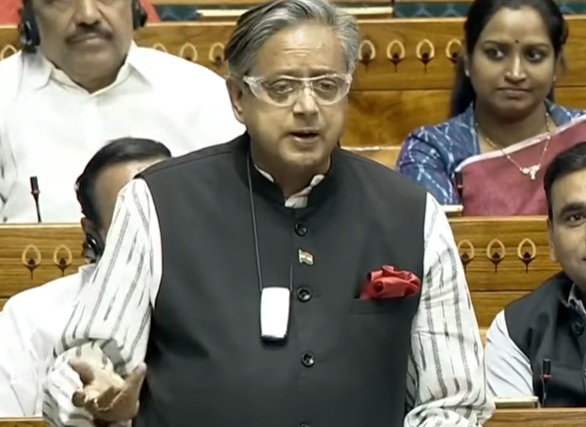
In the glorious circus that is the Indian Parliament—where debate usually means shouting “Jai Shri Ram” versus “Jai Bhim” at 120 decibels while the Speaker prays for early retirement—Shashi Tharoor stood up and committed the ultimate sin: he spoke like a professor who had actually read the Constitution. No slogans. No fist-pounding. Just crisp, lethal English laced with facts. The topic? The government’s masterful plan to bury the delimitation bomb inside the fragrant folds of the Women’s Reservation Bill. Even the Treasury benches blinked. For once, the House felt the unfamiliar chill of an actual argument.
With the poise of a man ordering a perfectly tailored suit while exposing a pickpocket, Tharoor dismantled the sleight-of-hand. Delimitation, he noted, is supposed to be the boring bureaucratic exercise of redrawing constituencies according to population. Instead, it has become the government’s favourite constitutional hack. Why debate something controversial in broad daylight when you can smuggle it wrapped in the unassailable silk of “empowering women”? It’s legislative genius—roughly equivalent to hiding a massive tax increase inside a speech about saving puppies.
The real masala, of course, is the north-south cold war that no one wants to name. Southern states like Kerala and Tamil Nadu, those over-achieving teacher’s pets of family planning, actually listened to the government’s slogans from the 1970s. They educated their girls, spaced their children, and built functioning health systems. Their reward for this responsible behaviour? Fewer seats in the next Parliament. Meanwhile, states with more enthusiastic approaches to procreation—blessed with higher fertility rates and lower governance metrics—stand to gain dozens of shiny new Lok Sabha seats. Punish success, reward enthusiasm. Classic Indian policy.
Tharoor didn’t shout “South India is being robbed!” like a regional chauvinist. He simply asked, in that annoyingly refined accent, whether a country that lectures the world about democracy can casually tilt its own power balance using 1970s census logic while pretending it’s all about Beti Bachao. The women’s reservation is popular across parties—exactly why it makes the perfect Trojan horse. Who dares vote against more women in politics? By the time MPs realise they’ve also voted for a massive southward transfer of political clout, the Bill will have become law and the south will wake up with a smaller voice in the House that claims to represent them.
This is where the satire turns deliciously dark. The same government that once championed cooperative federalism is now quietly engineering a demographic power shift under the cover of progressive feminism. It’s like announcing the demolition of your neighbour’s house during a joint family photo-op and calling it “urban renewal.” Tharoor called this what it is: legislative camouflage. Major constitutional surgery disguised as cosmetic gender reform. Parliament, that great theatre of democracy, reduced to a stage for political ventriloquism.
He wasn’t against delimitation itself. He wasn’t even against women’s reservation. He simply demanded the revolutionary idea that both should be debated honestly, separately, and with eyes wide open. An all-party committee. State consultations. Safeguards for federal balance. The radical notion that you don’t rewrite the electoral map of the world’s largest democracy by slipping it through as a side dish.
The government’s benches offered the usual indulgent smiles reserved for eloquent opposition irritants. The opposition cheered because Tharoor made their regional anxieties sound intellectual. And India’s millions busy surviving inflation and heatwaves, will discover much later that the rules of the game were quietly changed while they were clapping for the sari.
In the end, Tharoor did the most subversive thing possible in Indian politics: he treated Parliament like it still mattered. He spoke as if the Constitution was a living document and not a prop for soundbites. In a House drowning in rhetorical excess, that remains the sharpest satire of all.
