


By Advocate Salini T S ([email protected])
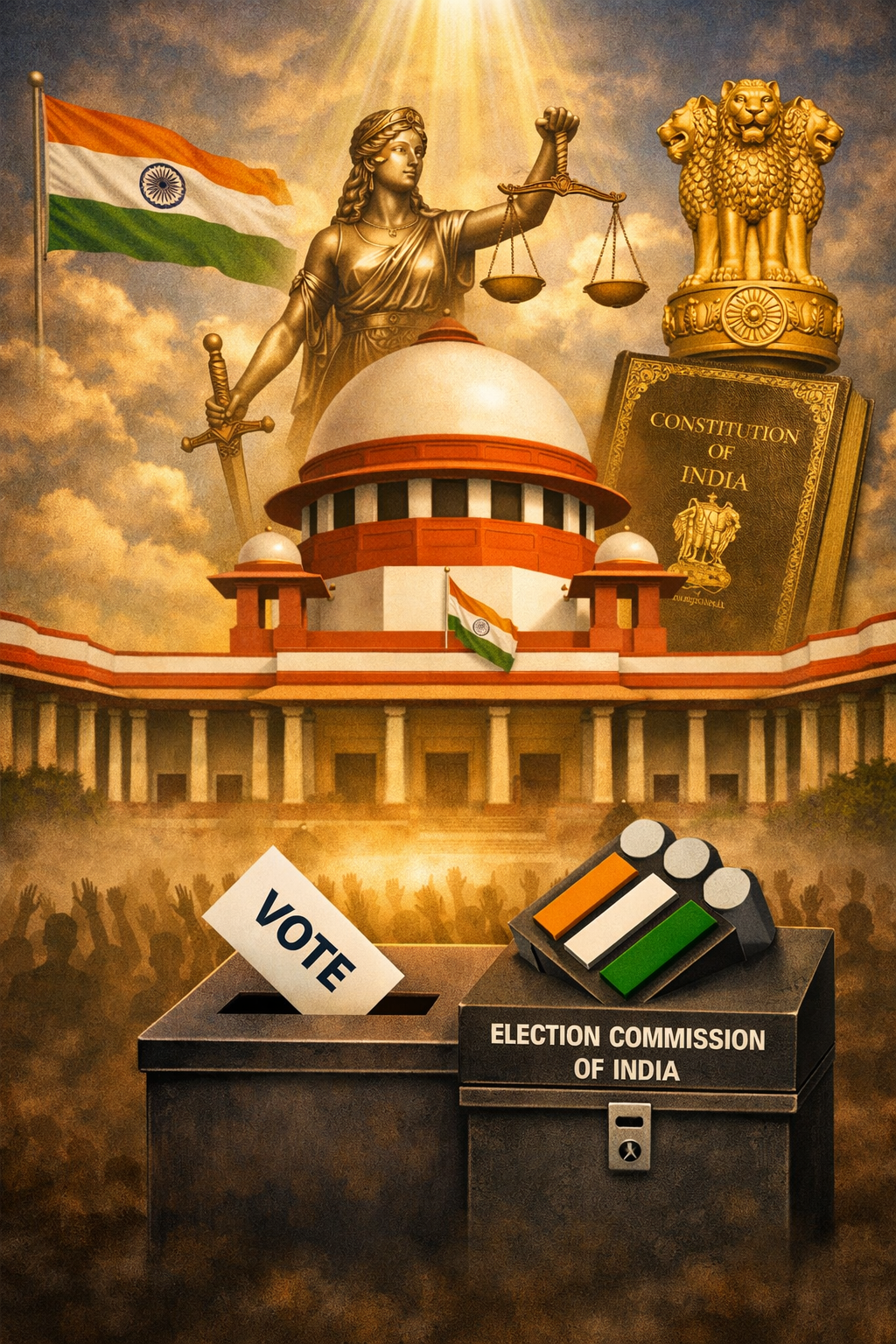
The constitutional debate unfolding before the Supreme Court of India over the appointment of Election Commissioners is far more than a technical legal dispute. It raises a fundamental question about the architecture of Indian democracy: how should those entrusted with conducting free and fair elections be selected, and to what extent must they be insulated from the executive? The answer will shape not only institutional design but also public trust in the electoral process.
At the centre of the controversy lies the Chief Election Commissioner and Other Election Commissioners (Appointment, Conditions of Service and Term of Office) Act, 2023, enacted by Parliament in response to the Court’s earlier ruling in Anoop Baranwal v. Union of India. In that landmark decision, the Court had intervened to fill a legislative vacuum, prescribing an interim selection committee comprising the Prime Minister, the Leader of Opposition, and the Chief Justice of India. The objective was to introduce a degree of neutrality into the appointment process until Parliament framed a law.
Parliament did enact such a law—but in doing so, it replaced the Chief Justice of India with a Union Minister nominated by the Prime Minister. This alteration has triggered the present constitutional challenge. Petitioners argue that the new structure effectively gives the executive a dominant voice in appointments, raising concerns about the independence of the Election Commission, a body that operates under Article 324 of the Constitution and is central to the conduct of elections.
The Union government, however, grounds its defence in constitutional text. Article 324 explicitly allows Parliament to legislate on the appointment process. From this standpoint, the 2023 judgment is framed as a temporary arrangement rather than a binding constitutional mandate. The government’s position is that once Parliament has exercised its authority, the Court must defer to the legislative framework unless it clearly violates constitutional limits.
The petitioners’ case takes a broader constitutional view. Relying on the basic structure doctrine, articulated in Kesavananda Bharati v. State of Kerala, they argue that free and fair elections are an essential feature of the Constitution. An independent Election Commission, they contend, is indispensable to that guarantee. Any law that risks executive influence over appointments—even indirectly—could therefore undermine a core democratic principle.
The Supreme Court’s engagement with these arguments reflects an awareness of the stakes involved. The Bench has questioned whether its earlier ruling was intended as a temporary stopgap or as a broader statement on institutional independence. At the same time, it has expressed concern about whether the current statutory framework provides adequate safeguards to ensure that the Election Commission remains insulated from political pressures.
In considering the likely outcome, three broad possibilities emerge.
One potential outcome is a complete validation of the 2023 Act. The Court could hold that Parliament has acted within its constitutional authority and that there is no requirement to include the judiciary in the selection process. Such a ruling would reinforce the principle of legislative supremacy in matters explicitly entrusted to Parliament. However, it may also invite criticism if it is seen as weakening the perceived neutrality of the Election Commission.
A second, more nuanced possibility is upholding the law with interpretative safeguards. The Court may choose to respect Parliament’s authority while reading into the law certain procedural protections—such as transparency in decision-making, a meaningful role for the Leader of Opposition, or stricter norms governing the search committee. This approach would allow the judiciary to preserve constitutional values without directly invalidating the statute.
The third possibility is partial invalidation or reading down. The Court could find that the composition of the selection committee, as currently structured, creates an imbalance that risks undermining institutional independence. Rather than striking down the entire law, it might direct modifications—such as reintroducing a neutral member or redesigning the committee to ensure greater balance. This would be consistent with the Court’s past approach of tailoring remedies to address constitutional concerns while avoiding institutional confrontation.
A complete striking down of the law appears less likely, given the explicit constitutional space granted to Parliament under Article 324. Historically, the judiciary has exercised restraint in areas where legislative competence is clear, preferring calibrated interventions over sweeping invalidations.
Ultimately, the Court is likely to seek a middle path—one that reconciles parliamentary authority with the constitutional imperative of maintaining public confidence in electoral institutions. The issue is not merely about who sits on a selection committee; it is about ensuring that the Election Commission commands unquestioned legitimacy in the eyes of the electorate.
The judgment, when it arrives, will resonate far beyond the courtroom. It will define the contours of institutional independence, clarify the limits of parliamentary power, and reaffirm—or recalibrate—the safeguards that underpin India’s democratic process. In doing so, the Supreme Court of India will once again be called upon to balance law with trust, and authority with accountability.
*The author is a practicing lawyer in the High Court of Kerala
