

Indian Economy- Ballooning Debt and Slowing Revenues; Trim Governance Costs to Escape Fiscal Disaster

By Our Business Desk
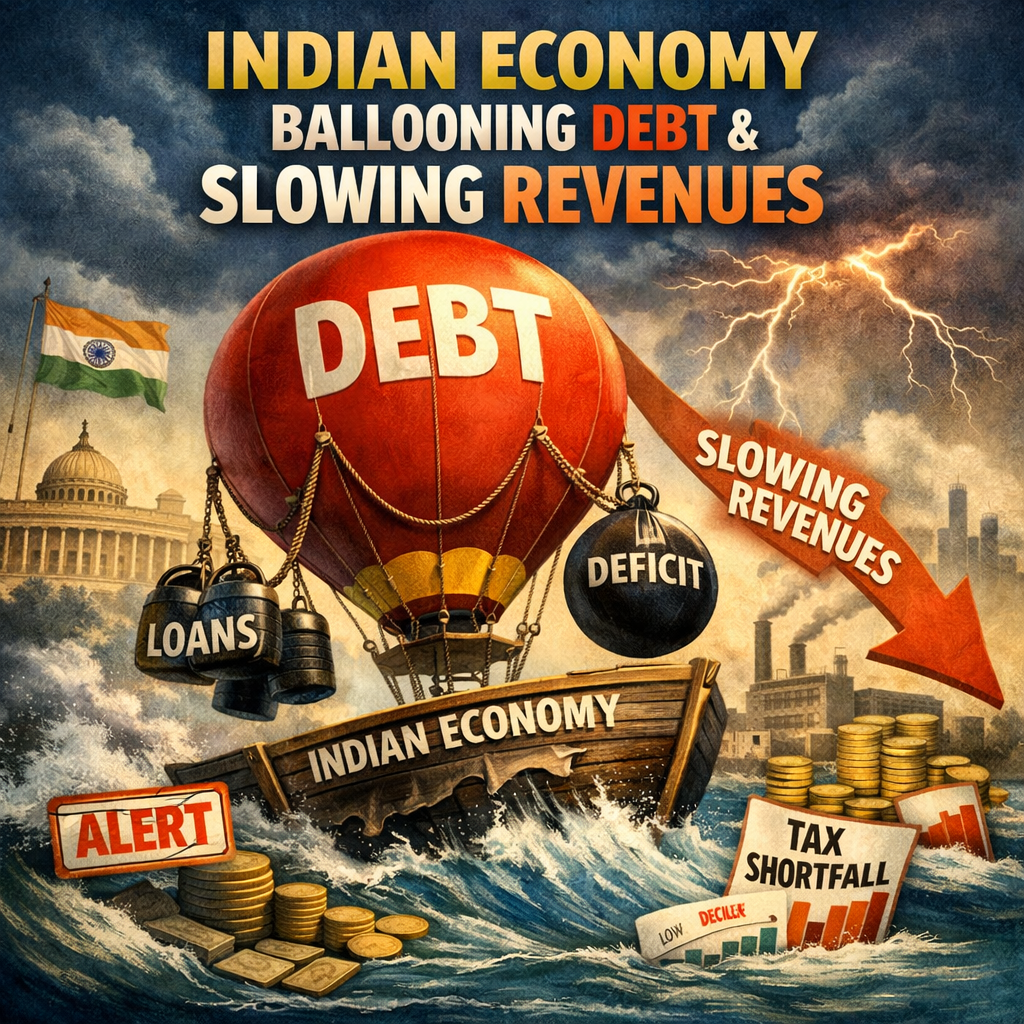
India’s Union Budget for 2026–27, with a total expenditure of ₹53,47,315 crore, arrives at a time when prudent fiscal management is critical. The central government debt has crossed ₹200 lakh crore, and revenue receipts are showing limited buoyancy amid slowdowns in key economic sectors. Interest payments alone stand at ₹14,03,972 crore — accounting for about 26% of total expenditure and nearly 40% of revenue receipts. In this challenging environment, a careful review of government spending, particularly avoidable and non-essential components in administration, establishment, and political machinery, can create much-needed fiscal space without compromising core governance or national security.
While committed expenditures such as salaries, pensions, and debt servicing are largely non-discretionary, there is scope for rationalisation, efficiency gains, and better prioritisation. Savings from these areas can be redirected towards welfare, infrastructure, and growth-oriented investments, helping ease debt pressure and support economic recovery.
The Rising Cost of Governance and Bureaucracy
The Establishment Expenditure of the Centre is estimated at ₹8,24,114 crore. This covers salaries, allowances, and administrative costs for around 3.5 million central civilian employees, along with substantial defence payroll. When combined with civil pensions of ₹2,96,214 crore and defence pensions, the total committed outlay on active payroll and pensions exceeds ₹7-8 lakh crore annually. The 8th Pay Commission, effective from January 2026, is expected to add further upward pressure on these figures.
These expenditures primarily serve government employees, pensioners, and their families — roughly one crore people including dependents. In comparison, major welfare schemes reach far larger sections of the population.
Practical Suggestions for Pruning:
Rightsizing the Workforce: Introduce a selective hiring freeze on non-essential and non-technical posts. Leverage natural attrition and redeploy existing staff. A thorough functional review across ministries can help eliminate overlapping roles and reduce administrative layers.
Technology-Driven Efficiency: Accelerate adoption of digital governance, automation, and artificial intelligence in routine administrative processes. This can significantly lower the need for additional manpower while improving service delivery and reducing paperwork.
Pay and Allowances Review: Strengthen the link between increments and measurable performance outcomes. Rationalise certain non-essential allowances and perks, especially those not directly related to productivity or hardship.
Pension System Reforms: Fully transition new recruits to the National Pension System (NPS) with sustainable parameters. Explore refinements in commutation rules and other benefits for better long-term affordability, while fully protecting the dignity and security of defence veterans and existing pensioners.
Departmental Rationalisation: Merge or restructure departments with similar mandates. Promote inter-ministerial coordination and single-window digital systems to cut duplication and operational costs.
Such measures, implemented gradually and thoughtfully, can generate meaningful savings over the medium term.
Political Executive, Elected Representatives, and Constitutional Offices
Allocations for the Council of Ministers, Cabinet Secretariat, Prime Minister’s Office, Parliament, President, Vice President, Governors, and related establishments, while relatively modest in the overall budget, carry high symbolic value. These cover salaries, allowances, travel, official residences, and support staff.
Suggestions for Austerity and Efficiency:
Restraint on Perks and Travel: Optimise use of official aircraft and international travel. Where security protocols permit, adopt more economical options and greater use of video conferencing.
Parliamentary and Ministerial Streamlining: Improve resource sharing across offices, reduce non-essential staff, and enforce stricter monitoring of constituency-related funds with clear outcome linkages.
Constitutional Offices: Align support structures and expenditures with current fiscal realities while maintaining the dignity of these high offices.
Greater transparency in reporting the full costs of political and administrative machinery, alongside measurable public outcomes, would strengthen public trust.
Public Welfare Spending: Reaching the Masses
In contrast to governance costs, direct welfare measures support hundreds of millions with relatively constrained resources. Core commodity subsidies are budgeted at around ₹4,10,495 crore, including the food subsidy under PMGKAY (₹2,27,629 crore) that reaches over 81 crore citizens, fertiliser subsidy for farmers, and PM-KISAN providing ₹63,500 crore to more than 11 crore farmer families. Broader social sector allocations in health, education, and related areas total around ₹9-10 lakh crore.
Committed expenditures on establishment, pensions, and interest together consume over 65% of revenue receipts, limiting flexibility for development and welfare programmes that touch the lives of ordinary citizens on a much larger scale.
The Path Forward: Balanced Fiscal Prudence
Addressing the current challenges requires a multi-pronged approach:
Universal Direct Benefit Transfers (DBT): Expand technology-enabled targeting to minimise leakages in subsidies. Even modest improvements in efficiency can release thousands of crore for genuine beneficiaries.
Performance-Based Budgeting: Link allocations more closely to tangible results — such as services delivered, projects completed on time, and measurable improvements in citizen outcomes. Reward departments that achieve efficiency targets.
Better Subsidy Design: Move progressively towards need-based and income-linked targeting in fertiliser, LPG, and other subsidies, while safeguarding support for the most vulnerable sections. Data analytics and Aadhaar linkage can reduce inclusion and exclusion errors.
Defence Expenditure Efficiency: Continue strong focus on indigenisation to lower long-term costs without affecting operational readiness. Encourage greater private sector participation in defence manufacturing.
Revenue Enhancement and Debt Management: Improve tax compliance, broaden the base, and accelerate asset monetisation and disinvestment. Prioritise low-cost borrowing and build buffers during periods of better revenue performance.
Centre-State Coordination: Encourage states to adopt similar austerity and efficiency measures, as fiscal health is a shared responsibility.
Even a 10-15% reduction in non-core administrative and overhead expenses, combined with leakage control in welfare delivery, could potentially free up ₹1-2 lakh crore over time. These resources could support additional capital spending, welfare expansion, or faster debt reduction — vital amid economic slowdown and revenue pressures.
India requires a capable bureaucracy, strong defence, and effective political leadership. However, in a democracy that belongs to its people, the costs of the governance machinery should not overshadow the needs of the wider population it serves. With public debt exceeding ₹200 lakh crore and moderating revenue growth, rationalising avoidable expenditures through rightsizing, technology, austerity, and better targeting is essential for long-term fiscal stability.
The 2026-27 budget presents an opportunity to begin this course correction more decisively. By striking a wiser balance between administrative costs and public welfare, India can strengthen its foundations for sustainable and inclusive growth, moving steadily towards the goal of a developed and self-reliant nation.
