


By Suresh Unnithan
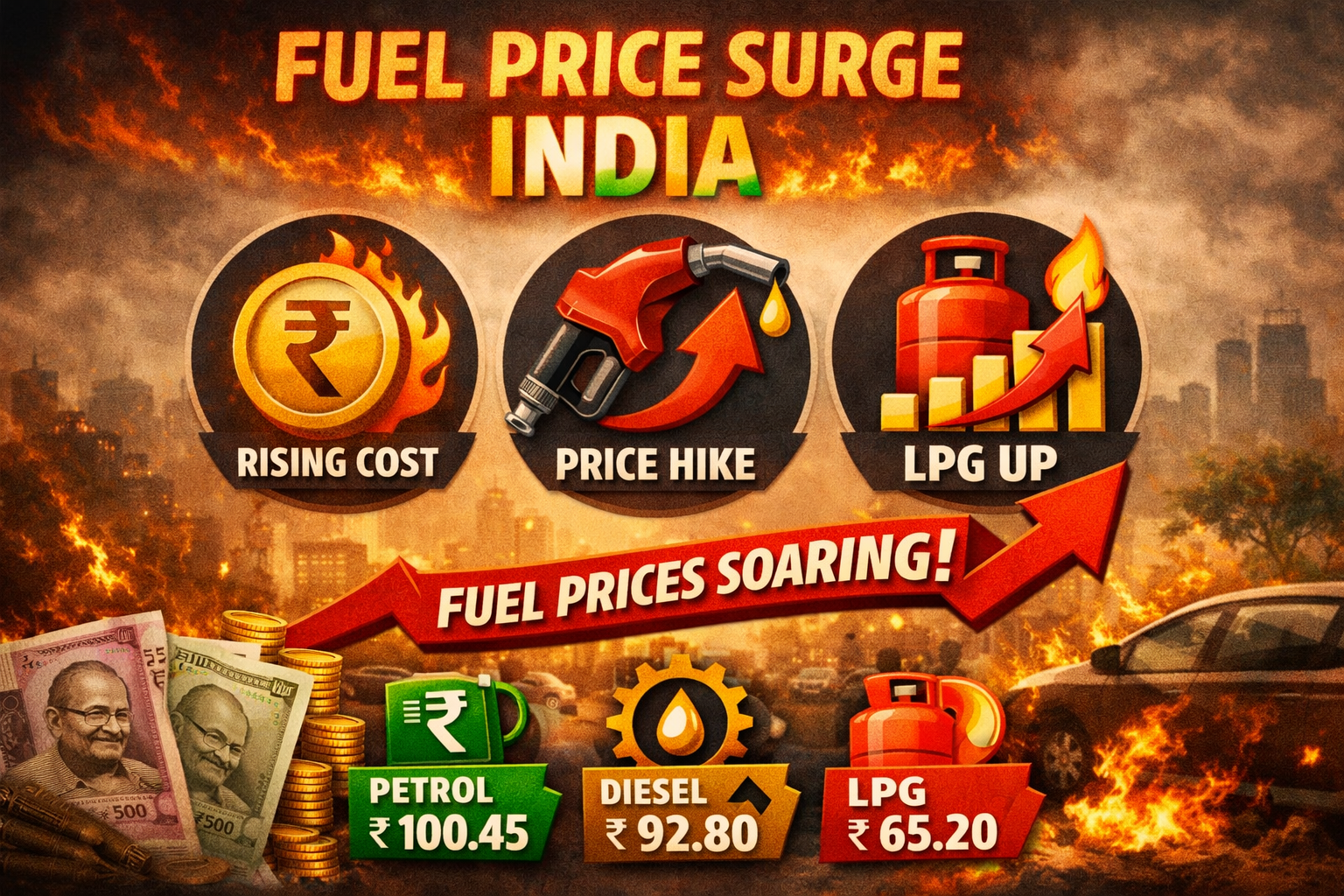
In the narrow lanes of Kollam, Kerala, and towns across India, the sound of a scooter or auto-rickshaw revving up has become a painful daily reminder of economic betraya l. Today, May 23, 2026, oil marketing companies announced yet another hike — the third in just eight days. Petrol prices jumped by 87 paise to ₹99.51 per litre in Delhi, while diesel rose by 91 paise to ₹92.49. Mumbai now sees petrol at ₹108.49, Kolkata at ₹110.64, and other cities even higher. These frequent revisions, often on alternate days, come amid global crude oil crossing $100-110 per barrel due to West Asia tensions.
For the common man, this is nothing short of a silent siege on survival. The days are becoming increasingly testing, with household budgets stretched to breaking point and patience wearing thin among those who voted the current government into power.
Crushing Daily Lives: The Relentless Burden on the Aam Aadmi
The impact is immediate, brutal, and deeply regressive. Daily wage earners — construction labourers, street vendors, delivery workers, and domestic help — who make up over 80-90% of India’s unorganized workforce, earn ₹400-700 a day. A significant portion now disappears into transport costs. A round trip that earlier cost ₹80-100 now demands ₹130-160, with zero wage increase to offset it. Many are forced to skip meals, reduce family portions, or walk longer distances, exhausting themselves before the workday even begins.
Middle-class salaried employees, already battling EMIs, school fees, and rising medical costs, watch their commuting expenses balloon by 20-30% in a matter of days. Families that once spent ₹6,000-7,000 monthly on essentials now face an extra ₹1,000-1,500 burden, pushing many into debt or distress. The cascading effect is merciless: vegetable, milk, and grain prices surge within hours as diesel powers the supply chain. This “essential inflation” devastates households where 50-60% of income already goes toward food and basic mobility. Frequent hikes destroy any possibility of budgeting, breeding chronic anxiety, helplessness, and deep resentment.
Growing unrest is palpable among the very public that voted this government in with hopes of Sabka Saath, Sabka Vikas. Protests are erupting in various parts, social media is flooded with frustration, and street-level discontent is rising as people question the disconnect between pre-poll promises and post-poll price shocks.
The Protected Class: Perks Shield the Powerful This pain is cruelly selective. For those in power — ministers, parliamentarians, and senior bureaucrats — regular fuel hikes never matter. They never pay from their own pockets. They live comfortably on public money, with taxpayer-funded official vehicles, free fuel allowances, free maintenance, and subsidized travel. Taxes collected from the common man are diverted to sustain their luxury lifestyles, shielding them entirely from the pump price reality. Big-ticket businessmen and corporations effortlessly pass on higher logistics costs to consumers, protecting — and often boosting — their profit margins. High-income groups spend just 2-5% of their earnings on transport, rendering these hikes practically irrelevant.
The Tax Trap: Where Your Pain Becomes Their Profit While the common man suffers, the government’s fuel tax machinery hums profitably. In 2024-25, petroleum taxes contributed a massive ₹7.57 lakh crore to the exchequer — Centre taking ~₹4.24 lakh crore and States ~₹3.33 lakh crore. This forms roughly 14% of Central tax revenue and 15% of States’ own tax revenue. Taxes and duties routinely make up 45–55% of the retail price at the pump.
Fuel remains outside GST, enabling a clever
layered extraction: base cost (~₹45-50), central excise and cesses (~₹19-22, with major portions like Road & Infrastructure Cess and Agriculture Infrastructure Cess going entirely to the Centre and kept outside the divisible pool), dealer commission (~₹3.5-4), and state VAT (₹15-30+, ad valorem — a neat “tax on tax”). The Centre dominates the lucrative non-shareable cess components, while States get VAT that automatically rises with central hikes.
Governments justify this as funding
infrastructure and welfare. In reality, it creates perverse incentives to keep prices elevated. The fiscal stakes are enormous, which is why sharp price cuts are rare even when global crude dips. The common man effectively subsidizes national highways and schemes, while bearing the inflation and reduced consumption that follow.
Economic Carnage: GDP, Inflation, and Eroded Purchasing Power The broader damage is severe. Repeated hikes ignite widespread inflation, potentially adding 20-50 basis points to CPI. The RBI may raise interest rates, choking loans for homes, education, and MSMEs. GDP growth projections for FY2026-27 (around 6.5-6.8%) face downward pressure — high energy costs could shave off 0.2-0.4 percentage points through reduced demand and manufacturing slowdowns.
Purchasing Power Parity (PPP)
suffers badly. India may be the world’s third-largest economy by PPP, but high domestic fuel prices erode real affordability for the masses. With modest per capita income, every litre feels exorbitantly expensive. This widens inequality, pressures the rupee via 85% oil import dependence, and risks stagflationary pressures: stubborn inflation alongside slowing economic momentum.
Political Hypocrisy: Slogans vs. Suffering
Sabka Saath, Sabka Vikas sounds increasingly like a satirical punchline. The slogan promised inclusive development for all, yet these frequent hikes expose a glaring disconnect. The ruling class remains blissfully unaffected, living off diverted public taxes, while the voters who brought them to power struggle with empty pockets and rising anger. Diversionary tactics in the media do little to hide the truth: short-term revenue gains are prioritized over long-term equity and growth.
A Call for Reckoning
Today’s hike exemplifies policy indifference and elitist disconnect. It erodes public trust, deepens inequality, and fuels growing unrest. Genuine reform demands rationalizing this regressive tax regime, bringing fuel under GST with safeguards, aggressive push for EVs and renewables, and targeted relief for the vulnerable. Until then, the pump price stands as a stark symbol of broken promises. For the daily wager skipping meals, the middle-class family cancelling doctor visits, and the salaried employee staring at depleted savings, the system feels rigged. The ruling class may remain unaffected by the heat at the pump, but India’s economic soul — and the common man’s patience — is reaching a breaking point.
* Research by Nanditha Subhadra
