

SEBI Order on Rajesh Exports Triggers Sharp Market Reaction, Raises Fresh Corporate Governance Concerns on Dalal Street

From Our Business Correspondent
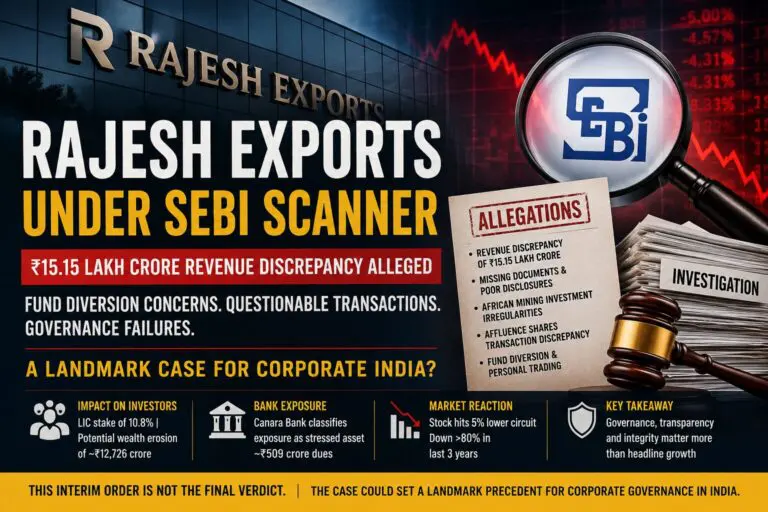
Mumbai: The Securities and Exchange Board of India’s (SEBI) explosive interim order against Rajesh Exports Limited (REL) has delivered an immediate jolt to investor sentiment, with the company’s shares crashing to the 5% lower circuit on June 4 and triggering wider unease about financial disclosures, auditor oversight, and risks in companies with heavy overseas subsidiary exposure.
The stock opened locked in the lower circuit and closed at around ₹104 on the BSE (down 4.99% at ₹104.65) and ₹103.92 on the NSE, reflecting heavy selling pressure as soon as the 109-page order became public. Trading volumes spiked amid panic exits, with the scrip witnessing circuit breakers that prevented further freefall but also trapped many investors.
Massive Wealth Erosion
SEBI’s order has spotlighted an estimated ₹12,725 crore erosion in public shareholder wealth since the stock’s peak of around ₹1,028 in early 2023. While not all of this decline is directly attributable to the latest revelations, the regulator noted that loss of credibility in financial statements significantly contributed to the sustained de-rating of the stock. Over the past year, REL shares have fallen nearly 47%, and over three years, the erosion exceeds 80%.
The company, once valued richly on the back of its reported multi-lakh-crore consolidated revenues, now trades at a fraction of its earlier highs, underscoring how quickly market trust can evaporate in the face of serious regulatory allegations.
Impact on Institutional Investors
Life Insurance Corporation (LIC), holding approximately 10.8% stake in Rajesh Exports, saw its own shares dip over 1% on June 4 amid contagion fears. LIC’s exposure is estimated at around ₹334 crore at current prices, making it one of the most visible institutional victims.
Foreign Institutional Investors (FIIs) hold around 14.26%, adding another layer of concern for overseas investors already wary of India’s corporate governance standards in certain sectors.
Over 1.94 lakh shareholders, predominantly retail, are directly affected, with many facing significant mark-to-market losses.
Mutual funds appear to have largely avoided the stock in recent years, limiting broader domestic institutional damage but highlighting LIC’s relatively concentrated bet.
Broader Market and Sectoral Ripples
While the immediate impact has been largely contained to REL and a few linked counters, the case has reignited debates on:
Transparency of overseas subsidiaries: A large portion of the alleged misrepresentation involved entities like Valcambi SA in Switzerland.
Auditor accountability and the effectiveness of consolidated financial reporting under Indian accounting standards.
Investor protection in high-profile mid-cap and sectoral stocks.
Analysts suggest this could lead to heightened scrutiny of other gold and jewellery exporters, companies with complex international structures, or those showing rapid revenue growth without matching cash flow or verifiable operations. It may also prompt fund houses and retail investors to demand stricter due diligence on related-party transactions and promoter conduct.
The benchmark indices — Nifty and Sensex — showed resilience on June 4 with marginal moves, indicating the incident has not yet spilled over into systemic risk. However, it serves as a stark reminder of company-specific risks in an otherwise buoyant market environment.
What Lies Ahead
Rajesh Exports has rejected the allegations, terming them a “communication gap” and pledging full cooperation with SEBI, including submission of detailed clarifications. The interim order restrains promoter Rajesh Mehta from dealing in the company’s securities, while a fresh forensic audit is underway. The final outcome could take months, involving possible penalties, disgorgement, or further bans.
Market watchers will closely track any follow-on actions, company responses, and potential contagion to other holdings of major institutions like LIC. For now, the episode has reinforced SEBI’s aggressive stance on corporate misreporting and delivered a painful lesson on the perils of trusting unverified financial scale.
This story continues to develop as investigations progress and the company prepares its defence. Investors are advised to monitor official disclosures and regulatory updates.
