


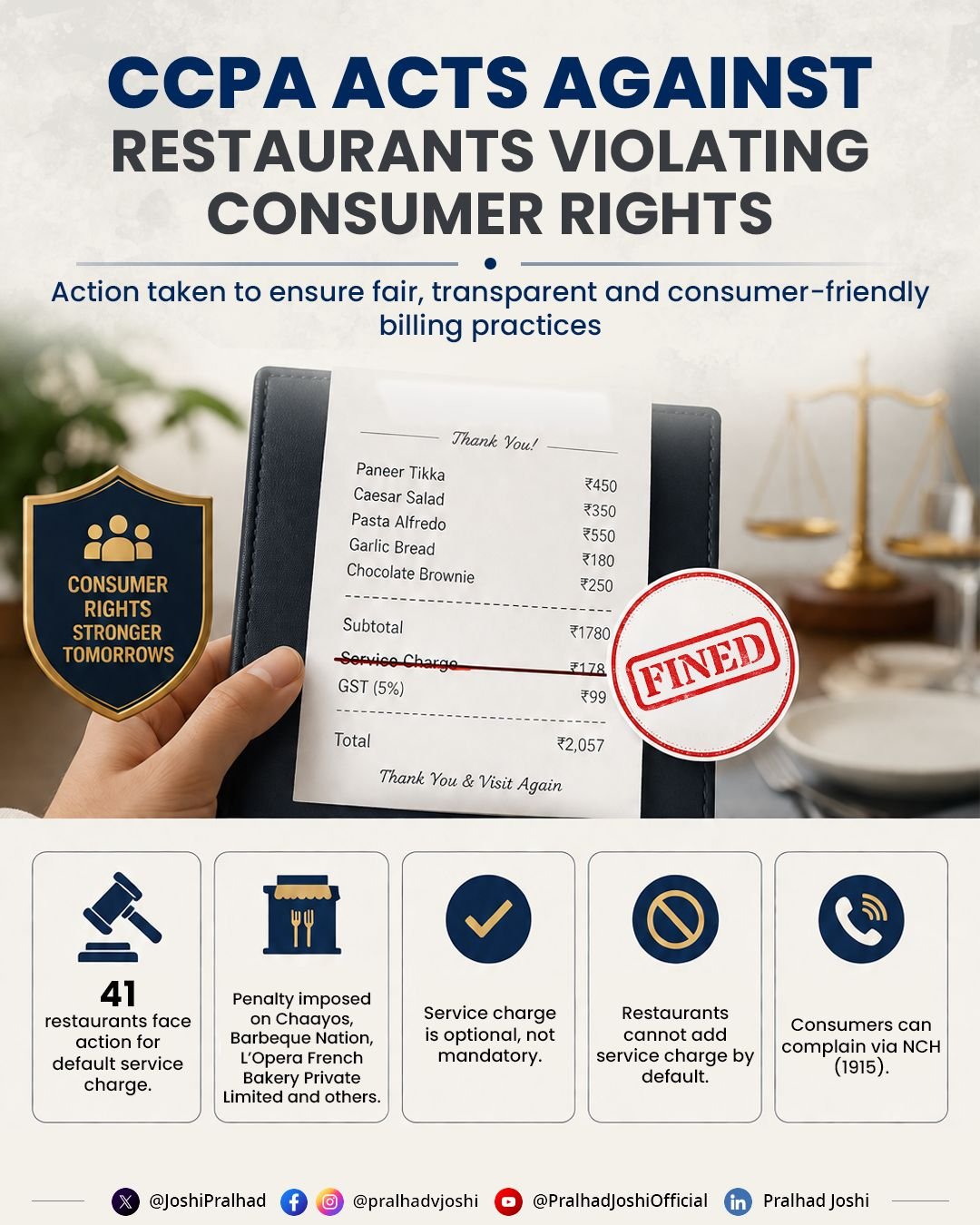
The Central Consumer Protection Authority (CCPA) has taken decisive suo motu action against 41 restaurants across the country for automatically levying service charges on bills without consumer consent, in clear violation of consumer rights and established guidelines. The move, based on numerous complaints received through the National Consumer Helpline (NCH), underscores the government’s commitment to protecting diners from unfair trade practices.
Union Minister of Consumer Affairs, Food and Public Distribution, Pralhad Joshi, shared the development on social media, highlighting the CCPA’s firm stance. “The CCPA has imposed penalties on violators, taken action against restaurants violating consumer protection law, and directed them to discontinue the automatic levy of service charge,” the Minister posted. He reaffirmed that service charge remains entirely voluntary and at the sole discretion of the consumer.
This latest crackdown builds on earlier enforcement actions, including cases against 27 establishments earlier this year. Restaurants found guilty were directed to refund collected amounts, modify their billing systems to prevent default additions, and, in several instances, pay penalties up to ₹50,000. Specific examples from prior actions involved outlets like Café Blue Bottle in Patna and China Gate Restaurant (Bora Bora) in Mumbai, where 10% service charges were added automatically.
Background and Legal Framework
The CCPA’s guidelines on service charges, issued in 2022 and upheld by the Delhi High Court in March 2025, clearly state that hotels and restaurants cannot mandate such levies. Key provisions include:
Service charge must not be added to the bill by default.
No restriction on service or entry for consumers refusing to pay.
The charge cannot attract GST when imposed mandatorily.
Establishments must inform customers that it is optional.
These rules stem from Section 2(47) of the Consumer Protection Act, 2019, which defines unfair trade practices. Investigations often begin with invoices submitted via the NCH (helpline number 1915), demonstrating how technology and consumer vigilance are driving accountability.
Implications for Consumers and the Industry
For millions of Indian diners, this is a significant win against a long-standing irritant. Many restaurants have historically added 5-10% service charges automatically, pressuring customers and inflating bills, especially in urban and tourist spots. The CCPA’s proactive approach is expected to deter widespread non-compliance and encourage transparent billing practices.
Industry bodies have been urged to educate members on compliance. Consumers are advised to review bills carefully, question any automatic additions, and report violations promptly. Refusing to pay a mandatory service charge should not result in denial of service.
This action aligns with the broader push for consumer empowerment under the Modi government. As Minister Joshi noted, the helpline remains open for grievances, empowering ordinary citizens to hold businesses accountable.
In an era of rising dining costs, such interventions reinforce trust in the system. Diners in Kerala and across India can now enjoy meals knowing their rights are protected. The CCPA has indicated continued monitoring, promising stricter measures against repeat offenders.
