

BJP Weighs Pradhan Exit Amid Gen Z Anger and Unrest Among NDA Partners

From Our Correspondent
New Delhi: The Bharatiya Janata Party is quietly weighing the political costs of retaining Union Education Minister Dharmendra Pradhan as student and Gen Z anger over repeated examination failures continues to swell across the country. What began as outrage over the NEET-UG 2026 paper leak has evolved into a sustained youth-led agitation that has put the ruling dispensation on the defensive, with NDA partners reportedly maintaining a calculated distance and privately signalling unease about the damage the protests could inflict on their own political futures.
The flashpoint remains the cancellation of the May 3 NEET-UG examination after a “guess paper” containing actual questions circulated widely. The National Testing Agency confirmed the breach, a CBI probe followed, and a re-examination was held on June 21 for more than 22 lakh aspirants. Pradhan himself admitted a “breach in the command chain.” Yet the episode was not isolated. Students and parents point to a pattern of paper leaks and evaluation controversies in recent years that have fuelled deep distrust in the National Testing Agency and the broader competitive examination system. Reports of student suicides linked to the stress have added emotional intensity to the protests.
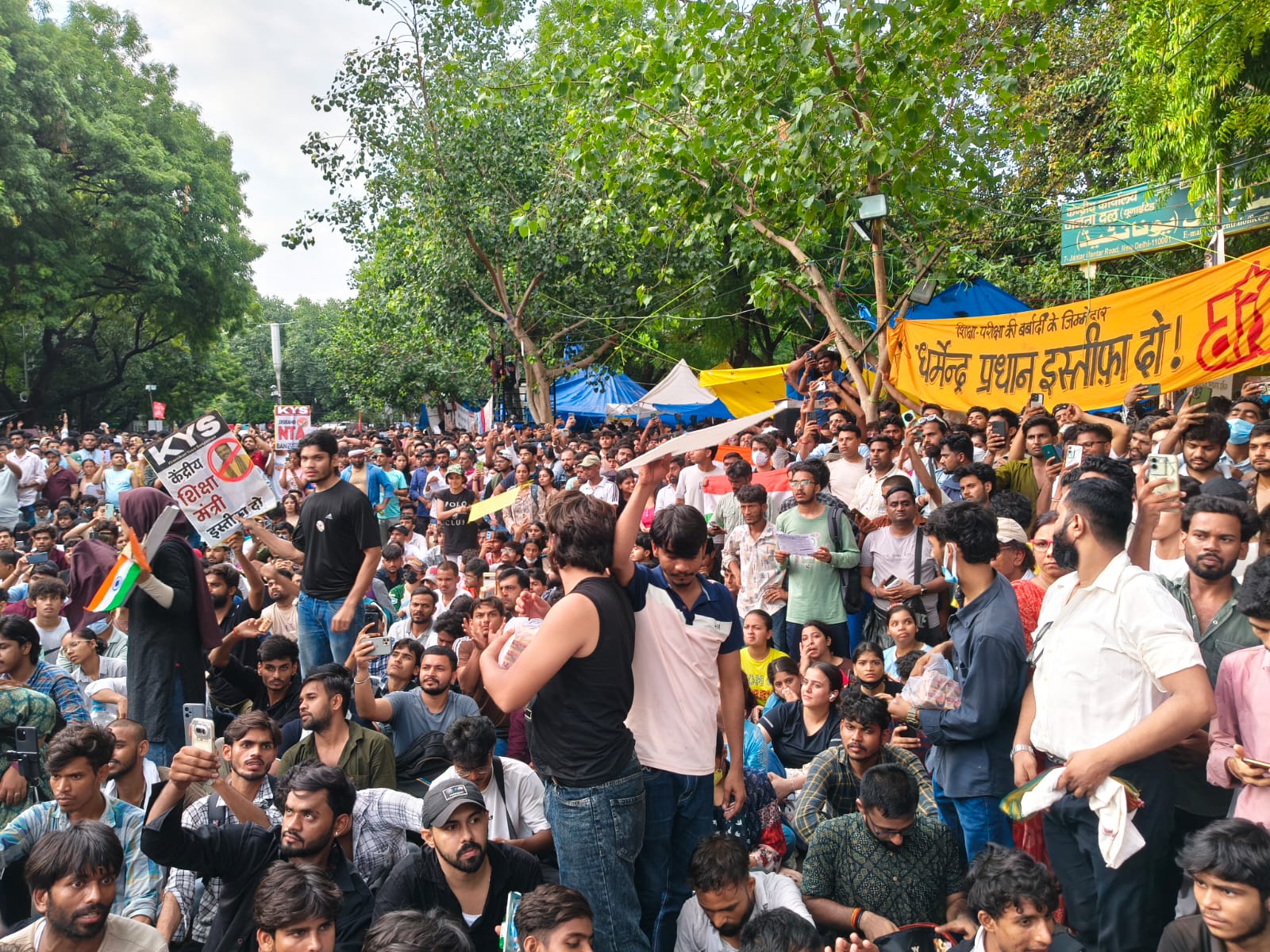
The Cockroach Janta Party (CJP), a youth-driven satirical movement that has captured Gen Z frustration, has kept the pressure alive at Jantar Mantar for over a month. Peaceful sit-ins have periodically escalated into marches towards Parliament, met at times with police batons and tear gas. Climate and education activist Sonam Wangchuk’s 26-day hunger strike, focused on systemic exam reforms and support for affected families, ended only after assurances of parliamentary discussion, compensation measures, and no action against peaceful protesters. The core demand, however, remains unchanged: Pradhan’s resignation.
Opposition parties have seized the moment. Parliament’s Monsoon Session has been repeatedly stalled, with Congress leaders including Rahul Gandhi and Priyanka Gandhi Vadra, along with other INDIA bloc voices, insisting that nothing short of the minister’s exit is acceptable. They frame the issue as one of accountability for systemic failure rather than an isolated administrative lapse.
Within the NDA, the response has been markedly more cautious. Allies have largely avoided public attacks on the agitating students, preferring silence or carefully worded statements that stop short of defending Pradhan. Political observers interpret this as a deliberate strategy. Regional partners fear that visible alignment with a hardline defence of the Education Minister could alienate the very young voters they hope to court in future state elections. The agitation, though concentrated in Delhi and major cities, has found echoes in Bengaluru, Mumbai and elsewhere, signalling that the discontent is not confined to one region or one community of aspirants.
For the BJP, the dilemma is sharper. The party has historically resisted sacking ministers under street pressure, viewing such moves as admissions of weakness that could invite a cascade of further demands. Pradhan has hit back, accusing the Congress of “exploiting students” for political disruption. Senior leaders have emphasised the government’s corrective steps — plans to shift NEET to a fully computer-based format from 2027, fast-track courts, and stricter penalties announced by the Prime Minister. Yet the optics of a minister remaining in office while students camp at Jantar Mantar and opposition benches refuse to let Parliament function are proving difficult to manage.
Sources within political circles suggest that informal discussions have begun about whether a graceful exit for Pradhan — possibly through a future cabinet reshuffle rather than an immediate resignation under duress — could help defuse the immediate tension without appearing to capitulate. The calculation is straightforward: prolonged student unrest risks hardening into a broader narrative of administrative indifference towards the aspirations of India’s youth. Gen Z, already sceptical of institutional processes, is watching closely. NDA partners, acutely aware of their dependence on youth and first-time voters in their respective states, are said to be conveying this concern quietly rather than through public confrontation.
The crisis, however, runs deeper than one minister’s tenure. It exposes long-standing vulnerabilities in the high-stakes examination ecosystem that determines the futures of millions. Paper leaks, opaque processes and the immense psychological burden on students have repeatedly surfaced, only to be met with temporary fixes. Whether Pradhan stays or goes, the agitation has already forced a national conversation on accountability, the credibility of testing agencies, and the political cost of appearing unresponsive to the anxieties of a generation that feels the system is stacked against it.
As the protests continue and Parliament remains disrupted, the BJP faces a familiar test of political management: how to project strength without allowing simmering youth discontent — and growing restlessness among its own allies — to harden into lasting electoral resentment. The coming days will reveal whether quiet internal pressure translates into concrete action or whether the government chooses to ride out the storm.
