


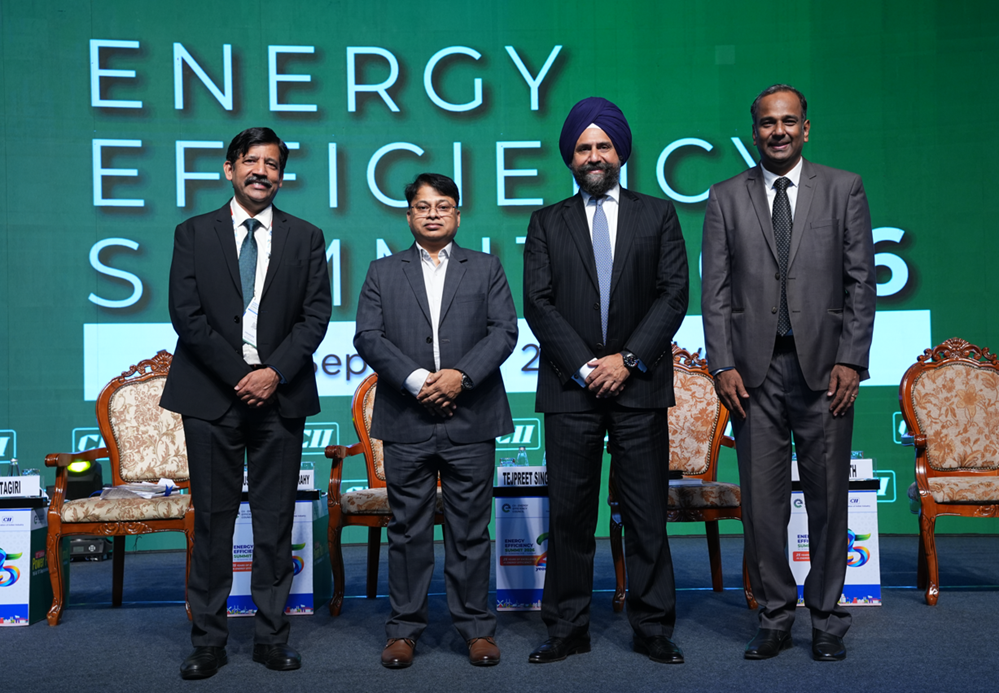
Hyderabad : The 25th edition of the CII Energy Efficiency Summit 2026 brought together policymakers, industry leaders, technology providers, academia and sustainability experts to deliberate on accelerating India’s transition towards a net-zero economy through energy efficiency, clean technologies and sustainable practices.
The next phase of India’s transition would require accelerated electrification, wider deployment of clean technologies, greater adoption of digital solutions and stronger collaboration between government, industry and institutions.
Shri Krushna Chandra Panigrahy, Director General, Bureau of Energy Efficiency (BEE), Government of India, Ministry of Power, in his keynote address said, “The 25th edition of the CII Energy Efficiency Summit marks an important milestone for India’s energy efficiency journey. The past 25 years provide lessons to build on as India enters a transformative phase of growth. Energy must remain affordable and reliable to support this growth. Energy efficiency and electrification will be central to meeting rising energy demand. While large industries have made significant progress, adoption among MSMEs needs to accelerate. The ADEETIE scheme can help address barriers related to technical capability, financing and operating costs. We must also advance industrial electrification, heat pumps, building efficiency, sustainable transportation, e-cooking and efficient cooling to support India’s Net Zero 2070 and Viksit Bharat 2047 goals.
Energy efficiency should not be seen as a compliance requirement, but as a pathway to global competitiveness. We need to use energy efficiently, electrify where technically viable, and progressively power electricity with cleaner sources. As energy demand grows, efficiency, affordability and reliability must remain central to India’s energy transition.”
Mr. Tejpreet Singh Chopra, Chairman, CII Energy Efficiency Summit 2026 and Founder & CEO, BLP-Industry.AI, said “AI and digital tools are becoming a catalyst for everything this Energy Efficiency Summit stands for, compressing the time between identifying an efficiency opportunity and acting on it. This is particularly important for India’s MSME sector, which contributes over 30% of our GDP, more than 33% of manufacturing output and close to 50% of our exports.
AI can bring tremendous impact to this vast base by making energy-efficiency insights more accessible, affordable and actionable. It can help MSMEs identify inefficiencies, optimise processes and make better data-driven decisions, even with limited technical teams. The opportunity is not AI versus workers, but AI plus workers — augmenting human expertise and accelerating India’s journey towards a Net Zero economy.”
Mr. P V Kiran Ananth, Executive Director- Energy Efficiency, Renewable Energy & Green Entrepreneurship, CII Godrej GBC while setting the context said, “Energy efficiency remains one of the most cost-effective levers for industrial decarbonisation. The 27th National Award for Excellence in Energy Management highlights this opportunity, with 720 industry respondents investing around ₹5,700 crore over the last three years and achieving savings of more than ₹7,100 crore.
Within just one year, participating companies have committed another ₹3,590 crores of investment towards electrification, process improvement, waste-heat recovery, digitalisation, IoT and AI. The focus now must be on maximizing the productivity of existing assets—where even 1% improvement in renewable-asset performance could deliver significant output without any additional investment. By combining energy efficiency, electrification, renewable energy, emerging technologies and innovative finance, India can accelerate decarbonisation while strengthening industrial competitiveness.”
A key highlight was the launch of the India Heat Pump Atlas – The National Installation Insights Dashboard, developed under the CII Heat Pump Alliance, a collaborative platform to accelerate heat-pump adoption and innovation in India. The Atlas consolidates data from 13 technology partners, covering 2,201 installations with a combined capacity of 288 MW of capacity, including 1,063 industrial and 1,138 commercial installations. Heat pumps have been deployed across sectors including automobiles, pharmaceuticals, chemicals, textiles, food, electronics, paper and petrochemicals, with applications ranging from hot water and process heating to drying, steam generation and boiler-feed-water heating. Notably, the Atlas identifies 34 industrial installations operating at 100°C or above, with applications reaching 140°C, demonstrating the potential of heat pumps for industrial process heating.
The afternoon sessions brought together industry leaders and experts to examine India’s progress and priorities in energy efficiency, renewable energy, electrification and decarbonisation. Discussions focused on energy efficiency as a key enabler of energy security and competitiveness, along with emerging policies, technologies, financing mechanisms and international best practices.
They also explored technological advancements, clean-energy solutions and programmes driving India’s net-zero transition. Discussions highlighted scalable technologies, innovation-to-impact models, technology adoption and measurable energy and emissions reductions. The final session examined academia’s role in taking clean technologies from laboratories to the market, with a focus on validation, entrepreneurship, industry-academia collaboration and technology transfer.
