

Two ECs Recorded 14 Objections as SIR Cut 13 Crore Names; Collegiate Character of Commission in Question

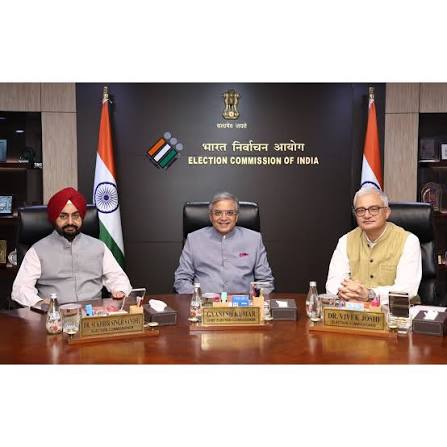
From Our Special Correspondent
New Delhi: A political and institutional storm has broken over the Election Commission of India after a leading national daily reported that Election Commissioners Sukhbir Singh Sandhu and Vivek Joshi formally objected, on record, at least 14 times in ten months to decisions they said were taken without their knowledge. The objections coincide with the nationwide Special Intensive Revision (SIR) of electoral rolls, which has struck more than 13 crore names from draft lists across 30 States and Union Territories.
Opposition parties have treated the report as evidence that Chief Election Commissioner Gyanesh Kumar concentrated power, ignored the collegiate character of the Commission, and allowed a process they call biased and disenfranchising. Election Commission sources have pushed back, insisting every decision, including those on SIR, was unanimous and carried the signatures of all three members. The clash goes to the heart of how India’s electoral umpire is supposed to work.
First among equals, not a one-man office
The Election Commission is a constitutional body under Article 324. Since 1993 it has been a three-member body: the Chief Election Commissioner and two Election Commissioners of equal rank. The CEC is first among equals. He does not have a casting or overriding vote.
That is Supreme Court law. In T.N. Seshan v. Union of India (1995), a Constitution Bench held that a multi-member Commission is valid; that the CEC is chairman, not a superior whose word is final; and that treating him as such would render the other Commissioners “non-functional or ornamental.” Differences must be resolved in a dignified way. The design is collegiate functioning, not a one-man office.
The Chief Election Commissioner and Other Election Commissioners Act, 2023, wrote the same idea into statute. Section 18 says the Commission’s business “shall, as far as possible, be transacted unanimously.” If the members differ, the matter “shall be decided according to the opinion of the majority.” Procedure and the division of work may be settled only by unanimous decision.
Gyanesh Kumar, a 1988-batch Kerala-cadre IAS officer, took charge as the 26th CEC on 19 February 2025—the first appointed under that Act. The selection committee comprises the Prime Minister, a Union Cabinet Minister and the Leader of the Opposition. That panel replaced the interim PM–LoP–CJI formula laid down in Anoop Baranwal (2023). Parliament dropped the Chief Justice. The Court has not struck the 2023 Act down. The fight over “who picks the umpire” sits beside the SIR merits ruling, not inside it.
What the objections covered
According to the investigation published by a leading national daily, the 14 recorded objections—four of them on a single day—touched SIR procedures, additions and deletions of names, restoration of voters, changes to statutory Form 6 (used for new voter registration), appeals against roll decisions, and access to the centralised electoral-roll database. Sandhu and Joshi described some steps as “unauthorised and illegal.” They argued that Form 6, a statutory form under the Registration of Electors Rules, 1960, could not be altered without amending the Rules. They warned against concentrating voter-database access in Delhi and bypassing State officials. In West Bengal they asked who had authorised large numbers of appeals seeking deletion of voters included by judicial officers.
In an unusual step, the two Commissioners separately wrote to Cabinet Secretary T.V. Somanathan over changes to the IT division’s work allocation that, they said, removed a layer of oversight of the electoral-roll backbone without their knowledge. A full three-member meeting on 9 September was described as the first such sitting in four months.
What the Supreme Court held on SIR
The SIR began in Bihar in June 2025 and was later extended nationwide. Official figures put deletions from draft rolls at over 13 crore. Opposition parties call the exercise a systematic purge; the Commission describes it as a necessary clean-up of dead, duplicate and ineligible entries.
On 27 May 2026, in Association for Democratic Reforms v. Election Commission of India (2026 INSC 564), a Bench of Chief Justice Surya Kant and Justice Joymalya Bagchi unanimously upheld the Bihar SIR. The Court held that Section 21(3) of the Representation of the People Act, 1950, allows a special revision “at any time” for reasons to be recorded, “in such manner as the Election Commission may deem fit.” Accurate rolls are the foundation of free and fair elections. SIR met the test of proportionality.
On citizenship the Court drew a careful line. Only citizens may be enrolled. The Commission may make a limited, prima facie electoral enquiry into citizenship. That enquiry is not a final determination under the Citizenship Act. Inclusion on the roll creates a rebuttable presumption. Deletion is an electoral consequence, not a citizenship decree.
The judgment was not a blank cheque. The Court directed that Aadhaar may be used as proof of identity, not of citizenship; that names deleted from the 2003 Bihar roll on the ground of non-citizenship must be referred to the competent authority under the Citizenship Act; and that persons deleted for absence, death, duplication or shifting may go to court. Those directions still bind the Commission. Later SIR phases have produced large first-cut deletions and, where appeals have been decided, high restoration rates—figures critics cite as evidence that the first cut was over-broad, even if the power to revise intensively is settled.
What the Court has not held is equally important. It has not held that the CEC may act alone. It has not held that statutory forms can be rewritten without following the 1960 Rules. It has not held that work allocation inside the Commission can be changed without the unanimous decision Section 18 requires. It has not ruled on the 14 written objections reported this week.
Functions, autonomy and the charge of a one-man office
The Commission’s core functions are superintendence of elections, preparation and revision of rolls, registration of parties, enforcement of the Model Code, and allocation of symbols. Technology platforms such as ECINet were meant to unify dozens of apps. The two Commissioners’ objections on centralisation and IT oversight go to whether that backbone remains under collegiate control.
Kapil Sibal said the majority was “not with Gyanesh Kumar” and demanded the CEC’s suspension and a halt to SIR. CPI(M) MP John Brittas called the Commission “a one-man autocracy.” Congress leader Manish Tewari spoke of an “invisible hand.” Derek O’Brien revived the earlier Rajya Sabha notice seeking the CEC’s removal. Akhilesh Yadav called the reported objections “extremely serious.”
ECI sources told several outlets that there was “no dissent,” only observations that were examined, and that all decisions bear the signatures of all three members. They stressed that majority rule exists if two of three agree. The Commission has not issued a detailed public point-by-point rebuttal of the 14 written notes.
Why the institution is under strain
Read in sequence, the law is this. The Commission is a multi-member constitutional body; the CEC chairs it and does not outrank the other two on decisions (Seshan). Intensive roll revision, including a limited citizenship enquiry for electoral purposes, is within the Commission’s power if it records reasons and keeps safeguards (ADR, 2026).
The present controversy is therefore not whether SIR can exist—the Court has said it can—but whether the manner of its national rollout, Form 6 changes, database centralisation, and IT-oversight orders were decisions of the Commission as a body or of the CEC acting as if the other two Commissioners were ornamental. That is exactly the distinction Seshan drew in 1995. The May 2026 SIR ruling does not dissolve it.
A multi-member Election Commission was designed so that no single officer could rewrite rules, alter statutory forms, or centralise the voter database without the others. When two Commissioners put “unauthorised and illegal” on paper, copy the CEC, and then write to the Cabinet Secretary, the appearance of collegiate functioning is damaged whether or not every final order carried three signatures. Until the Commission places the full record of those 14 notes, the work-allocation orders, and the Form 6 changes in the public domain, the charge of bias and of an autonomous CEC will continue to hang over an institution whose only capital is public trust.
