

New Labour Codes to Drive Simplified Compliance, Employment Linkages and Social Security: Labour Secretary at PHDCCI Seminar

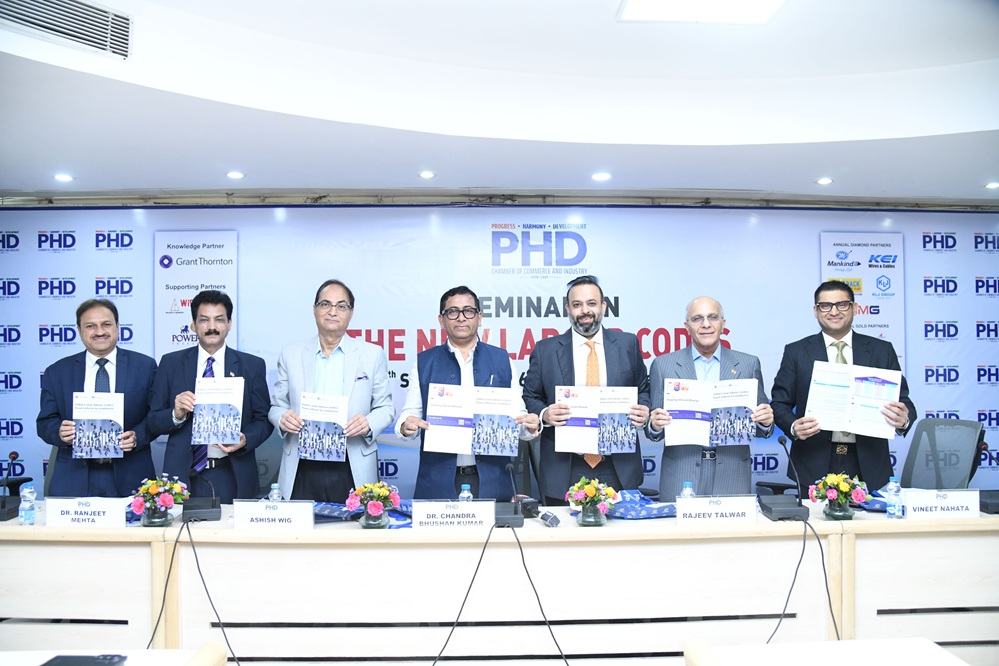
New Delhi: PHD Chamber of Commerce and Industry (PHDCCI) on Thursday organised a seminar on the new Labour Codes at PHD House, New Delhi, focusing on their practical implications, compliance requirements and operational changes for employers.
The seminar deliberated on the key provisions relating to wages, industrial relations, social security and occupational safety and working conditions, with industry stakeholders discussing the challenges and requirements involved in implementing the new framework.
Speaking at the seminar, Dr Chandra Bhushan Kumar, IAS, Secretary, Ministry of Labour and Employment, Government of India, described the new Labour Codes as a transformational shift from a regulatory approach centred on control towards greater collaboration and facilitation between government, industry and workers. He highlighted the rationalisation of the labour framework through the consolidation of laws, reduction in provisions, digitalisation of compliance, e-portals and uniform return filing, along with greater uniformity in the definition of wages. He stressed that implementation of this once-in-a-generation reform would be a collective responsibility, requiring close coordination with states and continuous engagement with industry. He said the Ministry is undertaking a coordinated awareness and training exercise across 316 districts with industrial clusters, while state labour machinery and master trainers are also being prepared. He noted that most states have pre-published their rules and said the Ministry is working towards completing the state-level rule-making process, while also providing greater clarity on floor wages and other implementation-related issues.
Highlighting the employment and social-security dimensions of the reforms, Dr Kumar spoke about strengthening the linkage between employment, skills and job opportunities through the National Career Service and integration of employment and skilling databases, including the expansion of career lounges. He said the new framework provides a stronger basis for extending social protection to gig, platform and unorganised workers, with the Ministry working towards connecting government welfare schemes through digital platforms to identify gaps and develop sustainable, long-term labour standards. He also emphasised that continued interaction with industry is essential for evolving FAQs and addressing implementation issues. Noting the growing international interest in India’s labour reforms, he said countries in the Global South are seeking to understand India’s approach, providing an opportunity to position India as a reference point for a modern labour ecosystem. He stressed that the focus now must be on executing the reforms through consultation and coordination with states and stakeholders, with patience and a solutions-oriented approach.
The broader implications of the reforms for workers and industry were also highlighted during the seminar. Mr Rajeev Talwar, IAS (Retd.), Director, Star Wire (I) Ltd., former CEO, DLF and former President, PHDCCI, said the implementation of the four Labour Codes must go beyond regulation to address formalisation, skilling, safety and dignity of labour and life. He emphasised the need to address affordable housing for migrant workers as urbanisation accelerates, noting that housing and access to basic services are closely linked to the education, safety and skilling of workers and their families. He also stressed that while labour reforms may increase costs for industry, higher productivity and skilling would be essential for India to remain competitive in manufacturing and services, calling for coordinated efforts by the government and private sector to strengthen worker welfare and living conditions.
Reflecting the need for greater handholding during this transition, Mr Ashish Wig, Chair, HR & IT Committee, PHDCCI, suggested that the government consider providing a one-year transition and support period to help industry adapt to the new compliance requirements. He emphasised the need to minimise confusion and potential disruption during the initial phase of implementation and proposed setting up a dedicated help desk to assist industry with queries and compliance-related issues.
The new Labour Codes mark a significant reform by expanding social security coverage, including to gig and platform workers, while decriminalising provisions that had acted as a deterrent to industry, Mr Vineet Nahata, Chair, Economics Affairs Committee, PHDCCI, said. He highlighted the focus on women’s empowerment and said the reforms are expected to foster entrepreneurship, strengthen management-labour relations and promote greater industrial harmony. He noted that industry has broadly welcomed the reforms despite the anticipated increase in compliance costs, viewing them as an important step towards strengthening India’s business environment and supporting India’s broader development objectives.
