


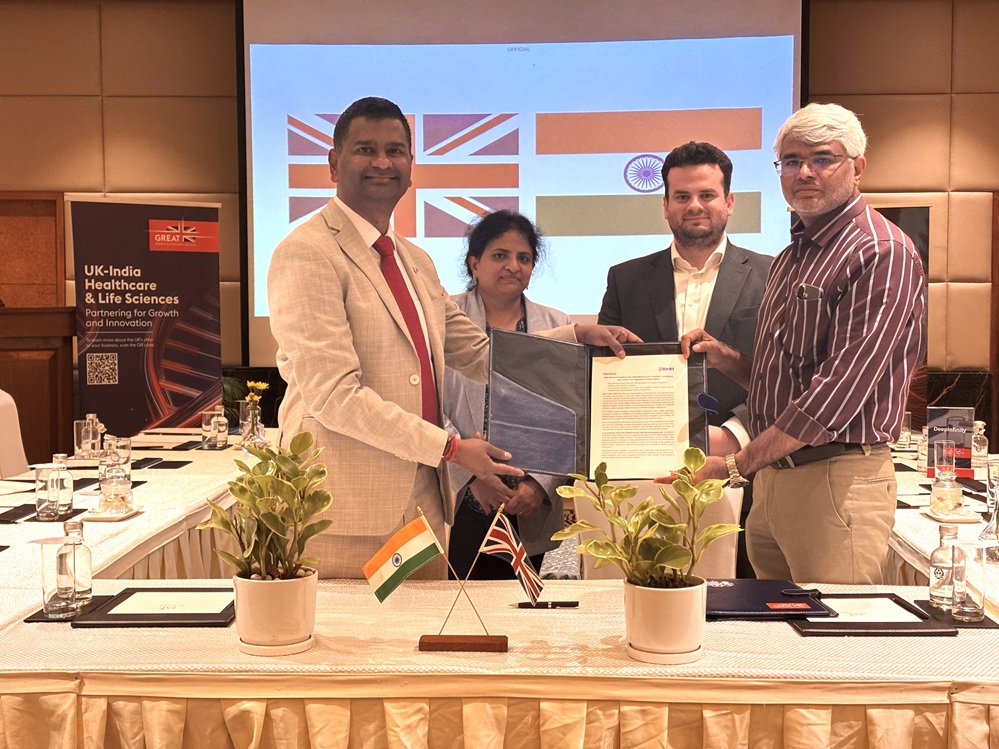
India : Baby Memorial Hospital (BMH) and DeepInfinity.AI have signed a Memorandum of Understanding (MoU) to introduce an integrated AI Partner model across BMH Group’s clinical and operational workflows. Announced during the UK-India Diagnostic Cohort Mission 2026, which brought together stakeholders to strengthen collaboration in healthcare and diagnostics between the two countries, the partnership aims to move healthcare AI beyond standalone applications towards a coordinated approach spanning multiple hospital functions.
The partnership will bring together AI applications across clinical documentation, radiology and laboratory reporting, intensive care unit (ICU) notes, discharge summaries, medical record digitisation and back-office operations under a single framework. The approach is designed to work with Hospital Information Systems to reduce the complexity of managing multiple technology vendors while enabling more consistent adoption across hospital workflows.
The partnership comes as healthcare providers increasingly look to translate AI’s potential into practical, everyday improvements in care delivery. For BMH Group, which operates nine hospitals, with more than 2,800 beds across Kerala, Tamil Nadu and Telangana, the opportunity lies in bringing AI into multiple workflows under a common approach to implementation, governance and performance measurement.
The implications extend beyond technology adoption. By automating routine documentation and reporting, AI could help clinicians spend less time on administrative tasks and more time with patients. More complete clinical records and timely reports and discharge summaries could support continuity of care. For hospital management, the coordinated approach offers the potential for greater operational visibility, reduced integration complexity and a scalable framework for AI adoption across the network.
Dr. Anup Warrier, Group Chief of Medical Services, Baby Memorial Hospitals, said, “As healthcare continues to evolve, the focus must be on adopting technology that meaningfully supports clinical teams and improves hospital operations. Through this partnership, we aim to take a more integrated approach to AI adoption, bringing applications across clinical and non-clinical functions under a coordinated framework. Our priority is to ensure that technology works alongside our existing systems, supports our healthcare professionals and contributes to efficient, patient-centered care.”
As AI Partner, DeepInfinity.AI will bring its portfolio of clinical AI applications to support workflows including clinical documentation, radiology and laboratory reporting, ICU notes, discharge summaries, medical record digitisation and back-office reporting. Its technology capabilities include ambient voice, speech recognition, clinical natural language processing and large language models designed to work with existing healthcare information systems. Individual applications will be introduced in mutually agreed phases.
Rama Krishna Boya, Co-Founder and CEO, DeepInfinity.AI said, “Being chosen as Baby Memorial Hospital’s AI Partner is a privilege. One partner that truly understands a hospital’s clinicians, operations and management can deliver AI faster, more safely and at lower cost than a patchwork of point solutions. We hope this model becomes a blueprint for hospitals across India.”
Harjinder Kang, His Majesty’s Trade Commissioner for South Asia and British Deputy High Commissioner for Western India, said: “The UK-India partnership is increasingly being shaped by innovation, technology and the ability of our businesses and institutions to solve real-world challenges together. This MoU demonstrates the potential for UK AI expertise and Indian healthcare leadership to work hand in hand, supporting responsible innovation while creating new opportunities for collaboration and growth across both countries.”
The collaboration reflects a broader opportunity for India’s healthcare sector: moving beyond individual AI experiments towards integrated, clinically governed systems that can scale across hospital networks. As providers seek to improve operational efficiency while maintaining quality, safety and accountability, approaches that combine interoperability, measurable outcomes and clinical oversight are likely to play an increasingly important role in the future of hospital care.
****
