

ISA Steel Conclave 2026 Concludes with Focus on Global Competitiveness, Quality and Growth of Indian Steel Industry

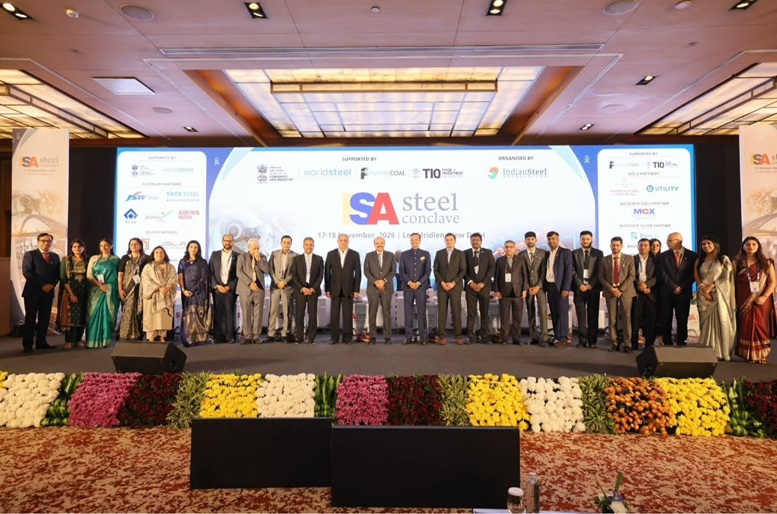
New Delhi : The seventh edition of the Indian Steel Association’s (ISA) ISA Steel Conclave concluded at Le Méridien New Delhi. The Government signalled that it would look into the levies outside GST that the industry says make Indian steel less competitive in global markets. Over two days, policymakers, steel producers and global partners deliberated on raw material security, trade, decarbonisation and the industry’s path to 300 million tonnes of capacity.
Addressing the valedictory session through a video message, Shri Piyush Goyal, Hon’ble Union Minister of Commerce and Industry, said, “Every day, steel builds homes, highways and factories. More than that, it builds a nation’s strength and its aspirations. Our ambition must now extend beyond producing more steel to producing the world’s most trusted steel. With India’s exports reaching $863 billion in FY26 and slated to touch $1 trillion this year, steel must add significant value to this growth. This calls for a shift from supplying steel to supplying solutions for ships, modern construction and advanced manufacturing. We must make quality our identity, so that customers choose Indian steel because they can trust it. The Government will ensure that Indian steelmakers are protected from unfair trade practices.”
The Minister added that the ₹25,000 crore Export Promotion Mission will help even the smallest steel enterprises meet export, certification and compliance requirements.
Shri Naveen Jindal, Hon’ble Member of Parliament (Lok Sabha), Chairman, Jindal Steel Limited and President, Indian Steel Association, said the industry is firmly on course to produce 300 million tonnes. He noted that dependence on imported coking coal and unfairly priced imports continue to put pressure on domestic producers who have invested heavily in the country.
“Indian companies pay several levies that are not subsumed under GST, such as royalty on raw materials, high premiums on coal and iron ore auctions, and electricity duty. On iron ore, most of our companies have paid premiums of more than 100%, which makes it almost as costly as imported ore. Since these levies fall outside GST, we receive no credit for them when we export. In other countries, such costs account for about 1 to 2% of the cost. In India, they account for 10 to 12%. The Indian Steel Association will carry the recommendations of this conclave forward to the Government with clarity and purpose,” said Shri Naveen Jindal.
Speaking at the valedictory session, Shri Rajesh Agrawal, Hon’ble Secretary, Department of Commerce, Ministry of Commerce and Industry, Government of India, said, “Shri Naveen Jindal has spoken about certain taxes that are not subsumed under GST and add to the cost of the industry. I take this message very strongly. These are not easy solutions, as they involve both state and central levies, but I will work within the Government to see how the Indian steel industry can become the most cost efficient producer in the world. Trade today is closely linked to geopolitics. It is not only about economic efficiency but also about trust, resilience and relationships.”
Shri Agrawal urged the industry to build supply chains in markets across Africa and parts of Latin America, ASEAN and Oceania,” he added.
A session on new growth centres for steel examined emerging hubs. A McKinsey presentation there pointed to around 50 million tonnes of steel capacity in Vidarbha, 17.8 million tonnes in Andhra Pradesh and 10.5 million tonnes in Koppal, Karnataka.
Shri Alok Sahay, Secretary General and Executive Head, Indian Steel Association, said, “Gadchiroli in the Vidarbha region of Maharashtra is a clear example of what a state can achieve when mineral access, logistics and policy support come together. Much of the new capacity planned for 2030 will come up beyond the traditional steel belt, and ISA will work with state governments to address the issues that will help these new growth centres grow.”
The final day of the conclave also turned the spotlight on coking coal, a raw material for which Indian steelmakers still depend heavily on imports. ISA hosted the fourth edition of the ISA Coking Coal Summit alongside the conclave, with EY Parthenon as Knowledge Partner. Two knowledge reports prepared by EY Parthenon in consultation with ISA, titled Steel, The Backbone of the Indian Economy and Coking Coal, Fueling India’s Steel Ambition in a Carbon Priced World, were released at the summit. They add to the body of insight ISA will draw on as it takes the conclave’s recommendations forward to the Government.
****
