

PCI President Calls for Industry-Ready Pharmacists, Stronger Academia-Industry Collaboration and Ethical Medicine Practices

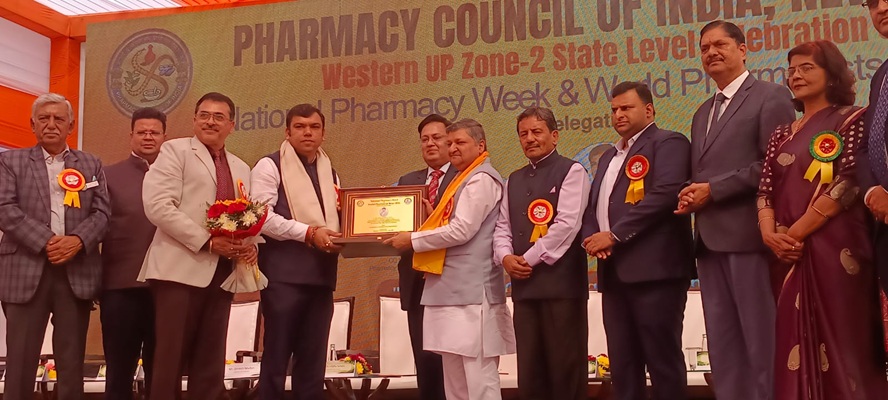
Ghaziabad/New Delhi : The Pharmacy Council of India (PCI), New Delhi, successfully concluded its state-level celebrations of World Pharmacists Day (WPD) and National Pharmacy Week (NPW) 2026 at HRIT University, Ghaziabad, Uttar Pradesh, on Friday. Organised under the theme “Swasth Bharat: Combating Antimicrobial Resistance (AMR),” the event brought together approximately 2,500 participants, including pharmacy students, faculty members, practising pharmacists, government representatives and distinguished guests from more than 100 pharmacy institutions across Uttar Pradesh and the West Zone.
The programme focused on raising awareness about antimicrobial resistance (AMR) and highlighting the critical role of pharmacists in promoting the rational use of medicines, responsible antibiotic dispensing and patient safety. A series of academic, awareness and cultural activities were organised to encourage students and faculty members to actively contribute towards addressing emerging healthcare challenges.
The celebrations commenced with an awareness rally led by pharmacy students, who carried messages highlighting the importance of responsible antibiotic use, prevention of antimicrobial resistance and the role of pharmacists in safeguarding public health. Students representing various pharmacy institutions participated enthusiastically in the rally.
The inaugural session was attended by Dr. Montu Kumar M. Patel, President, Pharmacy Council of India; Shri Anil Agarwal, Chancellor, HRIT University; Prof. (Dr.) Vibhu Sahani, State Convenor, Uttar Pradesh; Mr. Dinesh Kumar Madan, State Convenor, New Delhi; Shri Mohd. Basir, National Coordinator; Prof. (Dr.) Akash Ved, Co-Chairman; Prof. (Dr.) Nakul Gupta, State Coordinator; Prof. (Dr.) Shikha Parmar and Dr. Navneet, State Co-coordinators, among other dignitaries and representatives of the pharmacy fraternity.
Addressing the gathering, Dr. Montu Kumar M. Patel, President, Pharmacy Council of India, emphasised the need for comprehensive reforms in pharmacy education, stronger industry–academia partnerships and a greater focus on ethical professional practices and patient safety. He said:
“Pharmacy education and the pharmacy profession in India are undergoing an important transformation. Our vision is to bridge the gap between classrooms, clinical practice and the pharmaceutical industry by building industry-ready, ethical and patient-centric pharmacists. Academic knowledge alone is not sufficient; students must also acquire practical skills, professional ethics and an understanding of the real-world requirements of the healthcare and pharmaceutical sectors.
“To achieve this, we need stronger collaboration between pharmaceutical industries and academic institutions through Memorandums of Understanding (MoUs), enabling students and faculty members to benefit from industry exposure, practical learning and research opportunities. We also need to strengthen the practical component of pharmacy education by ensuring structured and compulsory exposure to the pharmaceutical industry for students. This will help prepare graduates who are skilled, competent and ready to meet the evolving requirements of the industry.
“Another important priority is to simplify and streamline pharmacist registration through a common digital portal that can facilitate registration across State Pharmacy Councils. Digitalisation, paperless administration and initiatives such as Healthcare Professional Registration will make professional services more accessible, transparent and efficient.
“Equally important is the promotion of ethical pharmaceutical practices, including appropriate pharmaceutical dosage, responsible dispensing and the rational use of medicines. Pharmacists have a responsibility that extends beyond dispensing medicines. They must actively educate patients about the correct dosage, appropriate use, possible side effects and the importance of following prescribed treatment. Patient awareness and responsible medicine use are essential to prevent misuse, self-medication and the growing threat of antimicrobial resistance.
“We are also committed to strengthening pharmaceutical research and addressing quality-related concerns by facilitating access to Active Pharmaceutical Ingredients and pharmaceutical excipients for researchers. This will support research activities and encourage quality-focused innovation in the pharmaceutical sector.
“One of the biggest challenges before the healthcare sector today is Antimicrobial Resistance (AMR). Pharmacists have a crucial responsibility in addressing this challenge by ensuring the rational use of medicines, preventing unnecessary antibiotic dispensing and discouraging self-medication. We must also encourage adverse drug reaction reporting among pharmacists, teachers and students, as timely reporting can help identify medicine-related risks and strengthen the country’s drug safety system.
“Teachers and students must be encouraged to adopt new learning methods through initiatives such as Faculty Development Programmes and skill-based training. Our objective is to create a new generation of professionally competent, industry-ready and ethically responsible pharmacists who put patient safety first and contribute to better healthcare delivery and the growth of India’s pharmaceutical sector.”
Highlighting India’s growing global position in the pharmaceutical sector, Shri Anil Agarwal, Chancellor, HRIT University, appreciated the contribution of Indian pharmaceutical companies and pharmacists in strengthening the country’s healthcare capabilities.
He said, “India has transformed itself from being dependent on imported medicines to becoming a global pharmacy. The contribution of Indian pharmaceutical companies and pharmacists, particularly during the COVID-19 pandemic, has been remarkable. I congratulate the Pharmacy Council of India and its President, Shri Montu Kumar Patel ji, for their dedicated efforts towards strengthening pharmacy education and the profession. Such initiatives will inspire pharmacy students and faculty to contribute towards India’s growing global identity in healthcare.”
The celebrations featured a range of academic and student engagement activities, including a panel discussion, Pharma Quiz, Scitoons, poster presentations, leaflet preparation, reels making and street plays (Nukkad Natak). These activities provided students with a platform to showcase their knowledge, creativity and communication skills while spreading awareness about antimicrobial resistance and the importance of responsible medicine use.
A cultural programme was also organised as part of the celebrations, providing students from participating institutions an opportunity to showcase their talents and cultural diversity.
The programme concluded with a valedictory session attended by participants, faculty members and dignitaries, marking the successful completion of the celebrations. The event reinforced the importance of collective efforts by pharmacy professionals, educators, academic institutions and the pharmaceutical industry in strengthening pharmacy education, promoting ethical practices and addressing the growing challenge of antimicrobial resistance.
****
