

A founding circle gathers in Mumbai to launch the Udayan Movement: a ten-year national effort to build 1,000 young institution builders for achieving Viksit Bharat 2047

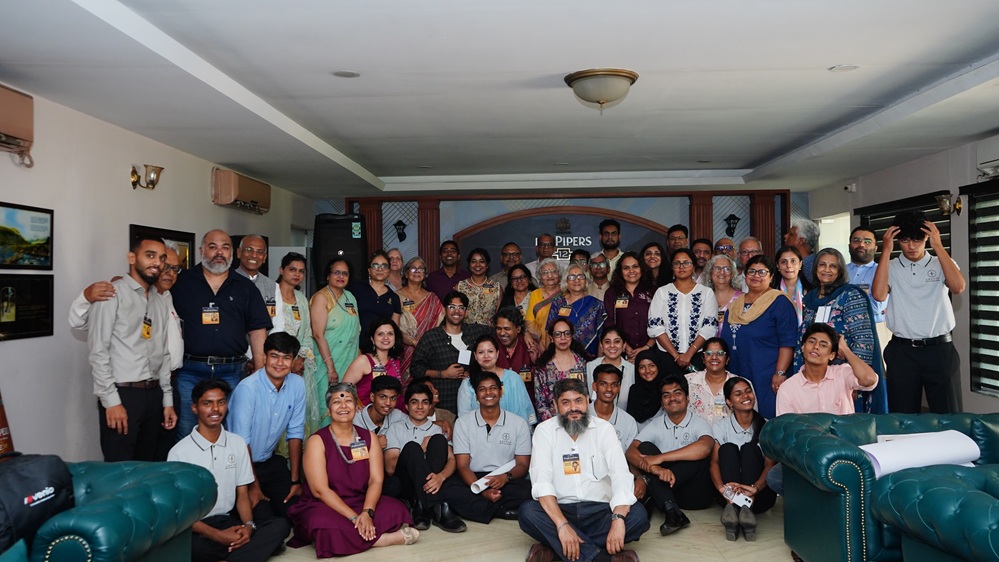
MUMBAI: As some young Indians take to the streets demanding change, a founding circle gathered in Mumbai on Saturday, 10 October, to begin a different kind of answer: a national movement to form the young leaders who will build the India of 2047.
The circle comprised vice chancellors of universities, leadership mentors to CxOs, CSR and social impact strategists, founders of businesses, serial entrepreneurs, lawyers, and administrators. They came from every stage of life: the gruhastha, building career and family; the vaanaprastha, guiding from experience; and the sanyaas, holding the long view. Beside them sat the students of the first USSL cohort, the brahmachari, the learner. In Bharat’s ashram vyavastha, these four stages together raised a leader. For one afternoon, all four were in one room.
The Udayan Movement begins from a conviction older than any school: Rashtra nirman manushya nirman se hota hai, nation-building begins with human development. In the gurukul parampara, no single teacher made a leader. A whole society did. The Udayan Movement’s purpose is to restore that interdependence and build communities anchored in arthasampada, dharma-aligned prosperity across generations. That is the road to Viksit Bharat.
As USSL’s first patron, I have seen what these students can do. What moved me in Mumbai was that the support in the room was not only capital. It was time, judgment and belonging, from people at every stage of life, given to young people who have not yet earned a thing from us. That is how a society invests in its future – Jayesh Shah, Social Equity Entrepreneur and First Patron of USSL
The need is large. By 2046, about 14.58 crore of today’s children and young people will be seeking work. * Skilling prepares workers. Someone has to create the work. The Movement’s answer is the builder: a young leader formed to create enterprises and institutions that employ others. The Udayan Movement aims to form 1,000 young institution builders in the next ten years.
India has never lacked young people. It has lacked the community that forms them. On Saturday, that community began to gather again. – Anamika Dasgupta, Social Entrepreneur and Educationist, Building leaders for Bharat rooted in the Arthashastra
At its heart is the Udayan School of Social Leadership (USSL), Pune: a five-year, full-time programme for students after Grade 10. It is the summit of the Wonder School Learning Collective, which forms young people from age 3 to 20, and it rests on 15 years of Potters Earth Foundation’s work with about 2 lakh students and 50,000 teachers. USSL is not a start-up incubator or a business degree. It is a leadership formation operating structure rooted in Arthashastra, Nyaya Darshan and Bharat’s Gurukul parampara, and it selects for character, not just academic performance. In ten years the Movement aims to form 1,000 young institution builders and 5,000 more founders mentored in their communities. These are USSL’s own targets.
In CSR, we usually ask what a programme will deliver in a year. The Udayan Movement asks what a generation will build in ten years. That is a longer horizon and a better investment: not in a programme, but in leaders who will create institutions that outlast the funding. – Saurabh Sharma, CSR and Social Impact Strategist
The first proof is already at work. For months, the students of USSL studied the Viksit Bharat 2047 documents, attended lectures on law and governance and masterclasses by industry veterans, and did field research in the communities where the problems live. They arrived at several enterprise ideas within the Sapta Dhara, the seven streams of national strength Prime Minister Narendra Modi set out as the roadmap to Viksit Bharat 2047: AnnaGati (food security and logistics) – moving safe surplus food to nutritionally insecure city communities, while earning income for local women; BeejSwaraj (agriculture and seed sovereignty) – helping farmers keep more of the value they create; DishaSetu (youth skills and career guidance) – giving young people direction, proof of skill and money sense beyond a marks number; FishLoops (blue economy and circular supply chains) – recovering value from the fish waste Pune’s markets discard; Voice of Cashew (women, nutrition and sustainability) – turning wasted cashew apples and shells into wealth, with safety, skill and ownership for the women of the chain.
Every idea is tested three ways: is it ethical, is it financially viable, and is it legal and fair to every stakeholder?
The founding circle will continue to work alongside the students to take each idea from research towards a working social enterprise.
“The Arthashastra begins not with power of authority, but with inner power: the discipline of the self (Indriyajaya). A leader is formed before he/she leads. I have carried that idea into corner offices and boardrooms for years. In this, we applied it to young people at the very start of their journey, and they were asking the Arthashastra’s questions: is it true to our dharma, is it viable, and is it healing to everyone it touches?” – Rajesh Kamath, Leadership Mentor to CxOs, taking Kautilya’s Arthashastra from text to modern management
*****
