

After Seeing Classmates Struggle, this 15-Year-Old from Delhi Built an AI Wearable for Children with Autism

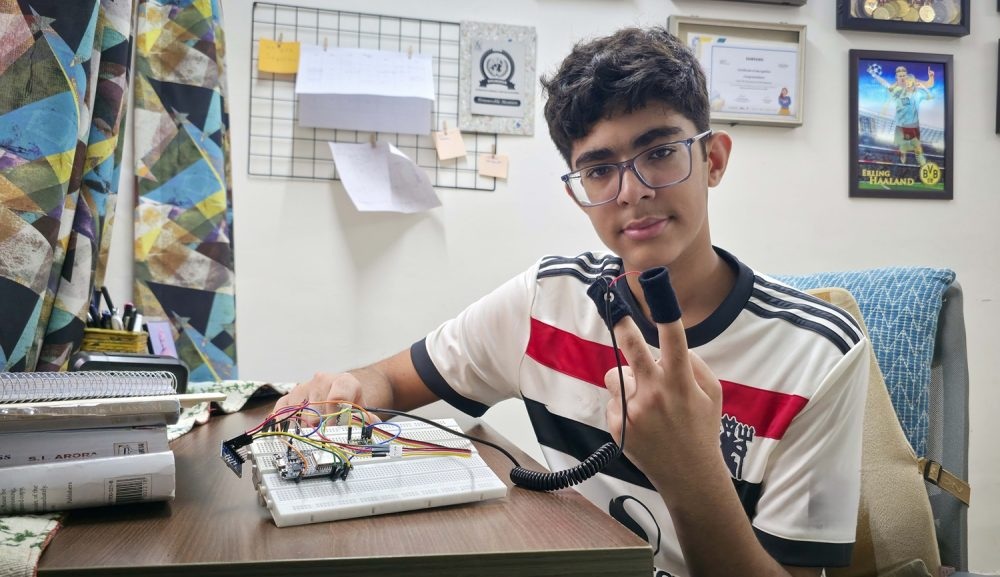
About a year ago, two children in Vidit Bhayana’s class who were on the autism spectrum experienced an outburst. Classmates did not know how to respond.
Vidit could not stop thinking about it.
What if a teacher had known that the child was becoming overwhelmed? What if there had been enough time to intervene, calm the situation and help the child remain part of the classroom?
Those questions led Vidit to develop VB Senacquard, a low-cost AI-powered wearable designed to predict sensory meltdowns in children with Autism Spectrum Disorder (ASD) before they occur.
Vidit is now among the Top 40 young innovators of Samsung Solve for Tomorrow, Samsung’s flagship CSR programme, which encourages young people to turn problems they see around them into solutions with the potential to create meaningful social impact.
VB Senacquard uses personalised AI to spot the warning signs
For children with autism, sensory overload can become overwhelming, sometimes resulting in a meltdown. These episodes are often recognised only after they have begun.
Vidit’s prototype aims to change that.
Developed over the past year, the wearable uses biosensors to track heart rate, skin conductance, skin temperature and movement. A personalised machine-learning model learns each child’s individual baseline and looks for physiological changes that could signal an approaching episode.
The system is designed to alert a caregiver’s smartphone up to 25 minutes before a potential meltdown, giving a teacher, parent or caregiver time to intervene.
A child could be moved to a quieter space, supported using familiar calming techniques or simply given the attention they need before distress escalates.
For Vidit, the objective is not to change the child so they can fit into the classroom.
It is to change how the people around them respond.
“It helps the child fit in, but also helps them learn,” said Vidit.
His own experience taught him the power of being understood
Vidit grew up in Delhi and was diagnosed with ADHD (Attention-Deficit/Hyperactivity Disorder). His experience taught him how important supportive caregivers can be when a person experiences the world differently.
That understanding shaped how he viewed his classmates’ experience.
Instead of seeing their outburst as disruptive behaviour, he wondered what could be done before it happened.
That empathy became the foundation of his innovation.
Now, Vidit wants VB Senacquard to eventually become a discreet wearable roughly the size of a ₹10 coin—small enough to be practical and unobtrusive in a child’s everyday life. The next phase could integrate in-ear EEG biomarkers to further improve prediction accuracy.
For Vidit, the technology is secondary to the human outcome.
He wants a child to be able to remain in class, continue learning and participate alongside their peers without feeling singled out.
His journey reflects a simple Gen Z instinct: when something does not work, don’t simply accept it—redesign it.
Vidit began with a moment that others might have forgotten.
He chose to ask why it happened. Then he spent a year trying to find a better answer.
At 15, his ambition goes beyond building a device. He wants to help create classrooms where children do not have to hide or suppress their differences to belong.
